
59 Best 80s Trivia Questions [With Answers]
59 80s trivia questions across music, movies, TV, tech, toys, gaming, sports, and world events. Answers included, plus why each one stumps.

Quiz yourself on these questions
How many do you know?
Think of your answer, then reveal it.
Did you know it before revealing the answer?
Read this answer in the articleRound complete
Challenge friends on this topic.
Start a new duel in LearnClash and learn from every answer.
Get LearnClashFree to play on iPhone and Android. No ads.
You think you know the 80s. The decade of neon, synthesizers, and shoulder pads has been quoted, sampled, and rebooted so many times that half of what people “remember” about it is wrong.
An admission before we start: I was born in August 1991. I never saw a single day of this decade live, which turned out to be useful. No nostalgia, no trusting my own memory. Every claim had to survive a source check instead, and checking cost this page more than a dozen of its original answers plus four whole questions (the first cell phone’s battery spec was printed backwards, of all things). What I couldn’t prove, I replaced, and the biggest fixes are flagged right where they happened.
The 59 questions run across music, movies, TV shows, technology, toys, video games, sports, and world events. They’re pulled from our curated trivia collection, which now spans 37 topic sets and 1,899 questions.
Challenge a friend to 80s trivia on LearnClash
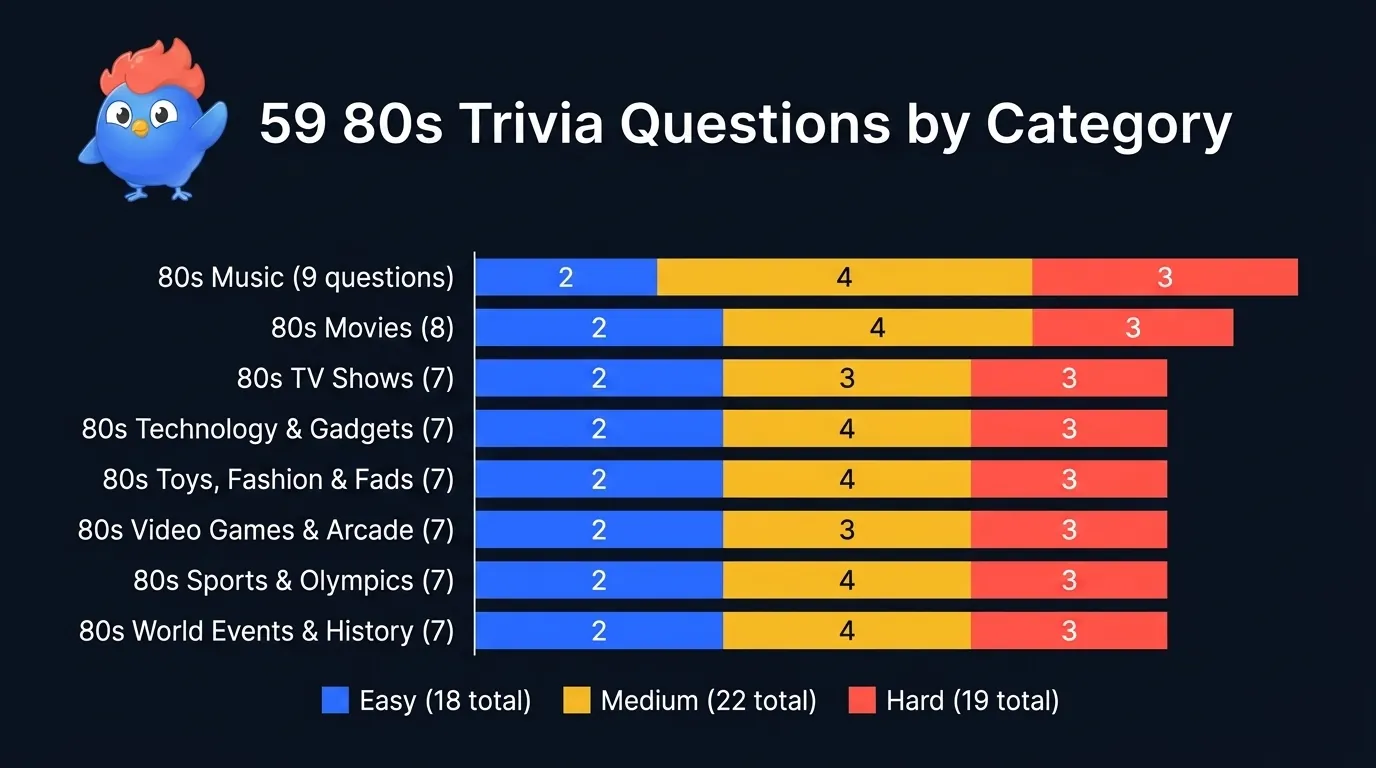
| Category | Questions | Easy | Medium | Hard |
|---|---|---|---|---|
| 80s Music | 1-9 | 3 | 3 | 3 |
| 80s Movies | 10-17 | 2 | 4 | 2 |
| 80s TV Shows | 18-24 | 2 | 3 | 2 |
| 80s Technology & Gadgets | 25-31 | 1 | 4 | 2 |
| 80s Toys, Fashion & Fads | 32-38 | 1 | 4 | 2 |
| 80s Video Games & Arcade | 39-45 | 2 | 3 | 2 |
| 80s Sports & Olympics | 46-52 | 2 | 3 | 2 |
| 80s World Events & History | 53-59 | 2 | 3 | 2 |
80s Music Trivia Questions (1-9)
MTV launched in 1981 and rewired how pop music got made within a single decade. The nine questions below dig into videos, one-hit wonders, and backstage facts almost nobody remembers right.
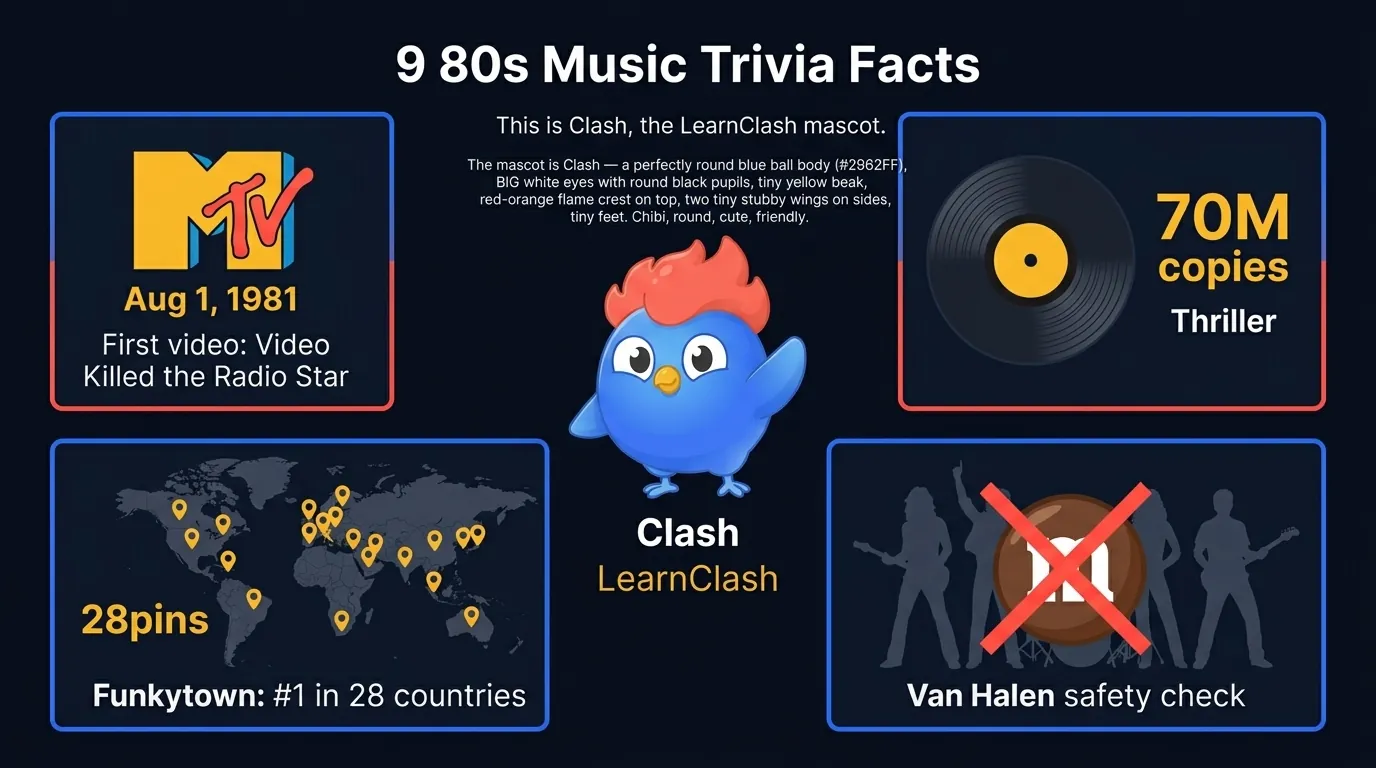
1. What was the first music video played on MTV when it launched on August 1, 1981? Easy
Answer: “Video Killed the Radio Star” by The Buggles. The channel went live just after midnight with the words “Ladies and gentlemen, rock and roll.”
Nearly everyone gets the song right. The date trips them up. People guess 1983 or 1984 because that’s when MTV felt mainstream, but it started in 1981, on so few cable systems that MTV’s own staff famously had to gather in a New Jersey bar to watch their channel launch. Manhattan didn’t carry it.
2. What was Michael Jackson’s bestselling album, released in 1982? Easy
Answer: Thriller. Estimates put its worldwide sales around 70 million copies, making it the best-selling album of all time.
This one looks too easy to include, until you hit the follow-up question: people mix up the year. Thriller came out in late 1982, not 1983. The “Thriller” music video didn’t arrive until December 1983, which is why the dates get tangled.
3. Which 80s band had a contractual clause requiring the removal of all brown M&Ms from their backstage snacks? Medium
Answer: Van Halen. The brown M&M clause was buried deep in their technical rider as a safety check, not an ego trip. If brown M&Ms showed up in the bowl, the band knew the venue hadn’t read the full contract, which also covered stage weight limits and pyrotechnics safety.
Your gut says rock star excess. David Lee Roth explained the real logic in his autobiography: the M&M test caught venues that cut corners on details that could get someone killed.
4. “Ice Ice Baby” sampled which Queen and David Bowie collaboration? Easy
Answer: “Under Pressure.” Vanilla Ice initially claimed his version was different because it had an extra note. Nobody bought it.
Here’s the part most people get wrong: there was no courtroom loss. Queen and Bowie’s side threatened to sue in 1990, the parties settled privately, and Queen and Bowie received songwriting credits. Vanilla Ice later said he spent about $4 million buying the publishing rights outright, reasoning it was cheaper than paying royalties forever.
5. Lipps Inc.’s “Funkytown” reached number 1 in how many countries, a record that stood for 25 years? Hard
Answer: 28 countries. No other single held the #1 spot in more nations until Madonna’s “Hung Up” topped charts in 41 countries in 2005.
Nobody associates “Funkytown” with records. It feels like a novelty hit, but 28 countries is a staggering reach for a one-hit wonder from Minneapolis.
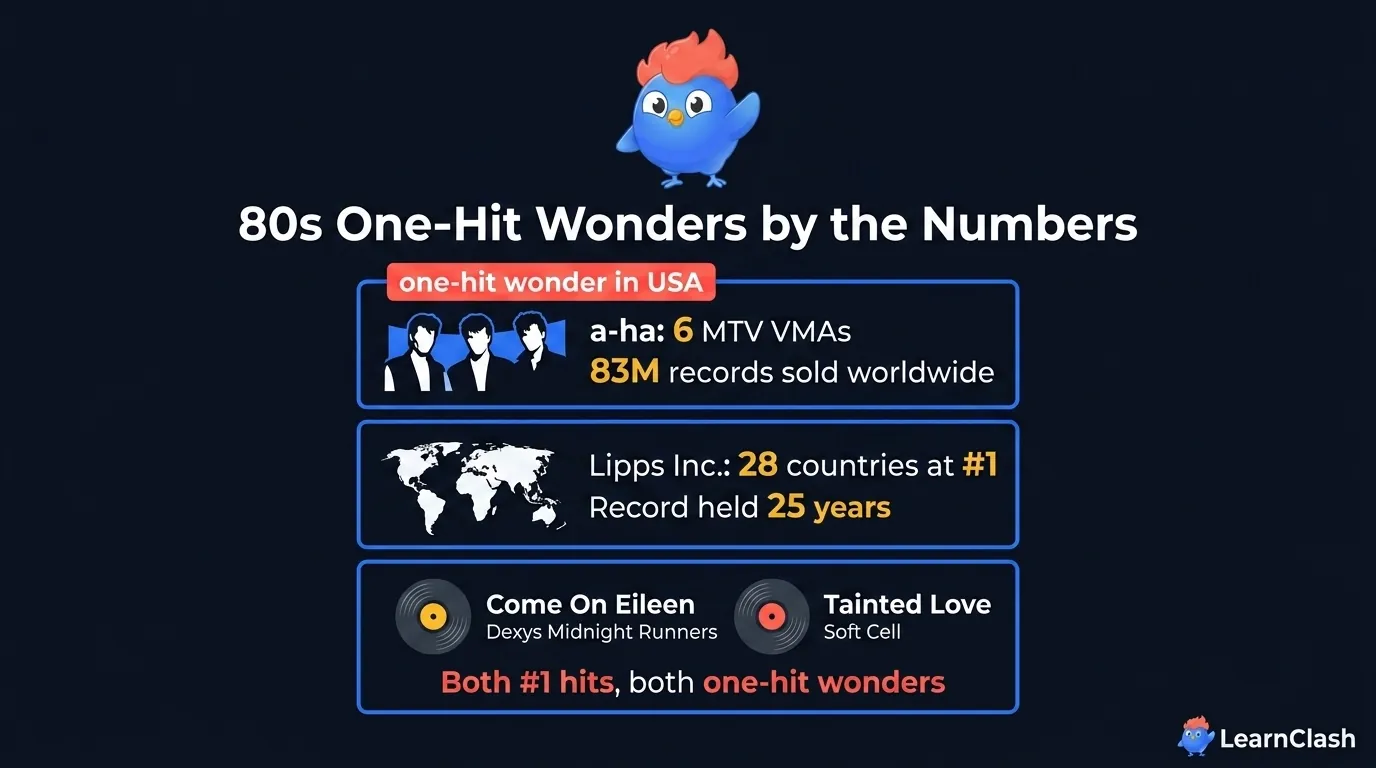
6. A-ha’s “Take on Me” won how many awards at the 1986 MTV Video Music Awards? Hard
Answer: Six, out of eight nominations, including Best New Artist in a Video and Viewer’s Choice. Despite this, a-ha is widely called a “one-hit wonder” in America.
Nearly everyone reaches for one or two awards. Six feels wrong for a band most Americans can only name one song by, but the rotoscope animation in that video was unlike anything MTV had aired, and it swept. Worth noting: this page once repeated a claim that a-ha sold 83 million records. The figure I could actually document, from Warner Music Japan, is roughly 35 million albums worldwide. Still an enormous career for a “one-hit wonder.”
7. In April 1983, “Come On Eileen” spent one week at US #1, wedged between two singles by the same artist. Who? Hard
Answer: Michael Jackson. Dexys Midnight Runners knocked “Billie Jean” off the top spot after its seven-week run, and “Beat It” took over the week after.
This replaced a question about the video shoot that I couldn’t verify, and honestly it’s a better one. A scruffy Birmingham soul band interrupting the Thriller juggernaut for exactly one week is the kind of chart accident that wins bar bets.
8. Which format outsold vinyl records for the first time in 1983, partly thanks to the Walkman? Medium
Answer: Cassette tapes. Sony’s Walkman turned portable listening into a cultural shift, and by 1983 cassettes had overtaken vinyl in US sales for the first time.
People guess CDs. Too early: the CD launched in late 1982 but didn’t outsell vinyl until the end of the decade. Cassettes won first. The Walkman held about half the entire portable-music market in 1989, and Sony went on to move roughly 220 million cassette Walkmans before production ended in 2010.
9. Soft Cell’s “Tainted Love” set which Billboard Hot 100 record in 1982? Medium
Answer: The longest consecutive stay on the Hot 100: 43 weeks. The record stood for seven years.
The paradox is that “Tainted Love” never even reached the US top 5. It peaked at #8, needed 19 weeks just to crack the Top 40, and then refused to leave. (The question it replaced implied the song topped the US chart; it never did, which is exactly why the 43-week record is the better question.) A UK #1 in 1981, a #1 in 17 countries, and yet Soft Cell never touched the US top 20 again. One hit is one hit, however enormous. Our full music trivia collection has 43 more where that came from.
Test your 80s music knowledge on LearnClash
80s Movie Trivia Questions (10-17)
Casting near-misses, studio rejections, and backstage accidents shaped the movies you’ve quoted a hundred times. Confident film buffs trip hardest here, because the legend is usually tidier than the real story.
10. Who was originally cast as Marty McFly in Back to the Future before being replaced by Michael J. Fox? Easy
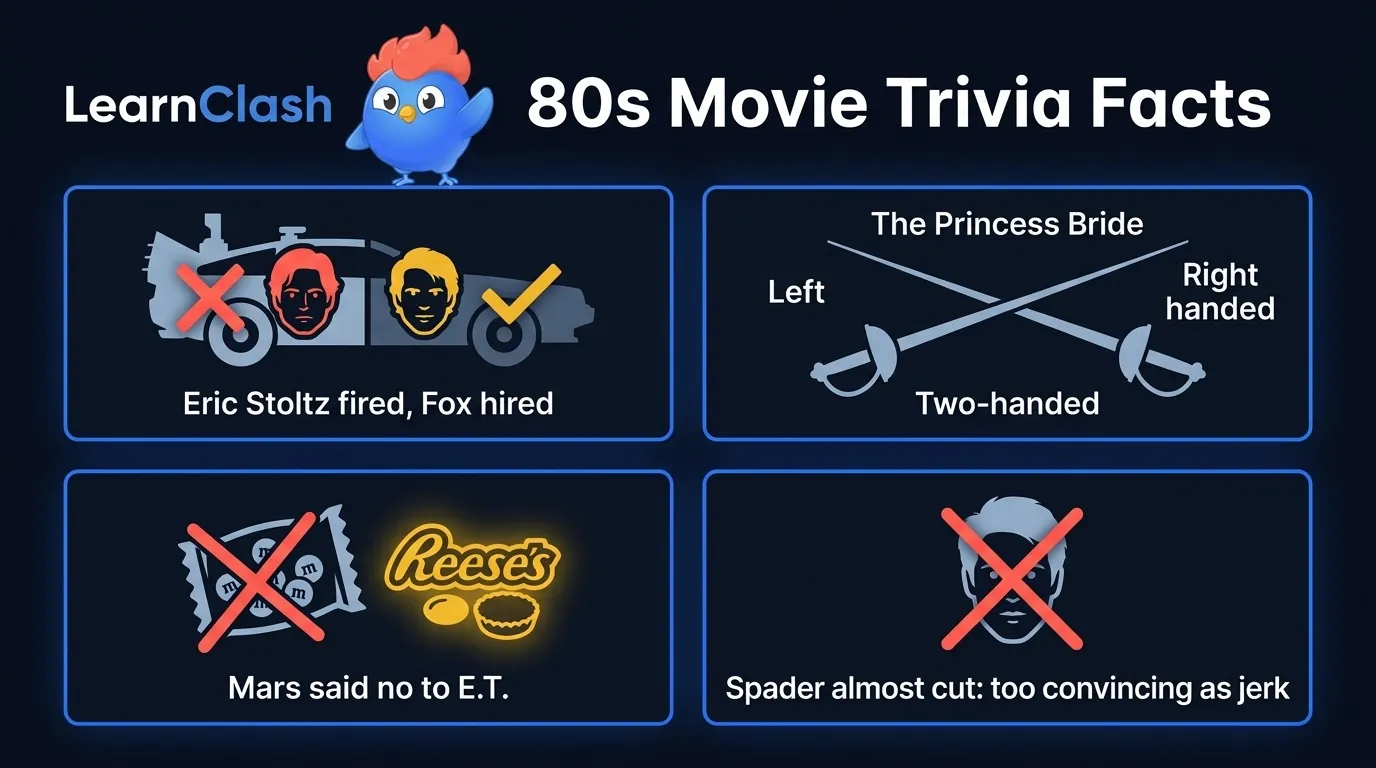
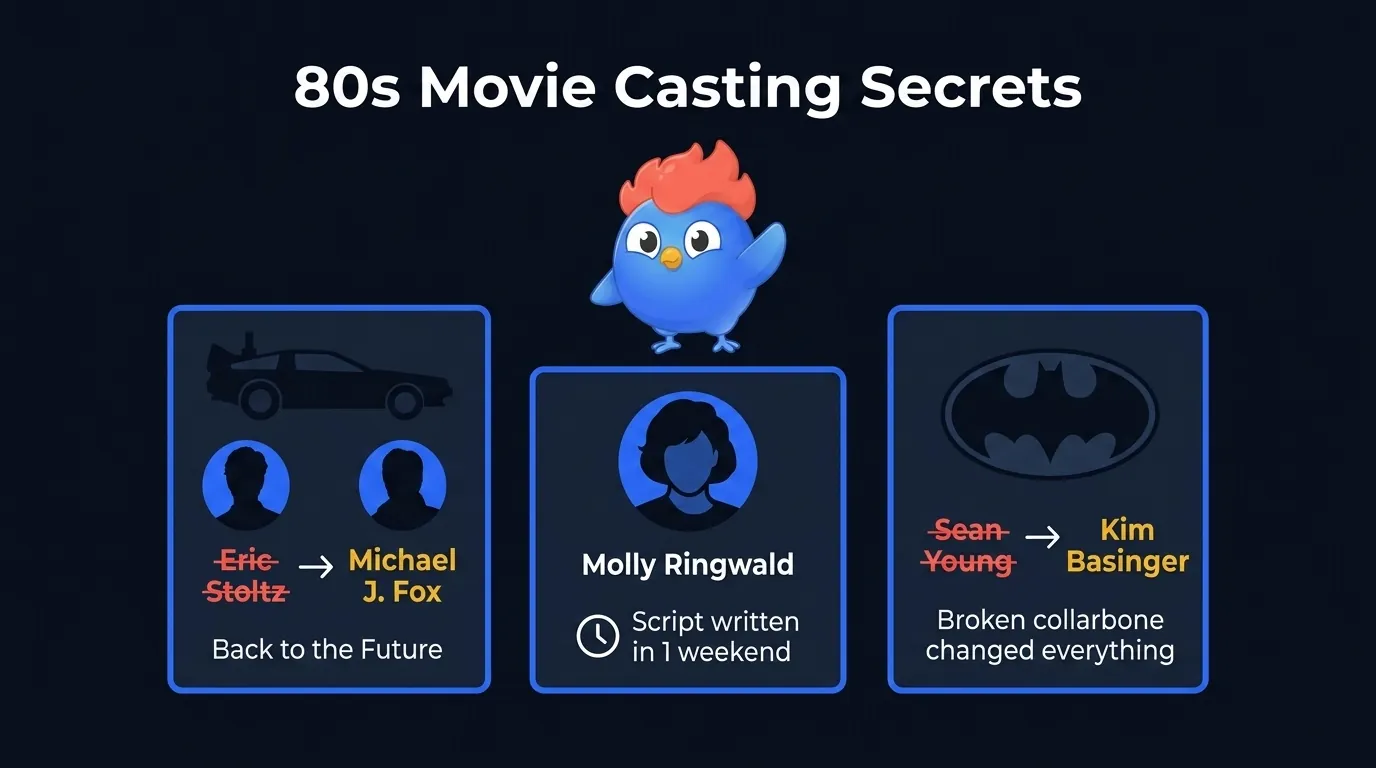
Answer: Eric Stoltz. He filmed for several weeks before director Robert Zemeckis decided Stoltz’s approach was too dramatic for the role’s comedic tone.
Fox was the first choice all along, but his Family Ties schedule made him unavailable. Stoltz played it straight; Zemeckis needed someone who could sell physical comedy. When the footage wasn’t working, they went back to Fox and reshot.
11. Michael J. Fox filmed Back to the Future while simultaneously starring in which TV show, surviving on 3-4 hours of sleep per night? Medium
Answer: Family Ties. Fox shot the sitcom during the day and the movie at night for roughly three months.
Fox has talked about falling asleep between takes and doing action sequences at 2 AM. Family Ties producer Gary David Goldberg only agreed because the studio promised Fox would be on set every morning. He was. Barely.
12. In E.T. the Extra-Terrestrial, Spielberg’s production originally wanted which candy brand, not Reese’s Pieces? Easy
Answer: M&Ms. Mars, Inc. turned the film down, and to this day the company has never publicly said why. Hershey said yes, and Reese’s Pieces sales jumped 65% within two weeks of the film’s release.
Hershey paid no placement fee. It committed about $1 million to promoting the film in exchange for using E.T. in its own marketing, and a Hershey executive later estimated the deal generated $15 to 20 million worth of promotion. Business schools still teach it.
13. In The Princess Bride (1987), Cary Elwes and Mandy Patinkin performed all their own fencing. What unusual skill did both actors learn for the duels? Medium
Answer: Both learned left-handed AND right-handed fencing so they could switch mid-fight, just like the characters do.
Book readers nail this one; film-only fans don’t. The sword switch is a plot point (“I am not left-handed!”), and the two actors trained for months so the entire duel could run without stunt doubles. If casting stories are your category, our movie trivia questions set goes far deeper.
14. Sixteen Candles was written by John Hughes over a single weekend after seeing whose headshot? Medium
Answer: Molly Ringwald’s. Hughes saw her photo, wrote the script in two days, and cast her.
A weekend. Most people assume a studio developed it for months. Hughes made a habit of these sprints (he famously drafted Ferris Bueller’s Day Off in about a week), and Ringwald’s headshot ended up sparking the whole Brat Pack era.
15. Which actress broke her arm in a riding accident during rehearsals and was replaced as Vicki Vale in Tim Burton’s Batman (1989)? Hard
Answer: Sean Young. She was thrown from a horse while practicing for a planned riding scene shortly before shooting began; the scene was scrapped, and Kim Basinger took the role.
The stranger sequel to the story: Young campaigned publicly for the Catwoman part in Batman Returns, at one point showing up at the studio in a homemade Catwoman costume. She didn’t get it.
16. James Spader almost lost his role as Steff in Pretty in Pink (1986) because producers thought what about him? Hard
Answer: That he was actually a jerk in real life. Spader deliberately stayed in character as the entitled rich kid for his audition, and it worked so well the production team briefly believed that was just his personality.
Actors usually lose roles for being not enough of the character. Spader nearly lost this one for being too much of it. He got the part, and Steff became one of the decade’s most quotable villains.
17. The cast of Predator (1987) went through genuine military-style training before filming began. In which country? Medium
Answer: Mexico. The principal cast trained together in the jungle around Puerto Vallarta: weapons drills, fitness work starting at 6 AM, and the silent hand signals you see throughout the film.
Bill Duke described it in an oral history for the film’s 30th anniversary, including Arnold Schwarzenegger shipping his own gym equipment to Mexico in trucks and training before breakfast every day. The sweaty unit chemistry on screen came from real shared discomfort.
Test your 80s movie knowledge on LearnClash
80s TV Show Trivia (18-24)
Cable exploded in the 80s, and the wall between TV shows and advertising got so thin you could barely see it. That’s why five of these seven questions are about commercials or the rules that governed them. They earned it.
18. What were the first words ever spoken on MTV? Easy
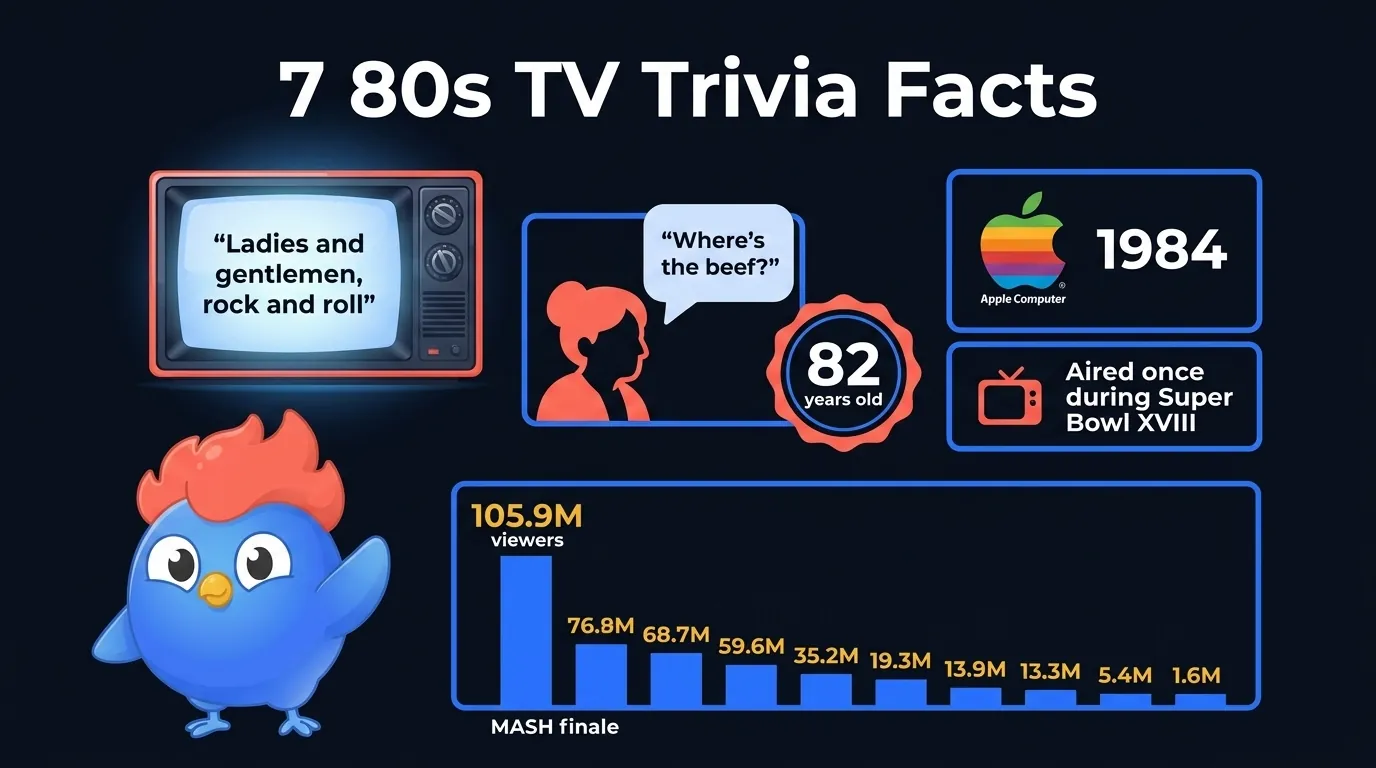
Answer: “Ladies and gentlemen, rock and roll.” Spoken by John Lack, one of MTV’s creators, just after midnight on August 1, 1981.
Most people jump straight to the first song. The spoken introduction gets overlooked, even though those five words launched the channel that rewired music for four decades.
19. The Wendy’s “Where’s the beef?” catchphrase became so popular in 1984 that which presidential candidate used it in a debate? Medium
Answer: Walter Mondale. He used the line against Gary Hart during the Democratic primary to suggest Hart’s policies lacked substance.
A burger slogan, in a presidential debate, weeks after the ad first aired. Clara Peller’s delivery made the phrase a national punchline so fast that Mondale’s team could count on a debate audience getting the joke. Hart’s momentum stalled soon after.
20. How old was Clara Peller, the actress who delivered the “Where’s the beef?” line, when the ad first aired? Hard
Answer: 81 years old. (Corrected in August 2026: this page previously said 82. Peller was born August 4, 1902, and the ad debuted January 10, 1984.)
Her backstory beats the ad. Peller worked 35 years as a Chicago manicurist, got hired at age 80 as a temporary manicurist for a commercial shoot set in a barbershop, and impressed the agency enough to earn an acting contract. Wendy’s found her doing local spots. She died in 1987, a week after turning 85.
21. What was the most-watched single TV broadcast in the United States during the entire 1980s? Medium
Answer: The M*A*S*H series finale on February 28, 1983. It drew 105.9 million viewers and stood as the most-watched US broadcast of any kind until the 2010 Super Bowl. No series episode has ever beaten it.
People guess a Super Bowl or a Dallas episode. Neither comes close. Businesses closed early, bars set up TVs, and New York’s water system reportedly saw a surge when the credits rolled and millions of toilets flushed at once.
22. Apple’s famous “1984” Macintosh commercial, directed by Ridley Scott, aired during Super Bowl XVIII. How many times was it broadcast on national TV? Easy
Answer: Once. The 60-second slot in the third quarter cost Apple $800,000, and the ad never ran nationally again. It’s now routinely called the greatest TV commercial ever made.
(That airtime figure used to read $900,000 here; the sourcing says otherwise. Steve Wozniak, who offered to personally pay half the cost when Apple’s board got cold feet, put it at $800,000.) The board actually tried to sell the slot off in the final week; Hertz and Heinz were lined up as buyers, and the agency quietly ran out the clock instead. One more wrinkle for trivia purists: the ad also ran once at 1 a.m. on December 31, 1983 on a single Idaho station, purely to qualify for that year’s advertising awards.
23. Which future sitcom star appeared in a 1988 Cherry 7Up commercial before becoming famous? Hard
Answer: Matt LeBlanc. Years before playing Joey Tribbiani on Friends, LeBlanc fronted Cherry 7Up’s “isn’t it cool in pink” spot, and a Heinz ketchup ad the year before.
The 80s commercial circuit was the proving ground for a surprising number of 90s TV stars, and these clips resurface online every few years to remind everyone.
24. In 1984, Reagan’s FCC removed a long-standing rule for children’s television. What did the change allow? Medium
Answer: Program-length commercials: cartoons built entirely around toy lines. The ban’s removal let shows like Transformers, G.I. Joe, and My Little Pony flourish as, essentially, 22-minute toy ads.
Before the Reagan-era FCC under Mark Fowler stepped back, regulators treated toy-first cartoons as a trap because young kids can’t reliably tell a show from a commercial. After the 1984 change, toymakers effectively paid for entire series built around their product lines. Question 38 covers where that logic ended up.
Try our 53 TV trivia questions
80s Technology & Gadgets (25-31)
Portable music, mobile phones, 3D printing, DNA forensics: most of the technology you lean on today got its clumsy, expensive first draft in the 1980s. This is also the section where this page owed readers the biggest correction.
25. The first commercially available cell phone, the Motorola DynaTAC, went on sale in 1984. How much did it cost? Easy
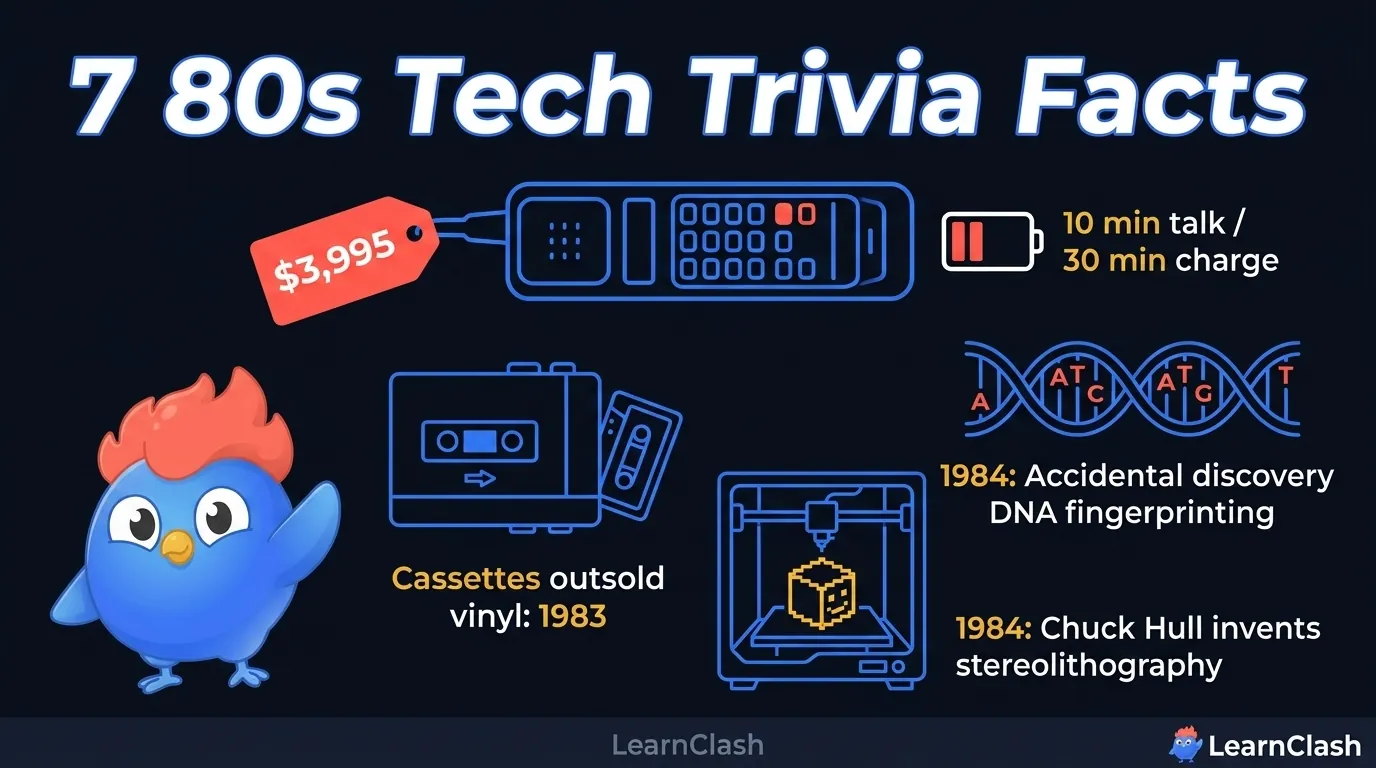
Answer: $3,995. That’s about $12,000 in 2026 dollars, for a phone that weighed nearly two pounds.
Most people guess somewhere in the hundreds. Almost four grand, in 1984, meant the DynaTAC’s customer base was basically Wall Street and Hollywood, which is exactly why it shows up as a status prop in 80s movies.
26. A fully charged DynaTAC gave you how much talk time, after how long on the charger? Medium
Answer: 30 minutes of talk time, after roughly 10 hours of charging.
I owe this question a correction, and it’s the most embarrassing one on the page: the previous version had the spec inverted, claiming 10 minutes of talk on a 30-minute charge. The documented numbers are 30 minutes of conversation bought with 10 hours plugged in. Either way the punchline survives: you could not finish a long phone call on the world’s most expensive phone, and when it died you were carrying a two-pound brick.
27. British geneticist Alec Jeffreys accidentally discovered what forensic technique in 1984 that changed criminal investigation forever? Medium
Answer: DNA fingerprinting. Jeffreys was studying gene variation in families when he realized every individual’s DNA profile was unique. He wasn’t looking for a forensic tool at all.
DNA fingerprinting feels like it must have come out of some huge government program. It didn’t. One scientist, one eureka moment, one Monday morning in a Leicester lab in September 1984. Within three years, DNA evidence was appearing in courtrooms.
28. The first commercial compact discs went on sale in Japan on October 1, 1982. Which American artist’s album is credited as CD number one? Medium
Answer: Billy Joel’s 52nd Street. Around 50 titles shipped that day, but 52nd Street carried the first catalogue number, so it gets the honor.
This question replaced a duplicate (the cassette-vs-vinyl fact was accidentally on this page twice, in slightly different clothes). The pedantic footnote trivia nights love: the first CD physically manufactured, a month earlier at the Langenhagen plant, was ABBA’s The Visitors. First pressed and first sold are different records.
29. In what year was the word “Walkman” officially added to the Oxford English Dictionary? Hard
Answer: 1986. Seven years after the device launched, the brand name had fully replaced “portable cassette player” in everyday speech.
Sony resisted its trademark going generic, but it was too late. “Walkman” did to portable audio what “Xerox” had done to photocopying in the 70s: the brand became the category.
30. Chuck Hull filed a 1984 patent on what manufacturing technology, now a multi-billion-dollar industry? Hard
Answer: 3D printing (stereolithography). Hull built objects layer by layer from liquid resin hardened by UV light, printed his first part in 1983, and filed the patent on August 8, 1984. It was granted in 1986, and his company, 3D Systems, still operates today.
Everyone places 3D printing in the 2010s, when desktop printers hit the shops. The invention predates that by roughly three decades; industry used it for prototyping all through the 90s while the public had never heard of it.
31. Kodak released its first disposable camera in 1987. What was it called? Medium
Answer: “The Fling.” A 110-film throwaway camera; a 35mm version followed in 1988 and was renamed the FunSaver in 1989, the name everyone actually remembers.
Two traps in one question. First, the forgotten “Fling” name. Second, Kodak wasn’t first: Fujifilm’s QuickSnap beat it to market in 1986, with better 35mm film from day one. The disposable camera then outlived the whole decade, only fading when phone cameras arrived.
Challenge a friend to 80s tech trivia on LearnClash
80s Toys, Fashion & Fads (32-38)
No decade did consumer mania quite like the 80s. Parents threw punches over a cloth doll, and a Hungarian professor’s puzzle sold 100 million units in two years. Fair warning: this is the section that starts arguments at parties, because everyone who lived it remembers it slightly differently. (Four of the seven questions here were rebuilt or corrected this August after their original claims failed fact-checking.)
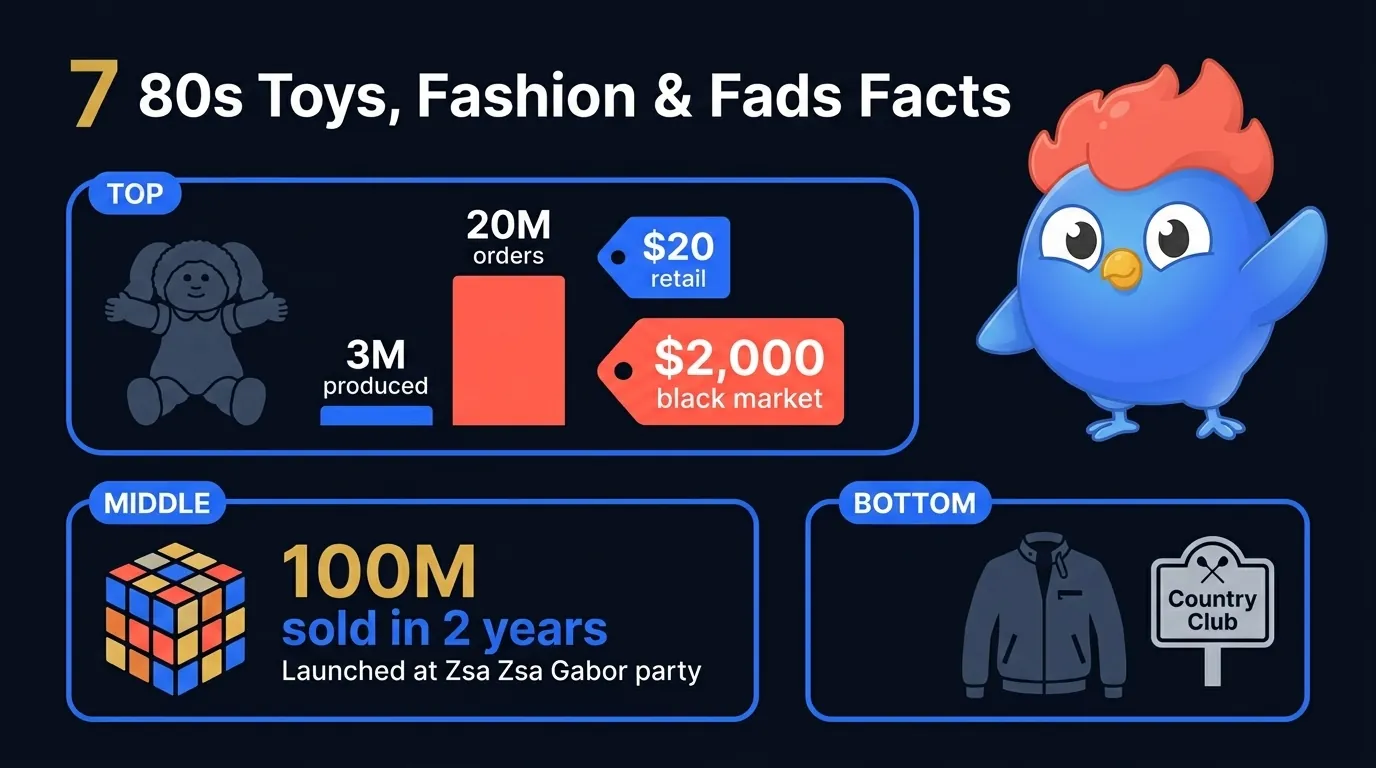
32. At the peak of the 1983 Cabbage Patch Kids craze, Coleco was producing 200,000 dolls per week. Roughly how many did it sell that year? Medium
Answer: About 3 million dolls in 1983, and every one of them sold out. Stores rationed stock, fights broke out in aisles, and news helicopters circled toy stores.
Honesty note: this question used to claim “20 million orders against 3 million dolls,” a ratio I could not source anywhere, so it’s gone. The documented reality needs no inflation. Shoppers were injured in crushes at multiple stores, and one Pennsylvania store manager reportedly armed himself with a baseball bat to manage a crowd of about a thousand people. Over a doll with a birth certificate.
33. By the end of 1984, Cabbage Patch Kids and their spin-off products had generated how much in retail sales? Hard
Answer: Over $2 billion. For scale, scalpers were reselling the roughly $21 dolls at $50 to $75 during the worst of the shortage, and Nassau County’s consumer-affairs office in New York even charged Coleco with harassing children by advertising dolls that weren’t available.
(The previous version of this question cited a $2,000 black-market price. I found no reliable source for it, so the verified numbers stand in its place.) The craze reads exactly like a modern console launch: preorders, scalpers, empty shelves. The 80s just ran it without the internet.
34. Erno Rubik’s “Magic Cube” was rebranded as the Rubik’s Cube in 1980. At whose Hollywood party was the US launch held? Hard
Answer: Zsa Zsa Gabor’s, on May 5, 1980. Ideal Toy imported the cube from Hungary and chose a party hosted by the Hungarian-American actress as its glamorous American debut.
It sounds made up, and that’s the appeal: a Budapest architecture professor’s teaching aid, launched into American culture through a Hollywood celebrity party. The marketing team wanted a brain teaser to feel glamorous, and somehow it worked.
35. How many Rubik’s Cubes sold worldwide in the first two years after the US launch? Medium
Answer: 100 million between 1980 and 1982, making the cube the fastest-selling toy in history at the time.
People undershoot this dramatically. Ten million feels like a lot; a hundred million in two years is a different scale entirely, and it’s why the craze burned out almost as fast as it ignited. The cube’s second life as a speedcubing sport came decades later.
36. Members Only jackets, the decade’s status windbreaker, hit US stores in 1980 at what retail price? Medium
Answer: $55. Herb Goldsmith’s Europe Craft Imports launched the jacket after a trip to Germany inspired the design, and picked the name precisely because it dripped snobbish exclusivity.
An earlier draft of this question repeated a story that the name came from a country club sign on Long Island. The documented version is less cinematic: Goldsmith simply loved what the phrase implied. Either way, the tagline “when you put it on, something happens” sold a membership that anyone with $55 could join.
37. The 1980s are widely described as the first decade when what fashion behavior became socially acceptable in America? Easy
Answer: Wearing visible brand logos. Fashion historians generally date the flip to the designer-jeans boom at the decade’s turn, after which outward logos went from tacky to aspirational.
This shift is so baked into how we dress now that it feels permanent. It isn’t even fifty years old. Calvin Klein, Ralph Lauren, and Nike didn’t just sell you products in the 80s; they sold you the right to advertise for them.
38. Hasbro killed off Optimus Prime in the 1986 animated Transformers movie. Why? Medium
Answer: To clear out the original 1984 toy line and make shelf space for new characters. The plan backfired spectacularly: children were distraught, parents wrote furious letters, and Hasbro brought Optimus Prime back from the dead by 1987.
This question replaced an unverifiable sales figure, and the swap is an upgrade. The Transformers cartoon existed because of the deregulation in question 24, and the Prime debacle is the purest example of what happens when a toy company plots a TV show: the marketing calendar wrote the script, and the audience revolted.
Every question you miss in the app feeds a spaced repetition queue: miss one and it returns in a week, answer it right twice and the wait grows to three months before it’s marked Mastered. The 1980s pop culture topic runs on exactly that system.
Love decade trivia? Try our 45 90s trivia questions
80s Video Games & Arcade (39-45)
Gaming nearly died in the 80s, then came roaring back. A yellow circle eating dots out-earned Hollywood, and one terrible game really did get buried in the desert.
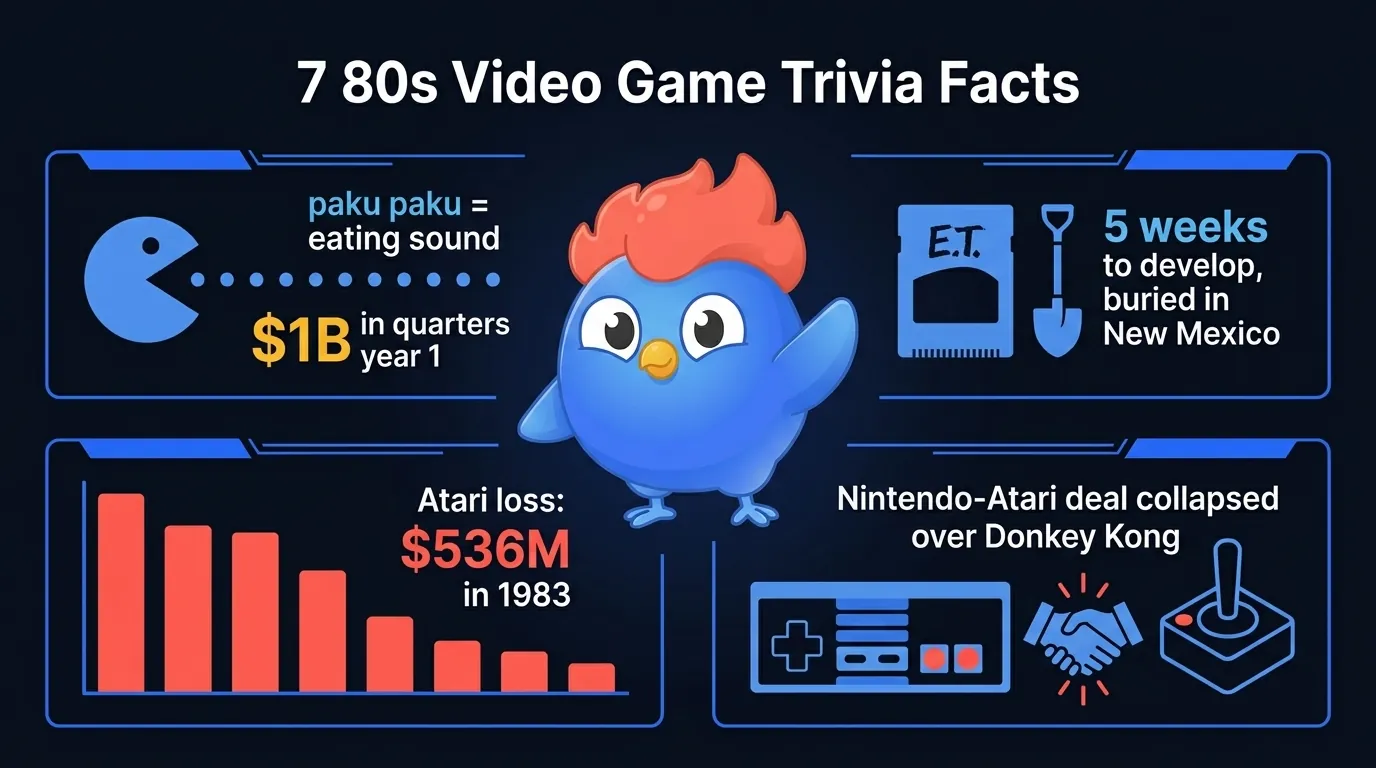
39. Pac-Man’s name comes from which Japanese onomatopoeia? Easy
Answer: Paku paku, the sound of a mouth opening and closing while eating. The game was originally “Puck Man” in Japan but was renamed for Western markets to avoid vandalism of the arcade cabinets.
The rename is the real hook. American arcade operators realized how easily a P on a cabinet could be altered into something obscene, so paku paku became Pac-Man, and a global brand was born from a vandalism concern.
40. How much revenue did Pac-Man arcade machines generate in their first year? Medium
Answer: An estimated $1 billion in quarters. At 25 cents per play, that’s four billion individual games.
A billion dollars in coins, starting from the North American launch in October 1980, collected one quarter at a time. No Hollywood release that year came anywhere near it at the box office. The machines out-earned the movies.
41. Atari secured the rights to make an E.T. video game in July 1982. How much development time did the programmer have before the Christmas deadline? Medium
Answer: Five weeks. Programmer Howard Scott Warshaw had just over a month to design, code, and finish the entire game.
Five weeks, for a major licensed title tied to the biggest movie of the year. Modern AAA games take three to five years. Warshaw did what was possible in the time given, and the result is still shorthand for “worst video game ever made.”
42. What happened to the millions of unsold E.T. cartridges? Easy
Answer: They were buried in a landfill in Alamogordo, New Mexico. For decades this was treated as an urban legend, until a 2014 documentary crew excavated the site and confirmed the burial was real.
Corporate shame, desert mystery, and a decades-long argument over whether it ever happened. It did. Atari dumped truckloads of cartridges and poured concrete on top.
43. Atari reported how much in losses during the 1983 video game market crash? Hard
Answer: $536 million. The crash nearly destroyed the North American home console market, and retailers refused to stock video games for years afterward.
Over half a billion dollars in losses, for one company, in one year. Plenty of people in the trade concluded home gaming had been a fad. It took Nintendo’s NES launch in 1985 to prove them wrong.
44. Nintendo and Atari nearly partnered to sell the Famicom (NES) in the US under the Atari brand. What derailed the deal? Hard
Answer: A blowup over Donkey Kong licensing. In the standard telling, from David Sheff’s book Game Over, Atari executives saw Coleco demonstrating Donkey Kong on its rival Adam computer at the June 1983 trade show, assumed Nintendo had double-dealt them, and the partnership collapsed. Nintendo went solo.
This one rewrites gaming history. Had the deal closed, the NES might have shipped as an Atari product, and the industry map would look completely different. Instead a trade-show misunderstanding pushed Nintendo to build its own empire.
45. Pac-Man is credited with several major “firsts” in gaming history. Name one. Medium
Answer: Historians credit it as the first video game mascot character, the founder of the maze chase genre, the first arcade game to draw a large female audience, and an early pioneer of cutscene-style intermissions between levels.
Most people know one of these. Knowing all four separates casual players from the historians. Arcade-era fans will recognize half this section in our 47 video game trivia questions.
Test your retro gaming knowledge on LearnClash
80s Sports & Olympics (46-52)
Boycotted Olympics, records that still haven’t fallen, and athletes who grew bigger than their sports. Three answers in this section didn’t survive re-checking; each correction is flagged below.
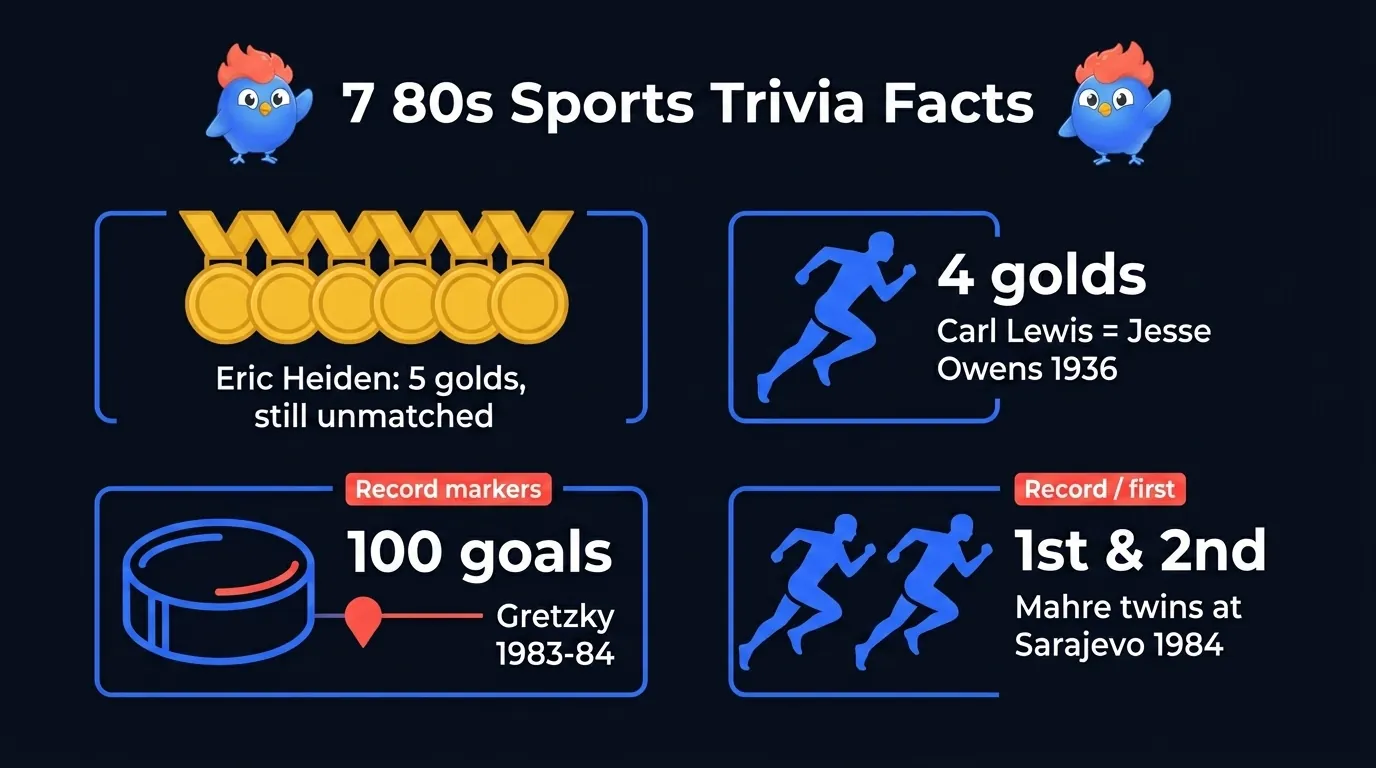
46. Speed skater Eric Heiden won all five individual gold medals at the 1980 Winter Olympics in Lake Placid. How many other Winter Olympians have matched that feat? Easy
Answer: Zero. Heiden remains the only Winter Olympian to win five individual golds at a single Games.
Everyone assumes somebody must have matched it by now. Nobody has, and Milan this year is the near-miss that proves the point: Johannes Klaebo left with six golds, but two of them came in team events, so Heiden’s five individual wins still stand alone. Five golds across five different distances, from sprint to 10,000 meters, is the speed-skating equivalent of winning the 100m and the marathon.
47. At the 1984 Los Angeles Olympics, Carl Lewis won four track and field gold medals, matching whose iconic performance from the 1936 Berlin Games? Easy
Answer: Jesse Owens. Lewis won the 100m, 200m, long jump, and 4x100m relay, the same four events Owens had won 48 years earlier.
The parallel is the story. Owens won his golds in Nazi Germany; Lewis won his during a Cold War Games the Soviet bloc boycotted. Both performances carried weight far beyond the track.
48. Wayne Gretzky scored how many goals across the 1983-84 NHL regular season and playoffs combined? Medium
Answer: 100 goals. 87 in 74 regular-season games plus 13 in the playoffs. No other player has reached 100 combined in a single campaign.
The number sounds like an exaggeration and isn’t. Gretzky held 61 NHL records at his retirement, and the 100-goal campaign is the one that reads like a typo.
49. Middle-distance star Mary Decker set how many world records in 1982, across distances from the mile to 10,000 meters? Hard
Answer: Six world records in a single year, including the outdoor mile (4:18.08), the 5,000 meters, and the 10,000 meters in her debut at that distance. She reset the indoor mile record three times in a single month that winter.
A small correction here: an earlier draft called Decker a sprinter. She was anything but; her range from the mile up to 10,000 meters is precisely what made 1982 absurd. Milers don’t run 10Ks. Decker did both, at world-record pace, in the same season.
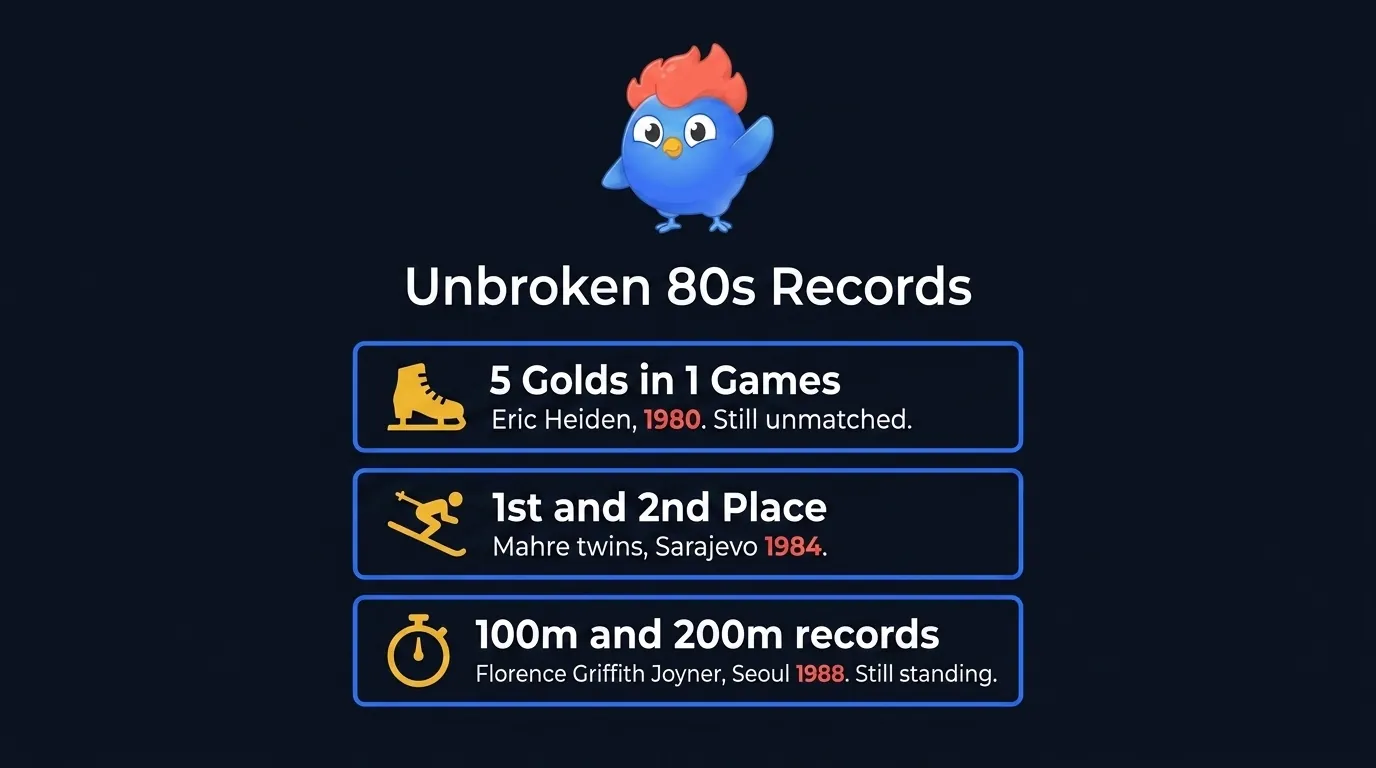
50. At the 1984 Sarajevo Winter Olympics, Phil and Steve Mahre finished 1st and 2nd in the slalom. What’s their relationship? Medium
Answer: Twin brothers. Phil took gold, Steve silver, and they remain the only twins to finish 1-2 in an Olympic alpine event.
The margin was 0.21 seconds. (Corrected: this page used to say four-tenths.) Steve actually led after the first run, and Phil radioed him course advice from the finish area before his second. The advice wasn’t enough, which is either a heartwarming or a very sibling story depending on how you read it.
51. Which “winner” of the 1980 Boston Marathon was later stripped of the title for cheating? Medium
Answer: Rosie Ruiz. She crossed the line first among women with a course-record time, but nobody had seen her anywhere on the course for the first 25 miles. She had likely joined the race about a mile from the finish.
Race officials revoked the win within days and named Jacqueline Gareau the rightful champion. Ruiz’s non-run remains the most famous cheat in marathon history, mostly because of how little effort went into making it plausible.
52. At the 1988 Seoul Olympics, which sisters-in-law BOTH won gold medals and set world records? Hard
Answer: Jackie Joyner-Kersee (heptathlon world record, plus long jump gold) and Florence Griffith Joyner (200m world record, plus 100m gold). Flo-Jo had married Jackie’s brother, Al Joyner.
Two of the greatest athletes ever, at the same Games, both breaking records, and they were family. One precision fix this update owed you: Flo-Jo’s 100m world record of 10.49 was NOT set in Seoul; it came at the US trials in Indianapolis that July. Her Seoul 200m mark of 21.34 and the Indianapolis 100m time both still stand today, as does Joyner-Kersee’s 7,291-point heptathlon.
Test your 80s sports knowledge on LearnClash
80s World Events & History (53-59)
A wall came down, a superpower started to come apart, and in between the decade absorbed a nuclear disaster and a space tragedy. These seven questions test whether you know the details behind headlines everyone recognizes.
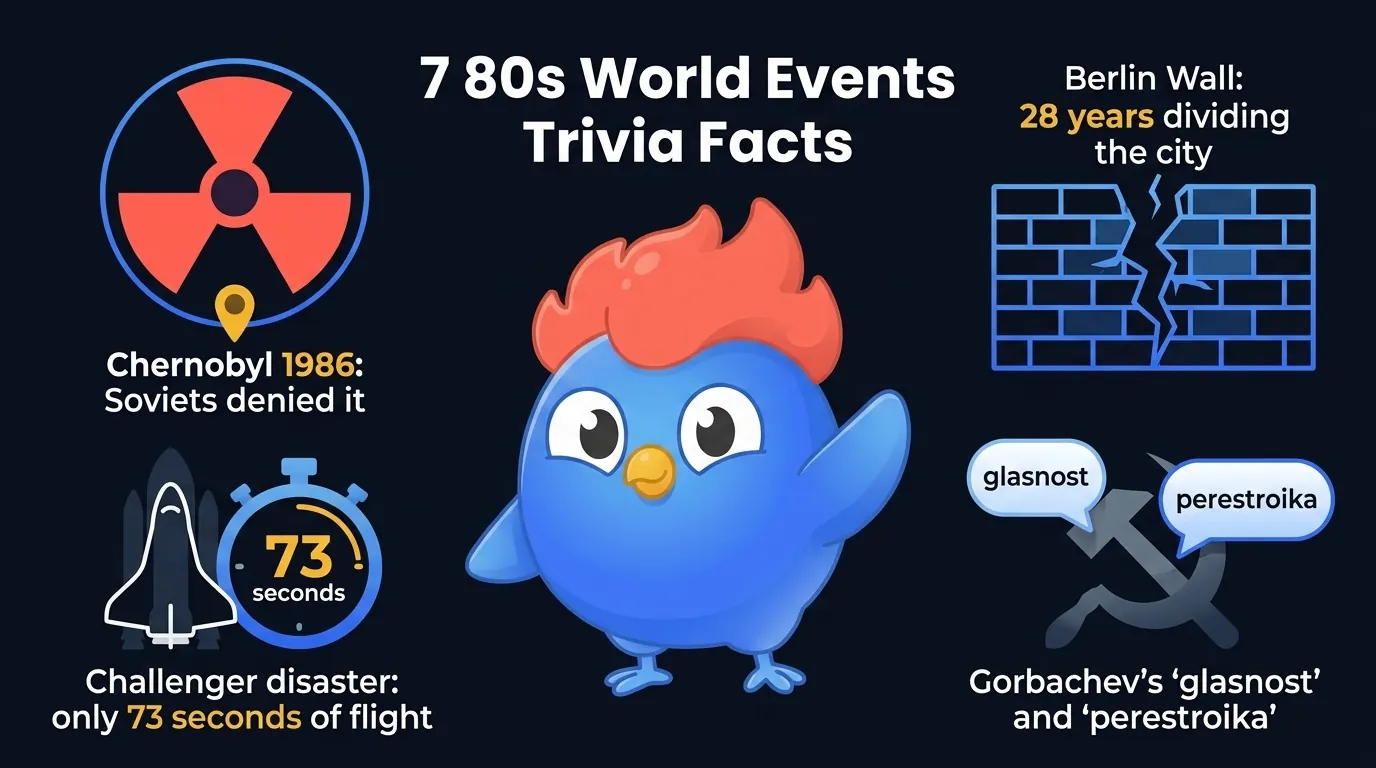
53. The Chernobyl nuclear reactor exploded on April 26, 1986. What did Soviet authorities initially do in response? Easy
Answer: They denied anything had happened. The Soviet government said nothing publicly for days; Sweden’s radiation detectors picked up the fallout, and international pressure forced the admission.
People know Chernobyl was bad. Fewer know the cover-up came first. Nearby Pripyat was evacuated about 36 hours after the explosion while the rest of the world was told nothing. Foreign instruments dragged the truth out.
54. The Berlin Wall fell on November 9, 1989. How many years had it divided the city? Medium
Answer: 28 years, since its construction began on August 13, 1961.
The fall is the famous part; the duration gets overlooked. Twenty-eight years is long enough to be born, grow up, and start a family without ever crossing to the other half of your own city. When the wall opened, some East Berliners stepped into the West for the first time in their adult lives.
55. The Space Shuttle Challenger disaster on January 28, 1986 killed all seven crew members. Who was the civilian teacher on board? Easy
Answer: Christa McAuliffe, a social studies teacher from Concord, New Hampshire, selected from more than 11,000 applicants for NASA’s Teacher in Space program.
McAuliffe’s presence is why the disaster was so widely witnessed. Schools across America had tuned in live to watch the first teacher go to space, which meant millions of children saw the explosion as it happened.
56. How many seconds after liftoff did the Challenger explode? Medium
Answer: 73 seconds. An O-ring seal on a solid rocket booster failed in the cold, causing a breach that destroyed the shuttle.
People round to “about a minute” or “two minutes.” It was 73 seconds, and the detail matters because engineers at Morton Thiokol had warned NASA the night before that the O-rings might fail in the unusually cold Florida weather. NASA launched anyway. The Rogers Commission later blamed a broken safety culture, a finding that risk-management courses still open with.
57. Mikhail Gorbachev introduced two reform policies that helped end the Cold War. What were they called? Medium
Answer: Glasnost (openness) and perestroika (restructuring). Together they loosened state control over information and the economy in the Soviet Union.
People remember one but rarely both. Glasnost gets the attention because it’s the more dramatic idea: Soviet citizens could suddenly criticize the government without prison. Perestroika was the economic half, permitting limited market reforms. Both weakened the party’s grip and set the stage for 1989.
58. The Chernobyl disaster directly accelerated which of Gorbachev’s two reform policies? Hard
Answer: Glasnost. The initial cover-up exposed exactly the government secrecy that glasnost was meant to end, and the disaster became a turning point for transparency in Soviet governance.
This connects two questions on this page into a single story. Chernobyl wasn’t just an environmental catastrophe; the embarrassment of the cover-up handed Soviet reformers proof that secrecy was itself dangerous. Historians count it among the catalysts of the union’s collapse.
59. Over 100 records were broken at the 1980 Summer Olympics in Moscow. How many of those were world records? Hard
Answer: 36 world records, alongside 39 European records and 74 Olympic records, at a Games skipped by more than 60 nations including the United States.
The asterisk is the real story. Those records were set with the Americans, West Germans, Japanese, and dozens of other delegations absent over the invasion of Afghanistan. Some marks stood for years; others fell immediately once full fields returned. Moscow 1980 remains the most politically tangled Games of the modern era, and our 43 history trivia questions pick up several threads from this section.
Try our 43 history trivia questions
Turning 59 Questions Into a Quiz Night
For a hosted round, a dozen or so questions spanning three or four categories is plenty; weight the point values by difficulty so a team that risks the hard ones can still catch a safe-playing leader. Music and technology make the best openers, since everyone in the room has an opinion about the 80s whether they lived it or not. If you read questions aloud party-style instead, expect the toys section to generate the most shouting, and the video-game section to quietly win over the mixed-age table.
Playing solo works differently, and honestly better, if remembering these facts is the goal. Pulling answers out of your head beats rereading them: in the classic retrieval-practice experiment, test-first learners recalled about 80% a week later versus 36% for rereaders. That result is why LearnClash duels are built as 6 rounds of 3 questions, 18 in all with 45 seconds on each, and why every miss gets recycled by the spaced repetition system instead of vanishing.
Loved this decade? The 45 90s trivia questions continue the timeline, gearheads can chase the DeLorean through our 31 car trivia questions, and the arcade era gets full treatment in the video-game set linked above.
Frequently asked questions
What are the best 80s trivia categories for quiz night?
Music, movies, and technology stump the widest range of players, and the usual trap is a decade detail: the right fact attached to the wrong year. This list covers eight categories at three difficulty levels with 59 verified questions and answers.
What 80s facts do most people get wrong?
E.T. was supposed to use M&Ms, not Reese's Pieces. Van Halen's brown M&M clause was a safety check, not ego. The first cell phone cost nearly $4,000, gave you 30 minutes of talk time, and needed 10 hours on the charger. LearnClash's spaced repetition catches these false assumptions by resurfacing questions you miss.
Is there an 80s trivia app with ranked competition?
LearnClash covers 80s pop culture and entertainment trivia with skill-rated 1v1 quiz duels. Pick any topic, challenge a friend, and the spaced repetition system moves each question through Learning, Known, and Mastered stages until you retain it.
What 80s music trivia stumps everyone?
A-ha winning 6 MTV VMAs despite being a one-hit wonder in America, and Lipps Inc.'s Funkytown holding the record for number 1 in the most countries (28) until Madonna's Hung Up in 2005. LearnClash builds on these surprises with music trivia at every difficulty level.
How many 80s trivia questions do I need for a game night?
A solid 80s round needs 10 to 15 questions across 3 to 4 categories. This list gives you 59 across eight categories with difficulty ratings. Award 1 point for easy, 2 for medium, 3 for hard to keep every team competitive through the night.