
43 General Knowledge Questions [With Answers]
43 general knowledge questions across science, history, geography, and pop culture. Answers included, plus why each one stumps.

Quiz yourself on these questions
How many do you know?
Think of your answer, then reveal it.
Did you know it before revealing the answer?
Read this answer in the articleRound complete
Challenge friends on this topic.
Start a new duel in LearnClash and learn from every answer.
Get LearnClashFree to play on iPhone and Android. No ads.

The capital of Australia is not Sydney. Octopuses have three hearts. The Great Wall is not visible from the Moon with the naked eye.
Those three are warmups. The 43 general knowledge questions below run across seven categories, from science and history to food and mythology, each with an answer and a short breakdown of why it catches people. For this August 2026 update I re-verified all 43 answers, and two of them did not survive the check: the ant-biomass claim in question 7 and the Moon golf distance in question 32 are both corrected below, with sources.
One pattern is worth naming up front. In our own production answer data, the worst miss rates land not on obscure facts but on questions with a built-in decoy, where the famous answer arrives faster than the correct one: Russia over France, collagen over RuBisCO. That pattern runs all through this list. For single-subject sets instead, the trivia questions by topic page covers 22 categories.
Test your general knowledge on LearnClash
What Are General Knowledge Questions?
General knowledge questions are quiz questions that test breadth across many unrelated subjects rather than depth in one. A round might jump from astronomy to the Hundred Years’ War to the origin of the word “salary,” so no single specialty carries you for long. Quiz hosts also call them knowledge questions or general information questions; the idea is the same either way: broad facts a curious adult could plausibly know, none requiring expert training.
Examples of knowledge questions in this style: Which country has the most time zones? What fruit is technically a berry? What was Nintendo’s original business before video games? All three are below, with answers and the reason each one fools people.
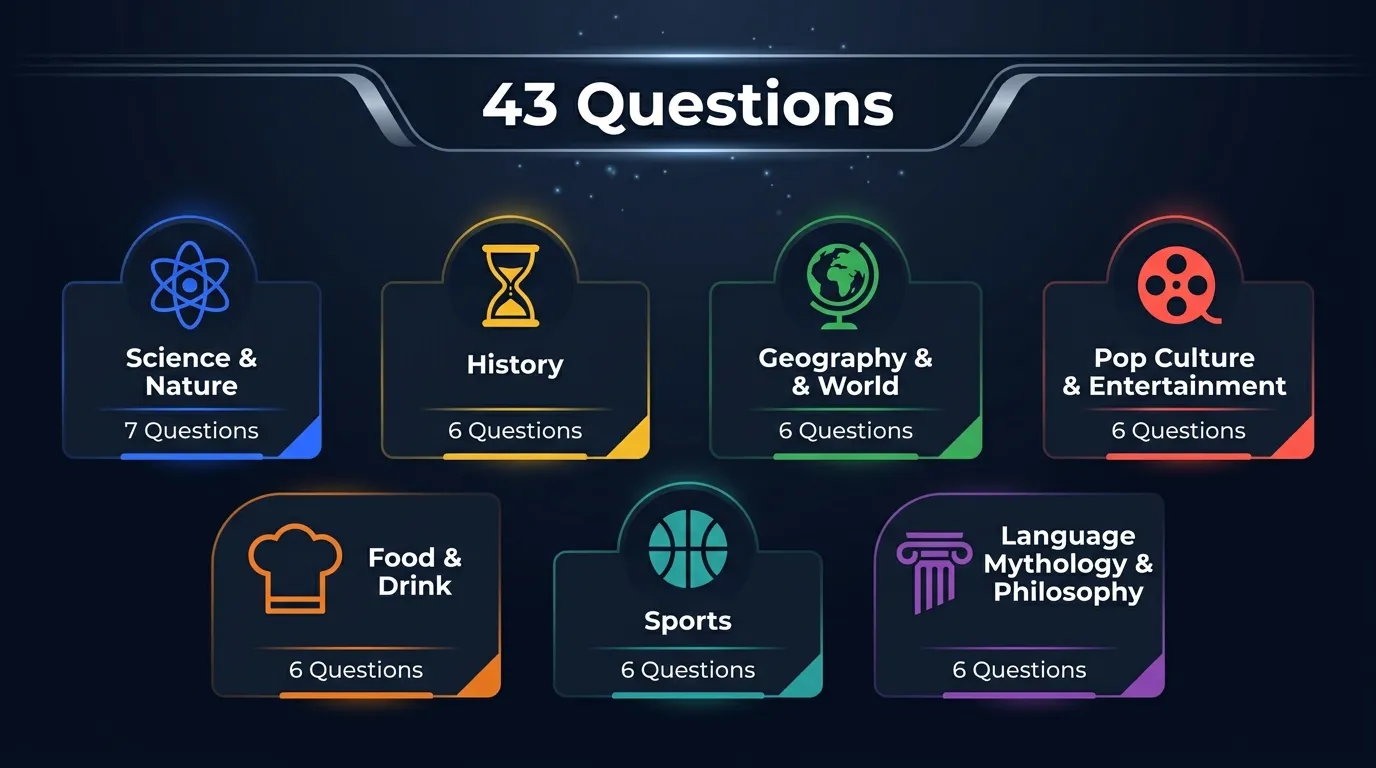
This list holds 43 of them across seven categories and three difficulty tiers: 11 easy, 18 medium, 14 hard. Easy questions exist for scoring rhythm; the medium and hard ones are what the room still argues about on the way home.
| Category | Questions | Easy | Medium | Hard |
|---|---|---|---|---|
| Science & Nature | 1-7 | 2 | 3 | 2 |
| History | 8-13 | 1 | 3 | 2 |
| Geography & World | 14-19 | 2 | 2 | 2 |
| Pop Culture & Entertainment | 20-25 | 2 | 2 | 2 |
| Food & Drink | 26-31 | 2 | 2 | 2 |
| Sports | 32-37 | 1 | 3 | 2 |
| Language, Mythology & Philosophy | 38-43 | 1 | 3 | 2 |
| Total | 43 | 11 | 18 | 14 |
Science & Nature Questions (1-7)
Seven questions from biology, ecology, astronomy, and biochemistry. This is where confident guesses have the shortest life expectancy, starting with a tree census that embarrassed a lot of stargazers.

1. Which has more: trees on Earth or stars in the Milky Way? Easy
Answer: Trees. Earth has roughly 3 trillion trees against an estimated 200 to 400 billion stars in the Milky Way.
Why it stumps people: Space feels infinite. Trees feel countable. Yet even the high-end star estimate leaves at least seven trees for every star in the galaxy. A 2015 study published in Nature used satellite imagery and ground surveys to arrive at the 3 trillion figure, eight times higher than previous estimates.
2. According to Seabed 2030, how much of the ocean floor was mapped to modern standards in June 2024? Easy
Answer: 26.1 percent.
Where it goes wrong: This is the June 2024 figure, not a live 2026 total. Sonar surveys require ships to cover the ocean; orbital images of the Moon and Mars use different methods and resolutions.
3. Which came first: sharks or trees? Medium
Answer: Sharks, by roughly 50 million years. Sharks appeared about 450 million years ago. The first trees evolved around 400 million years ago.
The trap: your gut says trees, because they feel ancient and fundamental. The first sharks swam Earth’s oceans when land was mostly barren rock and moss, and sharks predate dinosaurs by over 200 million years, surviving all five mass extinction events along the way. If you want more science surprises, our 37 science trivia questions go deeper into physics, biology, chemistry, and space. For a format that weaponizes common misconceptions directly, try our 53 true or false questions.
4. Which icy giant planets may have diamond rain deep inside them? Medium
Answer: Neptune and Uranus. Extreme pressure and heat could turn carbon into diamonds.
Why it stumps people: This is an experimentally supported hypothesis, not rain observed on either planet. SLAC researchers created nanodiamonds under conditions meant to resemble planetary interiors. For more planetary surprises, see our 42 space trivia questions or the six-round 97 pub quiz questions.
Now for one that trips up biology students specifically.
5. What is the most abundant protein on Earth? Medium
Answer: RuBisCO, the enzyme in plant leaves that drives photosynthesis.
The reflex answers are collagen, keratin, or gluten. RuBisCO is the enzyme that helps plants fix carbon dioxide during photosynthesis. Its abundance comes from its role across photosynthetic organisms, not from its familiarity outside biology.
6. What percentage of all species that ever lived are now extinct? Hard
Answer: Over 99%.
The blind spot: we think of extinction as rare and catastrophic, five events, each one a headline. In reality extinction is the background hum of evolution, and the vast majority of life that ever existed left no descendants. Every species alive today, including us, belongs to the surviving fraction of a fraction.
7. How does the total biomass of all ants on Earth compare to that of all humans? Hard
Answer: About one fifth of human biomass. The classic pub-quiz claim that ants and humans weigh roughly the same is wrong.
Full disclosure: an earlier version of this page gave the classic answer, “roughly comparable,” and cited a 2022 study in the Proceedings of the National Academy of Sciences as support. While re-checking every answer for this update I actually read the study, and it refutes the factoid it was supposed to support: Earth’s roughly 20 quadrillion ants add up to about 12 million tonnes of dry carbon, around 20 percent of human biomass measured the same way. The parity claim was popularized in the 1990s and did not survive the first rigorous census. The ants keep one title, though: they still outweigh all wild birds and wild mammals combined.
History Questions (8-13)
Six history questions, and not a date-memorization drill among them. The timelines here are for rearranging, not reciting. The full 43-question history set lives in our 43 history trivia questions.

8. How long did the Hundred Years’ War actually last? Easy
Answer: 116 years, from 1337 to 1453.
The catch: the name is a convenient label historians applied later. The conflict between England and France included long truces, regime changes, and flare-ups across more than a century, so the century label was always approximate. And Joan of Arc didn’t appear until year 92.
9. What was Cleopatra closer in time to: the building of the Great Pyramids or the Moon landing? Medium
Answer: The Moon landing. The Great Pyramids were built around 2560 BCE. Cleopatra lived around 30 BCE. The Moon landing was 1969 CE. That puts her roughly 2,530 years after the pyramids and only 1,998 years before the Moon landing.
The mental block: ancient Egypt ran for over 3,000 years, longer than the entire Common Era so far, and compressing that into a single era hides how late Cleopatra arrived in it. She reigned at the very end, nearer to us than to the pyramid builders.
Challenge a friend to history trivia
10. Which country was the first to grant women the right to vote in national elections? Medium
Answer: New Zealand, in 1893.
Where the guesses go: nearly everyone reaches for a Scandinavian or European country. New Zealand was decades ahead of the United States (1920), the United Kingdom (1928), and France (1944). Kate Sheppard drove the campaign, and her petition carried the signatures of nearly one in four adult European women in the country.
11. How long did the shortest war in recorded history last? Medium
Answer: Between 38 and 45 minutes. The Anglo-Zanzibar War on August 27, 1896.
Why it stumps people: It barely qualifies as a battle. The British issued an ultimatum to the new Sultan of Zanzibar. He refused. The Royal Navy bombarded the palace, the sultan fled through a back door, and it was over before the morning was out.
12. What common household product was originally sold as a surgical antiseptic? Hard
Answer: Listerine mouthwash. Invented in 1879 as a surgical antiseptic, it was later marketed for floors, dandruff, and finally halitosis in the 1920s.
The twist: Listerine invented “bad breath” as a social crisis. The term halitosis existed in medical literature but was almost unknown to the public until Listerine’s ad campaigns turned it into a household fear. The advertising history is clearer than the often-repeated, unsourced growth percentage.
13. Which ancient civilization built urban bathing areas and drains around 2500 BCE? Hard
Answer: The Indus Valley civilization (Mohenjo-daro and Harappa), around 2500 BCE. They had flush toilets, covered drains, and a city-wide sewage system.
Where the credit goes wrong: Greece and Rome own the reputation for ancient engineering. But the Indus Valley had sophisticated urban water management a full thousand years before Roman aqueducts, and nearly every house in Mohenjo-daro had a private bathroom connected to a municipal drainage network.
Geography & World Questions (14-19)
Your mental map is tidier than the planet. These six run from time zones to the letters of the alphabet, and the tidy version loses every time. The full set is in our 43 geography trivia questions that stump everyone.
14. Which country has the most time zones? Easy
Answer: France, with 12 time zones (including overseas territories like French Polynesia, New Caledonia, Martinique, and Reunion).
Why it stumps people: Russia, with its 11 zones, is the answer everyone fires off first, and it’s wrong. France’s scattered overseas territories span the globe from the Caribbean to the South Pacific, giving it one more time zone than the largest country on Earth.
15. Which extremely arid Antarctic valleys are named for their lack of extensive snow and ice cover? Easy
Answer: The McMurdo Dry Valleys.
The reflex: A desert need not be hot. These valleys are extremely dry, but snowfall has been measured there; the popular claim that they have had no rain or snow for two million years is false. Field measurements distinguish low precipitation from none.
16. In which direction does the Panama Canal run from the Atlantic to the Pacific? Medium
Answer: Southeast. The Pacific entrance is actually east of the Atlantic entrance.
The compass fails everyone here. Panama’s S-shaped curve bends so hard that a ship leaving the Atlantic side travels southeast to reach the Pacific, so “Atlantic east, Pacific west” falls apart here. You can watch the sun rise over the Pacific end of the canal.
17. What country has more pyramids than Egypt? Medium
Answer: Sudan. It has over 200 pyramids (the Nubian pyramids of Meroe and other sites) compared to Egypt’s roughly 130.
Where it goes wrong: Egypt defined the word “pyramid” in popular imagination. The Kingdom of Kush, centered in what is now Sudan, built smaller and steeper pyramids in far greater numbers over several centuries, and they receive a tiny fraction of the tourist attention.
18. What is the least densely populated country on Earth? Hard
Answer: Mongolia, with roughly 2 people per square kilometer.
Why Greenland doesn’t count: it would win easily, but it is a territory of Denmark, not an independent country. Mongolia’s vast steppe is home to more horses than people in some provinces. The capital, Ulaanbaatar, holds nearly half the country’s entire population.
19. What is the only letter of the alphabet that doesn’t appear in any US state name? Hard
Answer: Q.
The wrong letters: X and Z jump out first, but Texas covers X and Arizona covers Z. Every other letter appears at least once across the 50 states. Q never does.
Pop Culture & Entertainment Questions (20-25)
Pop culture is the one category where the room’s age decides the miss: a 20-year-old and a 50-year-old will get the same question wrong in two different directions. These six cover film, music, gaming, and television. For film-only rounds, our 43 movie trivia questions go deeper.

20. What was Nintendo’s original business before video games? Easy
Answer: Playing cards. Nintendo was founded in 1889 in Kyoto, Japan, making handmade hanafuda (flower cards).
The company behind Mario, Zelda, and the Switch began with cards. Nintendo’s own history dates its Kyoto hanafuda business to 1889. Later video games did not erase that earlier business.
21. What is the highest-grossing film of all time (not adjusted for inflation)? Easy
Answer: Avatar (2009), with about $2.9 billion in worldwide box office.
The reflex answer is Avengers: Endgame, which briefly held the record in 2019. Avatar later regained it through re-releases and leads the unadjusted worldwide chart at about $2.924 billion. Inflation-adjusted comparisons use a different basis. For film trivia, our 37 Harry Potter trivia questions go beyond the movies.
22. Which band has sold the most records worldwide? Medium
Answer: The Beatles, with estimated sales exceeding 600 million units.
Two names trip people up: Elvis Presley and Michael Jackson were solo artists. The question asks for a band. Historical sales estimates also vary because albums, singles, and certified units are different measures.
23. What is the best-selling video game of all time? Medium
Answer: Minecraft, with over 300 million copies sold across all platforms.
Why it stumps people: Tetris totals often combine several versions and publishers. Minecraft’s 300-million milestone was announced in 2023 for the game; copies sold are not a count of unique people. A player can own more than one edition.
24. Which toy is credited with the first US television toy advertisement in 1952? Hard
Answer: Mr. Potato Head, in 1952.
The change was the audience and medium: Mr. Potato Head’s 1952 television campaign reached children directly. That does not mean all earlier toy advertising appeared only in print, and the often-repeated sales total needs its own source.
25. What is the longest-running animated TV show in American history? Hard
Answer: The Simpsons, on the air since December 17, 1989 (35+ seasons and counting).
Why it stumps people: South Park and Family Guy are also long-running, but neither approaches The Simpsons’ tenure. The show has been on air longer than many of its current viewers have been alive. It overtook Gunsmoke in number of episodes for an American primetime scripted series in 2018.
Food & Drink Questions (26-31)
Everyone has food opinions. Food facts are rarer, which is why this category starts more table arguments than any other. Six questions on origins, biology, and consumption, with 43 more in the complete food trivia guide.

26. Which country is associated with traditional friteries or fritkots? Easy
Answer: Belgium.
The trap: The name “French fries” does not prove an origin. Belgium celebrates its fries culture, but even its official cultural site acknowledges uncertainty about the dish’s exact beginnings. The Meuse River and wartime naming stories are not settled historical facts.
27. What is the most consumed beverage in the world after water? Easy
Answer: Tea.
The go-to guess is coffee, because coffee runs Western media and social feeds. The world drinks more tea. China, India, Turkey, Japan, and the United Kingdom collectively down enough of it to leave coffee in a distant second place.
28. What fruit is technically a berry: a strawberry, a banana, or a raspberry? Medium
Answer: A banana. Botanically, a berry develops from a single ovary and contains seeds within the flesh. Bananas qualify. Strawberries and raspberries do not.
The mix-up: botanical definitions ignore everyday language completely. Grapes, tomatoes, eggplants, and avocados are also true berries, while strawberries are accessory fruits and raspberries are aggregate drupes. The words mean something very different in a botany lab than in a grocery store.
29. Which food did the Centre for Retail Research describe as a leading theft target in an earlier UK and European retail ranking? Medium
Answer: Cheese.
Why it stumps people: The research centre’s 2019 retrospective refers to an earlier regional ranking. It does not establish that four percent of all cheese produced worldwide is stolen each year. Value, portability, and resale demand help explain its appeal to thieves.
30. Which country is traditionally associated with the often-quoted figure of about 12 kilograms of coffee per person per year? Hard
Answer: Finland, at roughly 12 kilograms per person per year.
Where the guesses go: Italy, Brazil, or Colombia. Finland is the traditional answer associated with this often-quoted historical figure. It is not a live 2026 ranking or twelve kilograms of brewed drink. Specify the source, period and measurement before comparing countries.
31. What is the most expensive spice in the world by weight? Hard
Answer: Saffron. It takes roughly 75,000 crocus flowers to produce a single pound, and most of the harvesting is done by hand.
The labor explains much of the price: each crocus flower produces only three stigma threads. Harvesting them by hand takes time. Prices vary by origin and quality; a commercial price range is not a stable worldwide tariff.
Sports Questions (32-37)
Sports trivia keeps wandering off the scoreboard: golf on the Moon, the history of the marathon distance, a 300-yard polo field. These six reward whoever reads past the box score, and so do our 43 sports trivia questions if you want a deeper bench.

32. What sport was the first played on the Moon? Easy
Answer: Golf. Alan Shepard hit two golf balls during the Apollo 14 mission in February 1971.
The correction: the Moon and athletics don’t overlap in anyone’s mental model, so the story invites exaggeration. Shepard smuggled a makeshift 6-iron head onto the mission, attached it to a sample-collection tool, and swung one-handed in a pressurized suit. He claimed the second ball went “miles and miles,” and until this update the page repeated a 200-yard estimate. Both were wrong: in a 2021 analysis published by the USGA, imaging specialist Andy Saunders digitally enhanced the Apollo 14 photographs, located both balls, and measured the second shot at about 40 yards.
Play sports trivia on LearnClash
33. What does “BMX” in BMX racing stand for? Medium
Answer: Bicycle motocross.
Riders compete in BMX for years without wondering about the name. The sport started in the early 1970s when kids in Southern California began racing bicycles on dirt tracks, copying motocross motorcycle riders. The abbreviation stuck, the sport professionalized, and by 2008 it was an Olympic event.
34. How long is a marathon, and when was that distance adopted? Medium
Answer: 26.2 miles (42.195 km), the length used at the 1908 London Olympics and adopted as the standard in 1921.
Why it stumps people: The ancient Marathon-to-Athens story inspired the race, but early Olympic courses varied. World Athletics records the London distance and later standardization. Popular stories about royal seating preferences simplify a more complicated course history.
35. Which sport uses a full-size outdoor field measuring 300 by 160 yards? Medium
Answer: Polo. That is about 10 acres.
The trap: The dimensions identify the sport without claiming its field is larger than every golf course or horse-racing venue. Horses need room to accelerate, turn, and follow the ball across the field.
36. Which sport had the most gold-medal events at the 2024 Paris Olympics? Hard
Answer: Aquatics, with 49 medal events across five disciplines, according to World Aquatics.
The catch is what you count: aquatics includes swimming, open water swimming, diving, artistic swimming, and water polo. Athletics had 48 events, one fewer than aquatics as a whole.
37. What country invented basketball? Hard
Answer: The United States, but the inventor was Canadian. James Naismith, born in Almonte, Ontario, created basketball in 1891 while teaching at a YMCA training school in Springfield, Massachusetts.
Why it stumps people: This catches even die-hard fans. Basketball is synonymous with American culture, but its inventor was Canadian. Naismith needed an indoor game to keep his students active during harsh New England winters, so he nailed a peach basket to a 10-foot elevated track and wrote 13 rules. Within a decade, the sport had spread globally.
Language, Mythology & Philosophy Questions (38-43)
The last six come from the margins: word origins, dead gods, and one very translated document. They tend to change how you read the other 37. Greek myth gets a deeper cut in LearnClash’s Greek mythology topic.
38. What does “OK” originally stand for? Easy
Answer: “Oll Korrect,” a humorous misspelling of “all correct.” It first appeared in a Boston newspaper on March 23, 1839.
Why it stumps people: “OK” is one of the most recognized words on the planet, used in almost every language. Its origin is weirdly mundane: an 1839 newspaper joke during a trend of playful abbreviations (KY for “know yuse,” KG for “know go”). Most of the abbreviations died. OK never stopped.
39. What language has the most native speakers worldwide? Medium
Answer: Mandarin Chinese. The question counts native speakers, not everyone who uses a language as a second language.
The denominator matters: native speakers and all speakers answer different questions. English has a large second-language population; that does not put it first by mother tongue.
40. In Norse mythology, what happens at Ragnarok? Medium
Answer: The end of the world. Gods including Odin and Thor die in a final battle against giants and cosmic monsters. The world is consumed by fire and water, then reborn.
Marvel framed it as one battle. The films flattened it, but the myth is bigger. The actual myth is a complete cosmological cycle: destruction followed by renewal, with a green, peaceful, empty world emerging and two surviving humans, Lif and Lifthrasir, repopulating it. The story is about rebirth, not just destruction. Tolkien drew heavily from Norse mythology when building Middle-earth, and our 37 Lord of the Rings trivia questions test whether you know the world he constructed from these roots.
41. What is the most translated document in the world? Medium
Answer: The Universal Declaration of Human Rights, available in over 500 languages and dialects.
The Bible is the reflexive answer, and it is translated into more languages overall. But the UDHR holds the Guinness World Record for the most translations of a single, continuous document; it was deliberately translated into as many languages as possible to emphasize its universal applicability. Speaking of the Bible, our bible trivia questions collection covers 67 questions across Old Testament, New Testament, and the misconceptions almost everyone repeats.
42. What is the origin of the word “salary”? Hard
Answer: The Latin word salarium, connected with sal, meaning salt. The familiar story that Roman soldiers were routinely paid in salt is not established by that etymology.
Why it stumps people: An etymological connection is easy to turn into a vivid historical story. Salt mattered in food preservation and trade, but that does not by itself prove how soldiers received their wages.
43. Which ancient Mesopotamian epic follows a king’s search for immortality? Hard
Answer: The Epic of Gilgamesh, written on clay tablets in ancient Sumer (modern Iraq) around 2100 BCE.
Why it stumps people: Homer already feels like the beginning of literature, and the Iliad is from around 800 BCE. By then Gilgamesh had been on clay for some 1,300 years: a king hunting immortality after losing his closest friend, complete with a flood account that is centuries older than the story of Noah and strikingly similar to it.
Keeping the Ones You Missed

Run the 43 once and note your misses. Then come back to exactly those in a few days. Pulling an answer out of your own head does more for retention than rereading it ever will, which is the well-replicated testing effect, and it works best on the questions that stung:
“Practicing retrieval produces greater gains in meaningful learning than elaborative studying with concept mapping.” Karpicke & Blunt, Science (2011)
General knowledge is hard to fake because the facts refuse to cluster. A banana, a 38-minute war, and Mongolia’s steppe have to be recalled separately. A standard LearnClash duel covers 18 questions across six topics, three per topic. Ranked matches use a skill rating. The spaced-repetition system moves questions through Learning, Known, and Mastered: correct answers can promote them after 7-day and 90-day cooldowns, while a miss drops one stage. Those are promotion rules, not guaranteed next-appearance dates; Mastered questions are not permanently retired. See the Kahoot comparison or Trivia Crack comparison.
Hosting a quiz night instead? Deal one category per round and score hard questions double, so the mythology specialists and the sports fans each get their inning. We also published a free open-source trivia database with 100 questions across 8 categories, downloadable as JSON and licensed under CC BY 4.0. And when the general round runs dry, our 53 TV trivia questions cover everything from M*A*S*H records to the real sounds behind Law & Order’s famous “chung-chung.”
Frequently asked questions
What are good general knowledge questions for quiz night?
The best quiz night questions have answers that surprise the room, like 'Which country has the most time zones?' (France, not Russia) or 'What fruit is technically a berry?' (a banana). This list includes 43 verified questions across seven categories at easy, medium, and hard difficulty, organized to run a full quiz night with minimal prep.
What categories do general knowledge questions cover?
Standard general knowledge spans science and nature, history, geography, pop culture and entertainment, food and drink, sports, and language or mythology. LearnClash covers all of these categories and more, with questions at every difficulty level generated for any topic you can imagine.
Are general knowledge questions good for family game night?
Yes. General knowledge questions work for mixed-age groups because they cover a wide range of topics. Kids often know pop culture answers that adults miss, and adults know history and geography. LearnClash supports family play with adjustable difficulty and topics you choose yourself.
What are the hardest general knowledge questions?
The hardest questions combine obscure facts with misleading intuition. Questions like 'What percentage of all species that ever lived are extinct?' (over 99%) or 'What country has more pyramids than Egypt?' (Sudan) stump even trivia veterans. In LearnClash production answer data, the most-missed questions are the ones where a better-known wrong answer crowds out the correct one.
Where can I practice general knowledge questions online?
LearnClash lets you practice general knowledge on any topic with questions at every difficulty level. The app tracks your accuracy per category and uses spaced repetition to resurface questions you miss. Pick a topic, challenge a friend, and the app handles the rest. Available free on iOS and Android.