
LearnClash vs Kahoot: Quiz Duel vs Classroom [2026]
LearnClash vs Kahoot, 2026: 1v1 ELO duels with spaced repetition versus Kahoot's classroom mode, Spirit AI 25-seat floor, and Khanmigo's free generator.

Kahoot has logged 12 billion participants (non-unique, by its own 2025 count) since the platform launched in 2013 out of a Norwegian university project (the company behind it was founded in Oslo in 2012), and a Goldman Sachs consortium paid $1.72 billion to take it private in January 2024. Those two numbers tell you what Kahoot is: a host-led classroom platform at global scale.
LearnClash is the opposite shape. No host, no shared screen, no game PIN. Two players, one ranked duel on any topic, and a spaced repetition system that keeps working after the match ends.
This comparison covers questions, multiplayer, ranking, retention, AI generators, pricing, and the enterprise wall around Kahoot 360 Spirit AI. Kahoot’s prices and participant caps were re-checked against its own plans and help-center pages on May 22, July 5, and July 27, 2026; anything we could not re-verify carries a date. Or start a 3-minute duel on any topic before reading.
LearnClash vs Kahoot at a Glance
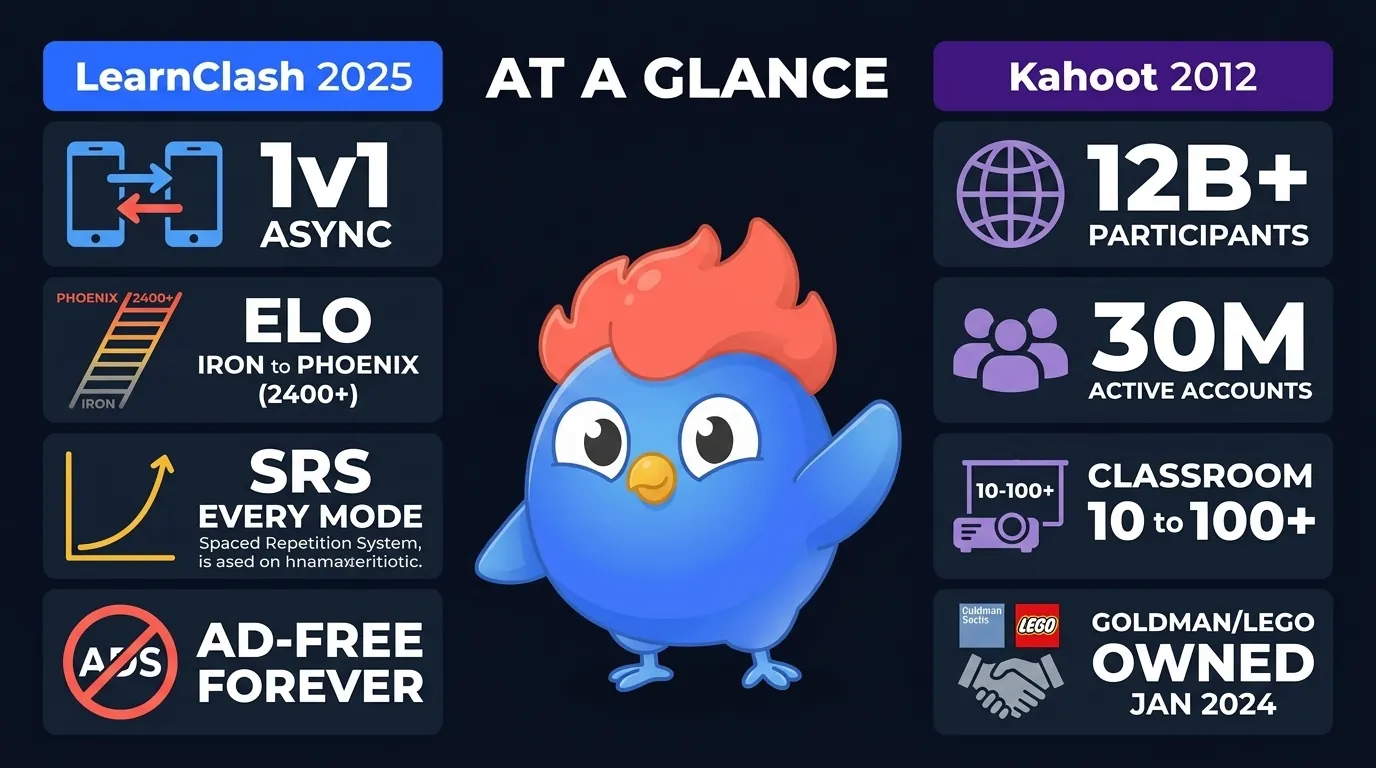
LearnClash runs 18-question asynchronous 1v1 duels with ELO skill matchmaking across eight tiers from Iron to Phoenix (2400+), and LearnClash keeps spaced repetition active in every mode. Kahoot runs live host-led sessions with participant caps that scale by plan, from 10 on the free tier to 4,000 on Kahoot! One Ultra. Both ship AI question generation in 2026, but Kahoot’s AI Generator is a paid-plan feature (its free path is Quiz Starter, on-device and iOS 26 only), while LearnClash includes AI generation free on every tier.
For a broader ranking of quiz games with similar energy, see our guide to the best games like Kahoot.
| Feature | LearnClash | Kahoot |
|---|---|---|
| Founded | 2025 | 2012, Oslo (NTNU spinout) |
| Ownership | Independent | Goldman Sachs / Kirkbi / General Atlantic (Jan 2024) |
| Scale | Growing learning app | 12B+ cumulative participants (company figures, 2025); ~30M active accounts at last public disclosure |
| Primary use | 1v1 competitive duels | Group/classroom quizzes |
| Players | 2 (1v1, asynchronous) | Live groups: 10 free, up to 4,000 by plan |
| Question creation | AI on demand, any topic | AI Generator (since 2023) + host-built quizzes |
| Topics | Any topic at three difficulty levels | Whatever the host or AI generates |
| Rating system | ELO rating, 8 tiers (Iron → Phoenix) | Per-game points (no persistent rank) |
| Spaced repetition | Built into all modes | None; Test Mode added Sept 2025 |
| Solo practice | 6-question SRS sessions | AI-generated study sets (paid plans) |
| AI tutor | Clash mascot (chat about any topic) | Step-by-step solver + study buddies (paid) |
| Asynchronous play | Yes (72h per turn) | Self-paced kahoots (assigned) |
| Deep stats | Per-topic accuracy, battle record, H2H | Per-quiz host report |
| Ads | None on every tier | Free tier shows in-app upsells |
| Free tier limit | Daily duels, all topics | 10-player live cap (40 on the free teacher plan) |
| AI quiz generator | Free in every tier, any topic | Gated to Kahoot+ Study ($3+/mo annual). Free workaround: Khanmigo + Blooket (since Jan 2025) |
| AI for teams (enterprise) | Same $7.99/mo, no minimum | Kahoot 360 Spirit AI: published $20/license/mo, 25-license minimum; now quoted via sales |
| Paid plans | Premium $7.99/mo or $59.99/yr (annual: 7-day trial) | 8 plans as of the May 2026 check: $3-$19/mo individual, $19-$59/mo business; annual billing on most tiers |
| Platforms | iOS, Android | iOS, Android, Web |
Questions: AI on Demand vs Host-Created Content
The core split is who drives the prompt. In LearnClash the player picks a topic and fresh questions arrive seconds later, at easy, medium, or hard. In Kahoot the host (or a learner on a paid plan) sets a quiz up once, then the group plays it. Kahoot’s own AI-enhanced question generator dates to June 2023 and was expanded with the September 2025 study-tools pack, but it still sits behind paid plans. The September 2025 announcement also confirms the iOS 26 Quiz Starter generates kahoots free and on-device through Apple’s Foundation Models, on iOS 26 only.
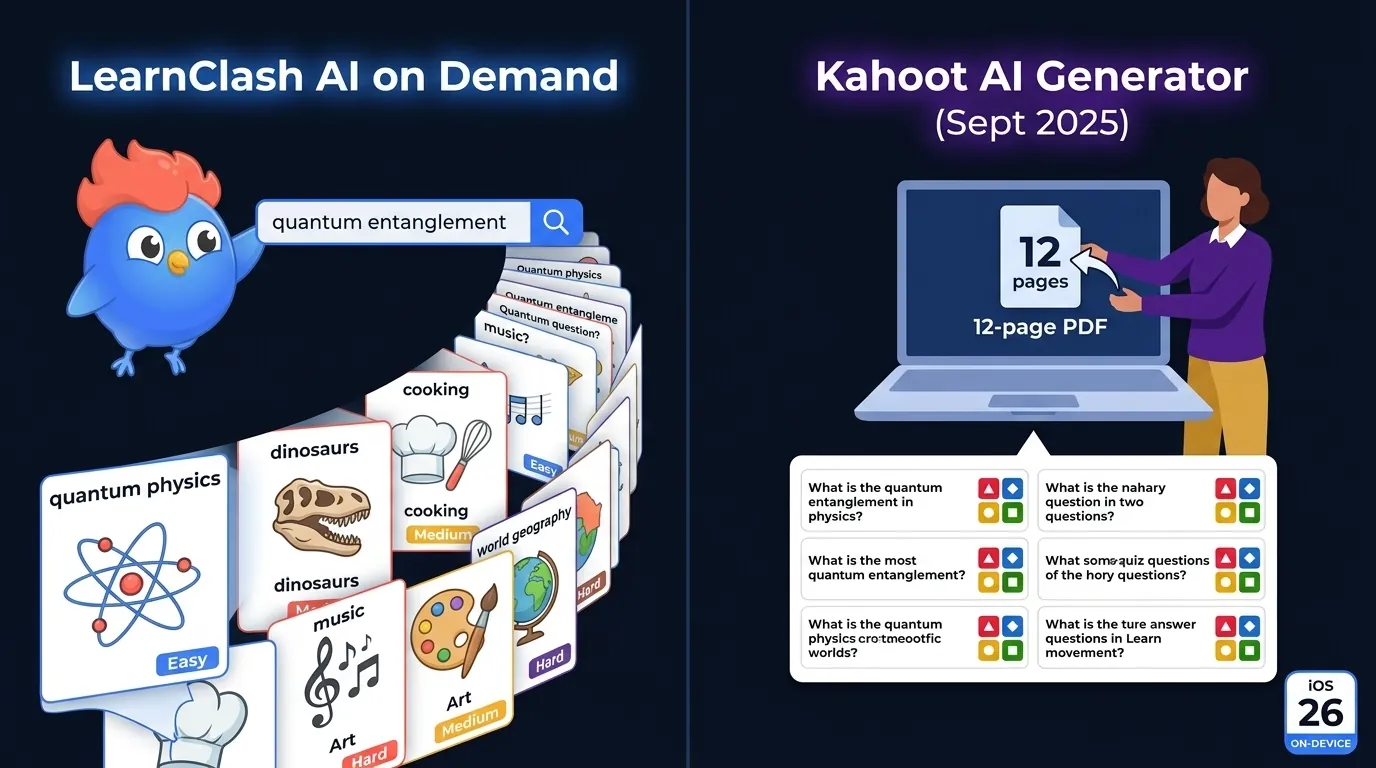
The unglamorous half of running an AI question pipeline is rejection, not generation. Every LearnClash question passes an automated fact check before it can enter a duel, and the ones that fail get regenerated rather than patched. That filter is why accuracy holds on narrow topics like dinosaur paleontology or Ottoman naval history, and why two duels on the same topic rarely feel like the same quiz.
For a teacher who just wants free AI questions for a classroom game, neither app is the cheapest path in 2026. That is Khanmigo + Blooket, covered below.
Multiplayer: 1v1 Async Duels vs Live Classroom Sessions
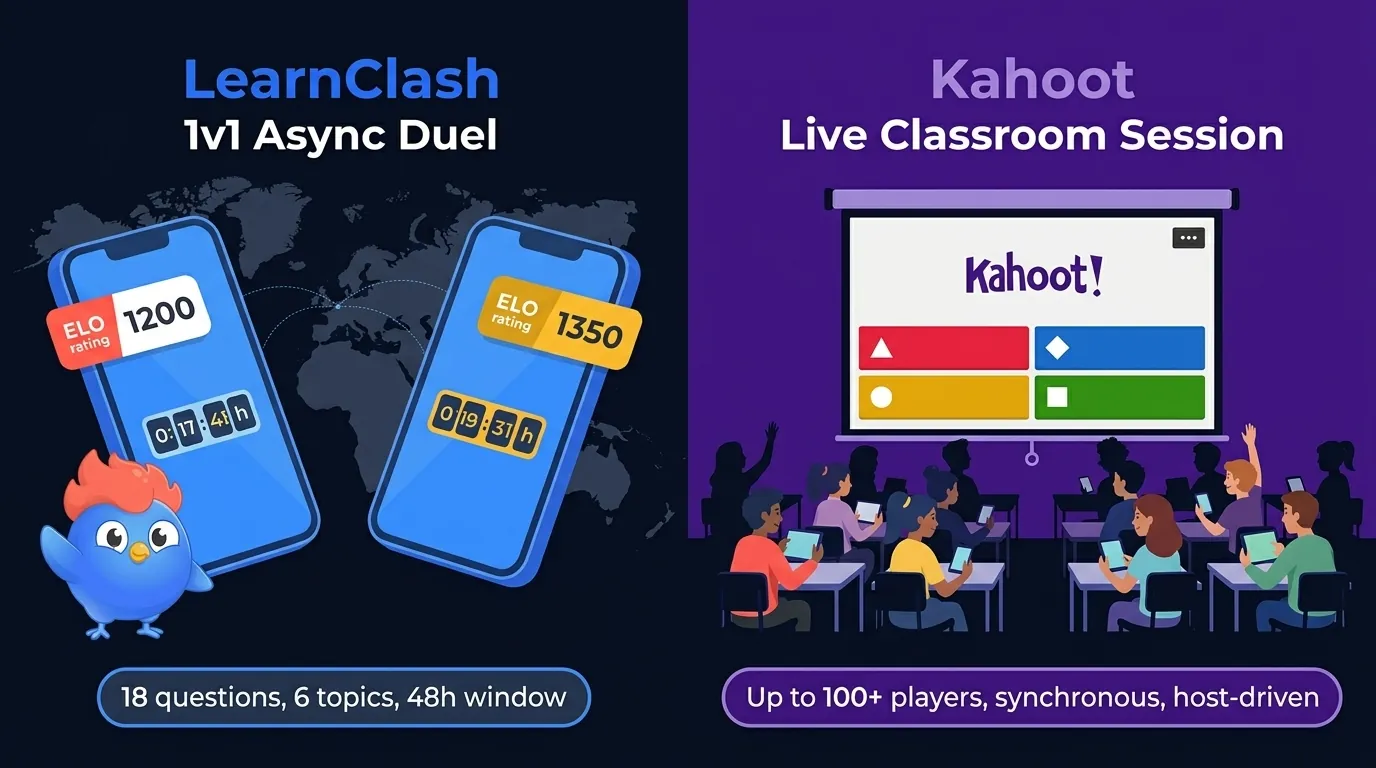
Kahoot multiplayer starts with a host and a game PIN: everyone joins the same live session, and the host controls the pace on a shared screen through Classic, Team, or Accuracy mode. LearnClash inverts every one of those choices. Each duel runs 6 rounds of 3 questions, 18 questions total across 6 distinct topics, with a 45-second timer per question, and players answer at their own pace inside a 72-hour turn window, which is what lets a duel survive opposite time zones.
| LearnClash | Kahoot | |
|---|---|---|
| Format | 18 questions across 6 topics | Host-controlled live quiz |
| Players | 2 (1v1) | Live group, capped by plan |
| Timing | Asynchronous (72h window) | Synchronous (everyone online) |
| Pacing | Self-directed, 45s per question | Host controls |
| Free-tier player cap | None | 10 per session (40 teacher plan) |
Why 6 topics per duel? When we tested formats during development, three questions per topic proved focused enough to test real knowledge, while six topics kept one-trick specialists from dominating. Topic-locked duels exist too, where all 18 questions cover a single subject. For the closest 1v1 async sibling comparison, see LearnClash vs QuizDuel.
Ranking: ELO Tiers vs Per-Game Points
Kahoot awards points per question based on speed and accuracy, shows a top-three podium, and then forgets everything when the session ends. No tiers, no matchmaking, no ladder. LearnClash keeps score the opposite way, on a persistent ladder: new players start at 1300 (Gold II, the ladder average) and climb through eight tiers, Iron, Bronze, Silver, Gold, Platinum, Emerald, Diamond, Phoenix (2400+).
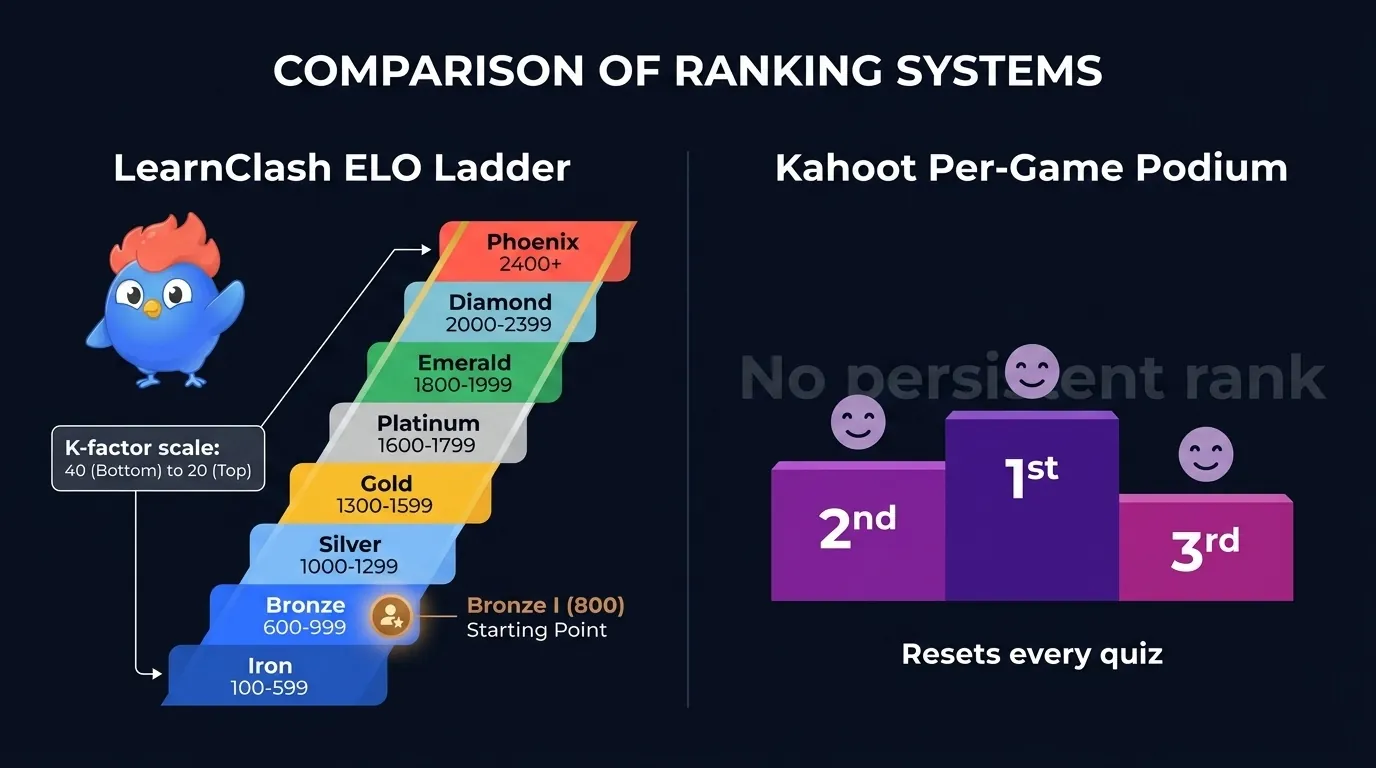
LearnClash updates your ELO after every rated duel, including the first. Early results can move it more because the system has less evidence of your skill. Rating changes depend on that uncertainty and your opponent, not a switch after match ten. After ten rated duels, your rank becomes public and ELO leaderboards become available; the rating keeps adapting as you play. Our breakdown of the ELO rating system explains how it works.
“A proper rating system should go a step beyond mere ranking and should provide some estimate of the relative strengths of the competitors, however strength may be defined.” Arpad Elo, The Rating of Chessplayers, Past and Present (1978)
Kahoot’s per-game points work fine for a single classroom round; that is what they are for. They just cannot tell you whether you are better at geography this month than last month, and they cannot pair you with an opponent at your level.
Learning Value: Spaced Repetition vs Test Mode
LearnClash builds retention through spaced repetition in every game mode: any question you meet in a duel or a solo session enters a review cycle with three mastery stages (Learning, Known, Mastered), and LearnClash demotes a question one stage the moment you miss it. Kahoot added Test Mode in September 2025 for exam simulation, but it still schedules no reviews and tracks no mastery across sessions.
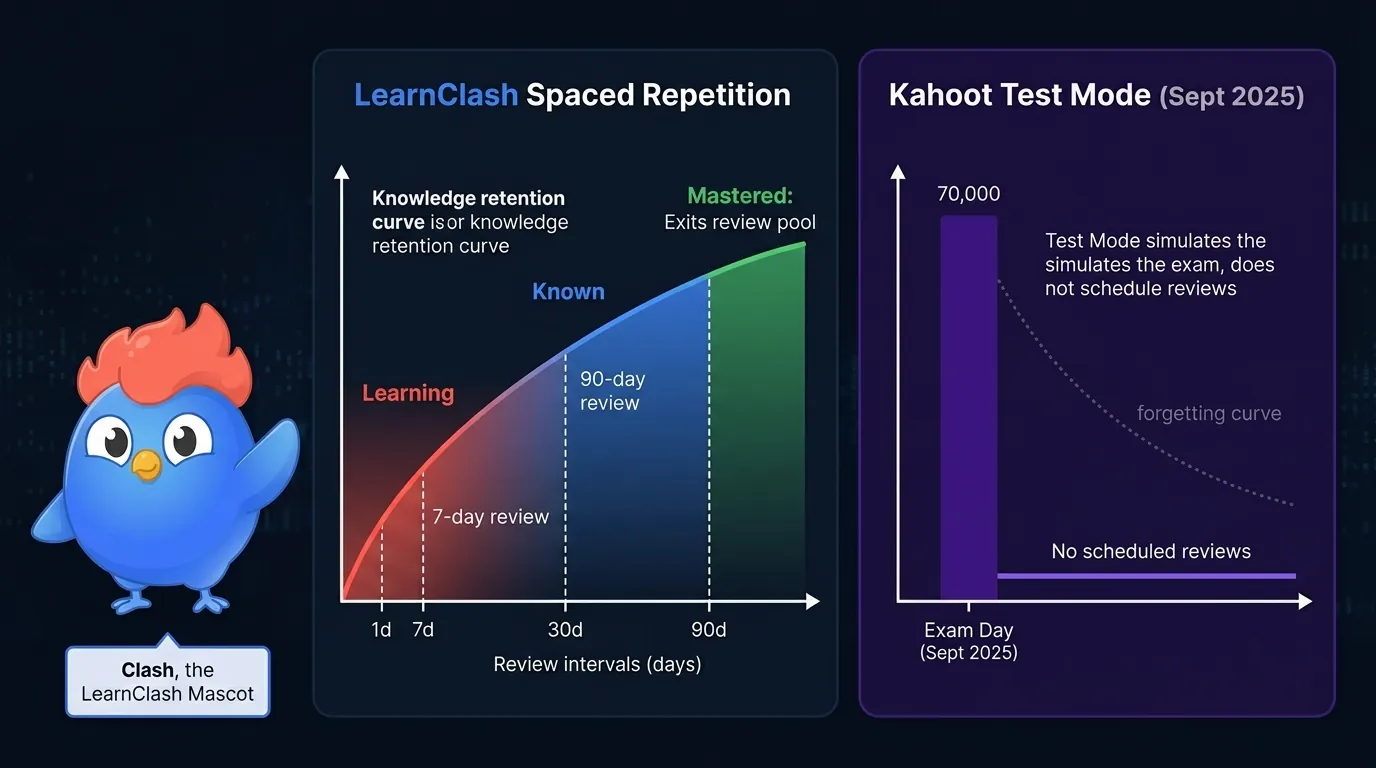
| LearnClash | Kahoot | |
|---|---|---|
| Spaced repetition | Built into all modes | None |
| Mastery tracking | 3 levels (Learning → Known → Mastered) | None |
| Solo practice | 6-question SRS sessions | AI study sets (paid plans) |
| Exam prep | Per-topic accuracy + SRS | Test Mode (added Sept 2025) |
| Knowledge retention | Compounds over time | Resets after each session |
The reason we built it this way is boring and well documented: testing-effect research shows retrieval-based study roughly doubles long-term retention versus rereading, and the spacing effect is one of the most replicated findings in experimental psychology (Cepeda et al., Psychological Bulletin, 2006).
Kahoot’s research base is genuinely strong on engagement, and weaker exactly where you would expect. A 2025 meta-analysis of 43 Kahoot studies covering 1,706 experimental and 1,647 control students found achievement gains of 0.772 standard deviations and a striking 1.492 SD on retention (Özdemir, JCAL 41(1), 2025). Read the conditions, though: the retention effects show up in studies where teachers wrapped Kahoot in structured, repeated review. A separate WiKIT review of 155 studies across 51 countries, commissioned by Kahoot itself, flagged its own evidence gaps: a shortage of large-scale randomized trials, almost no studies with children under 13, and no studies of Kahoot’s apps beyond the core quiz.
That structured-review gap is where LearnClash’s 3-stage SRS lives: the app does the scheduling a teacher would otherwise have to run by hand, and it does it in every mode rather than a separate flashcard product. Pair it with memory techniques like the memory palace and the loop closes on its own.
Beyond the Classroom: Kahoot’s 2024-2026 Pivots
Kahoot has run three strategic shifts in parallel since 2024. The $1.72 billion Goldman Sachs / Kirkbi / General Atlantic take-private delisted it from Oslo Børs in January 2024. September 2025 brought the AI study-tools pack (AI Generator, Test Mode, a step-by-step solver). And Apple’s iOS 26 Quiz Starter now generates kahoots on-device for free.
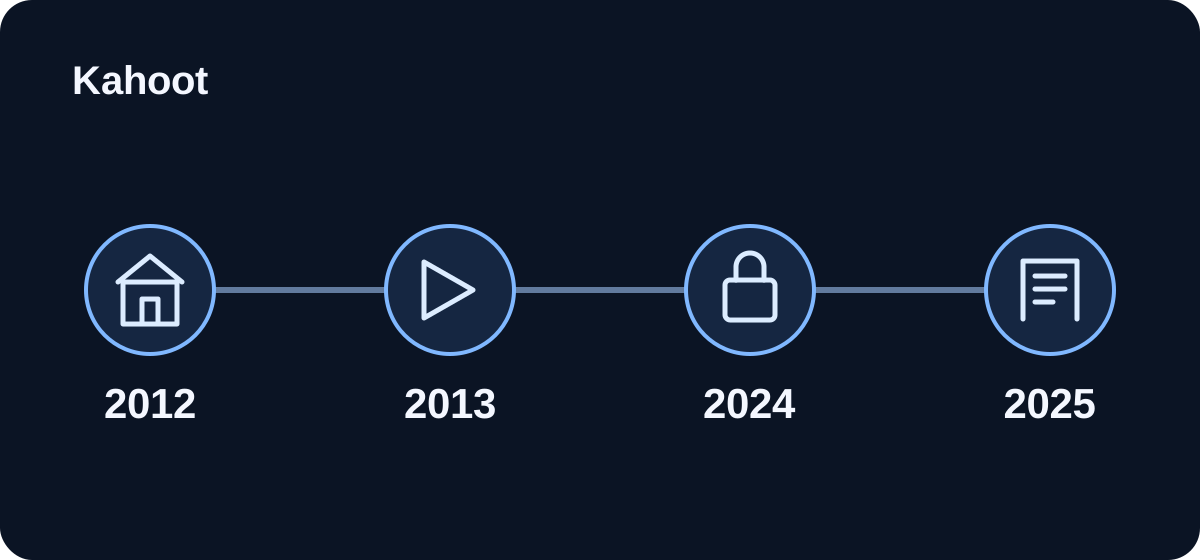
The investor base explains the direction. Kirkbi positions itself as a permanent, long-horizon owner, and Goldman bought a profitable ed-tech with global classroom reach; the visible thesis is monetizing an installed base Kahoot last publicly sized at about 30 million active accounts before the take-private, through paid AI features and business plans. The Kahoot Group is a portfolio now, spanning Clever (US K-12 sign-on, acquired 2021), DragonBox, Poio, Drops, and the Whiteboard.fi / Actimo / Motimate collaboration tools.
For a classroom power user the risk is feature gating. The strongest September 2025 tools (Test Mode prep, advanced study buddies, the full solver) sit on paid Kahoot+ Study plans, billed annually: study tools start at $3 a month, and Test Mode specifically requires the $12 Gold tier. The free tier still works; it just covers less of the product than it used to.
Khanmigo + Blooket: The Free AI Path Kahoot Doesn’t Offer
Khan Academy and Blooket launched the free Khanmigo Blooket Generator on January 21, 2025. A teacher types a topic, gets a generated question set in seconds, and clicks Export to Blooket to play, with no paywall and no usage cap. Kahoot’s own AI Generator remains paid-only, which makes this the odd fact of 2026: the cheapest way to run an AI-generated classroom quiz is not Kahoot.
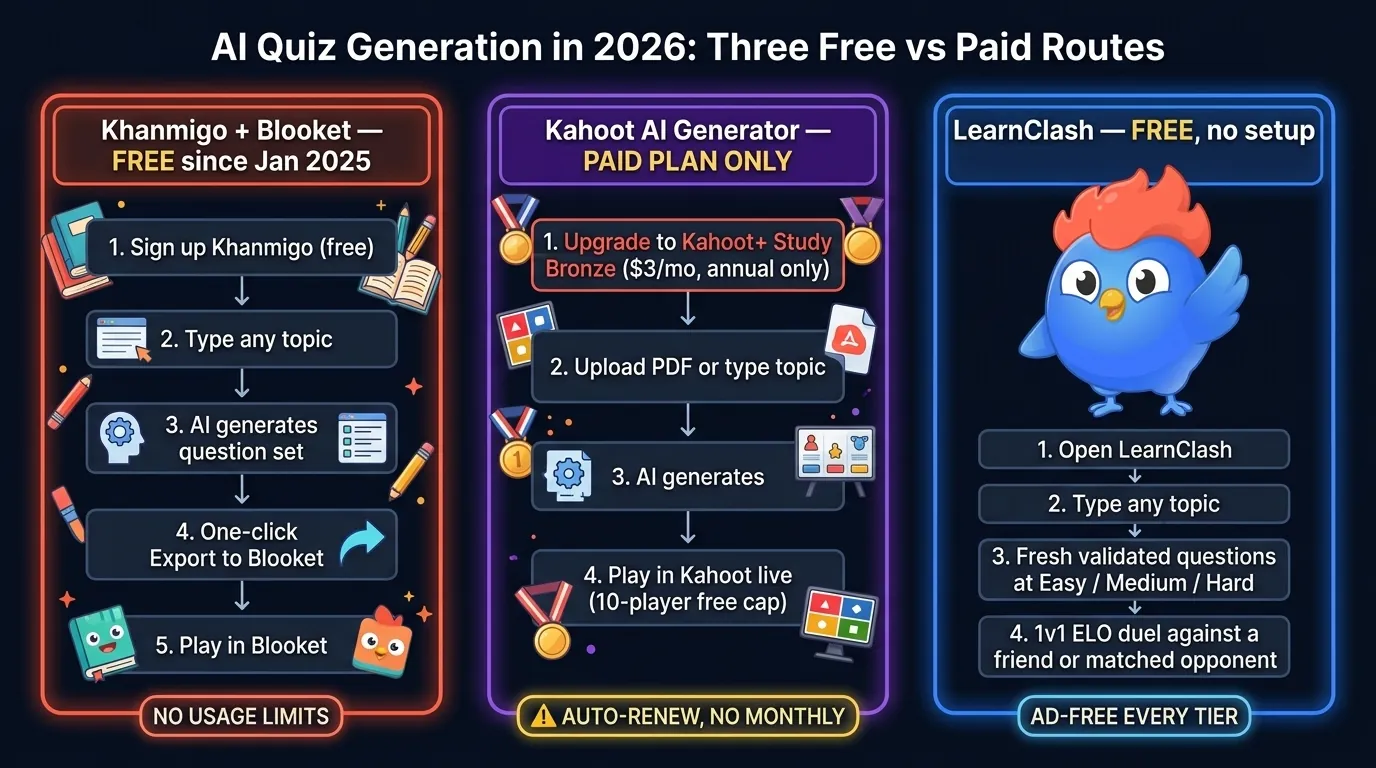
| Path | Cost to teacher | Usage cap | Free tier player cap |
|---|---|---|---|
| Khanmigo + Blooket | Free | None | Blooket free tier (per Blooket plan) |
| Kahoot AI Generator | Paid plan only (Bronze $3/mo, annual) | Plan-tier limited | 10 live (40 teacher plan) |
| LearnClash | Free | None | 1v1 ELO duel, free daily |
When we checked the Khan Academy announcement on May 22, 2026, the partnership was still listed as free with “no usage limits”: teachers sign up at khanmigo.ai, the generator lives in the Khanmigo dashboard, and one click pushes the set to Blooket. For the classroom-game-mode side of that stack, see our Blooket vs Gimkit comparison.
LearnClash sits beside both rather than between them. The same generated questions power duels, solo practice, and the Clash Chat tutor that explains wrong answers; there is no export step because there is no host.
Pricing in 2026: Free Tiers vs Eight Paid Plans
LearnClash keeps its whole learning core free (daily duels, all topics, ELO rankings, spaced repetition, zero ads), and LearnClash Premium costs $7.99/month or $59.99/year with a 7-day free trial on the annual plan; the LearnClash pricing page lists what free and Premium each include. Kahoot’s free personal tier caps live sessions at 10 players (verified teachers get 40 free); above that sit eight paid plans as of the May 22, 2026 check, four Kahoot+ Study plans for individuals and four 360 Pro plans for business.
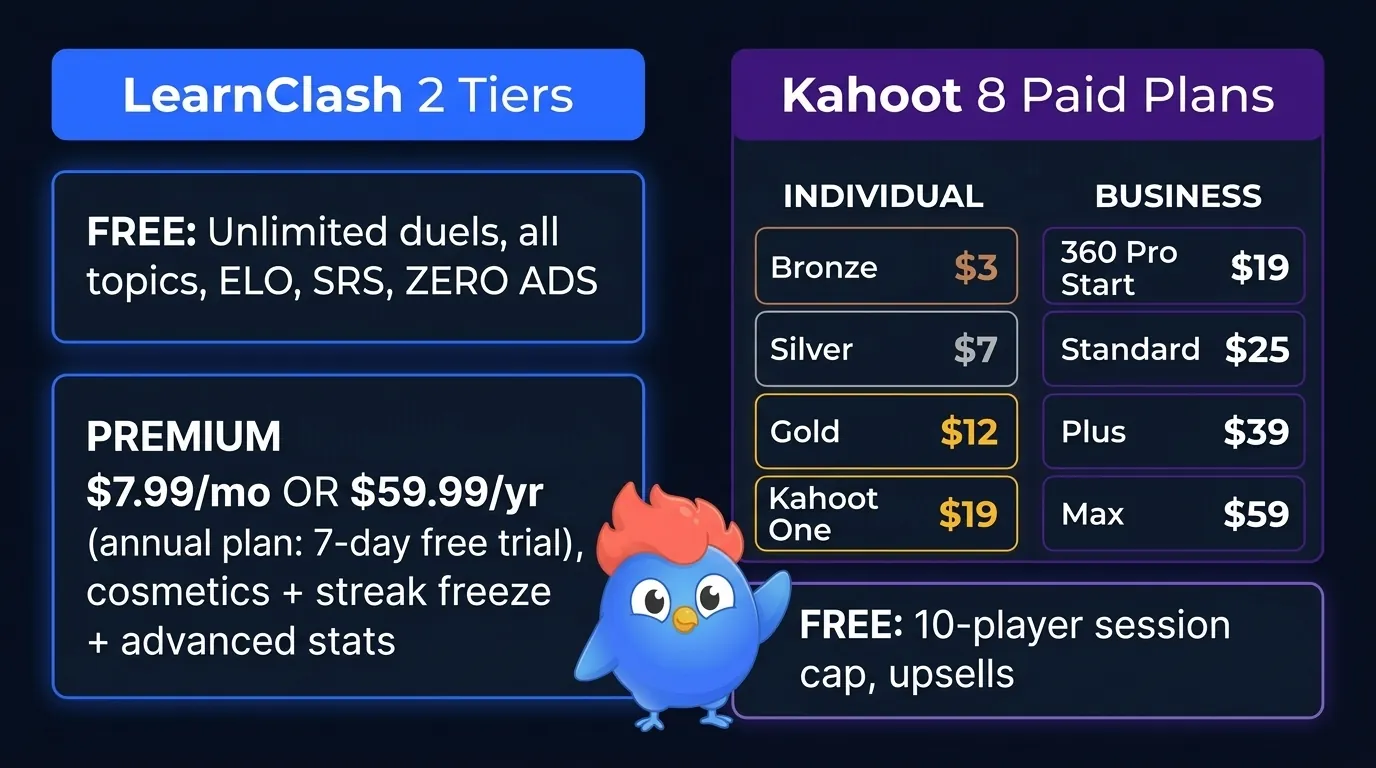
| Plan | LearnClash | Kahoot |
|---|---|---|
| Free | Daily duels, all topics, ELO, SRS, zero ads | 10-player live session cap, basic kahoots |
| Entry individual | $7.99/mo Premium | $3/mo Kahoot+ Study Bronze |
| Mid individual | $7.99/mo | $7-$12/mo Silver / Gold |
| Top individual | $59.99/yr Premium (7-day trial) | $19/mo Kahoot One |
| Entry business | N/A | $19/mo 360 Pro Start ($228/yr) |
| Mid business | N/A | $25-$39/mo Standard / Plus |
| Top business | N/A | $59/mo Max ($708/yr) |
Kahoot’s list prices move more than you would guess. On our July 5, 2026 re-check of the plans page, the Silver plan showed strikethrough promo pricing ($9 cut to $7), so treat the individual-tier numbers as a snapshot, not a contract. One threshold has stayed stable across our checks: AI generation starts at the $3/month Bronze plan. The player cap, meanwhile, is a free-personal-tier limit rather than a hard paywall: verified teachers already host 40 free, Kahoot+ Bronze at $3 lifts the cap to 50, and for business accounts larger rooms start at $19/month with 360 Pro Start.
Two structural differences matter more than any single price. First, every paid Kahoot tier bills annually with auto-renew on by default, and complaints on Kahoot’s Trustpilot page through 2026 repeatedly describe surprise second-year charges after the 14-day refund window. LearnClash Premium offers monthly and annual options side by side at signup.
Second, Kahoot monetizes by gating features; LearnClash monetizes cosmetics, profile control, and advanced stats while the learning engine stays free. That was a deliberate pricing decision, not an accident of youth.
For another classroom-quiz pricing breakdown, see Kahoot vs Gimkit.
Kahoot 360 Spirit AI: The 25-Seat Enterprise Floor
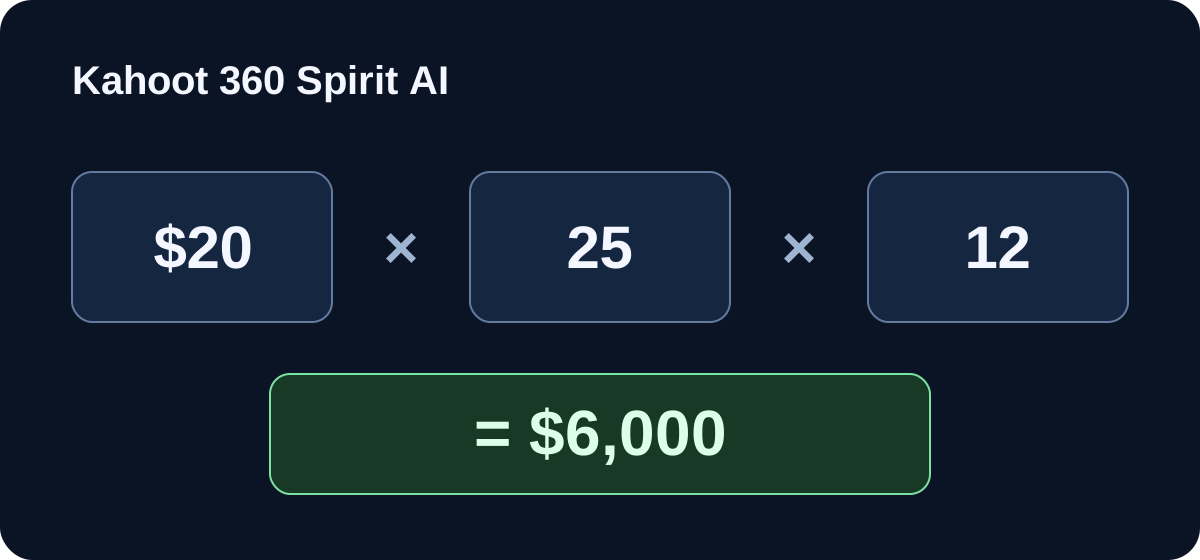
Kahoot’s enterprise AI tier is worth a section because the pricing model, not the feature list, is the story. Kahoot published Kahoot 360 Spirit AI at $20 per license per month with a 25-license minimum, which puts the smallest possible contract at $6,000 a year, and Spirit Premium at $25 per license ($7,500 a year). Annual billing only.
Those are the last published numbers, not necessarily today’s quote. When we re-checked kahoot360.com on May 22, 2026, Spirit no longer appeared on the public pricing matrix at all: the page listed Pro plans ($19 to $69 per month; kahoot360.com runs a slightly different business ladder than the four 360 Pro tiers on kahoot.com’s plans page) and routed Spirit through a contact-sales form. Third-party roundups such as TriviaMaker’s April 2026 pricing breakdown still cite the $20 figure.
The floor is the point. Under the published terms, a five-person training team pays for 25 seats to get 5 users, because the minimum applies even to the base tier. LearnClash Premium, for scale, has no seat minimum at $7.99 per month. That gap lands hardest on exactly the segment Kahoot is courting in 2026: small workplace L&D teams sitting below the enterprise line.
Who Should Choose LearnClash?
Pick LearnClash if the point is you, or you and one friend, actually learning something and being able to prove it.
Choose LearnClash if you:
- Want ranked 1v1 play with ELO matchmaking and a persistent ladder from Iron to Phoenix (2400+)
- Want questions on any topic at three difficulty levels, each fact-checked before it enters a duel
- Want spaced repetition running inside the game instead of a separate flashcard app
- Prefer asynchronous 72-hour turns that survive time zones and busy weeks
- Want to try before committing: onboarding starts new players inside a playable duel, before account creation
- Like daily quests, friend quests, and streaks (free accounts hold one streak freeze, Premium holds three)
- Want zero ads on every tier, including free
If you have used Anki or Quizlet, the review mechanics will feel familiar. The difference is a real opponent waiting on the other side of the questions, and per-topic stats plus head-to-head records that show exactly where you stand.
Where Kahoot Is Simply the Better Pick
Kahoot’s strengths are real, and pretending otherwise would make this page useless. It has been the default classroom quiz tool since 2013 for a reason.
Choose Kahoot if you:
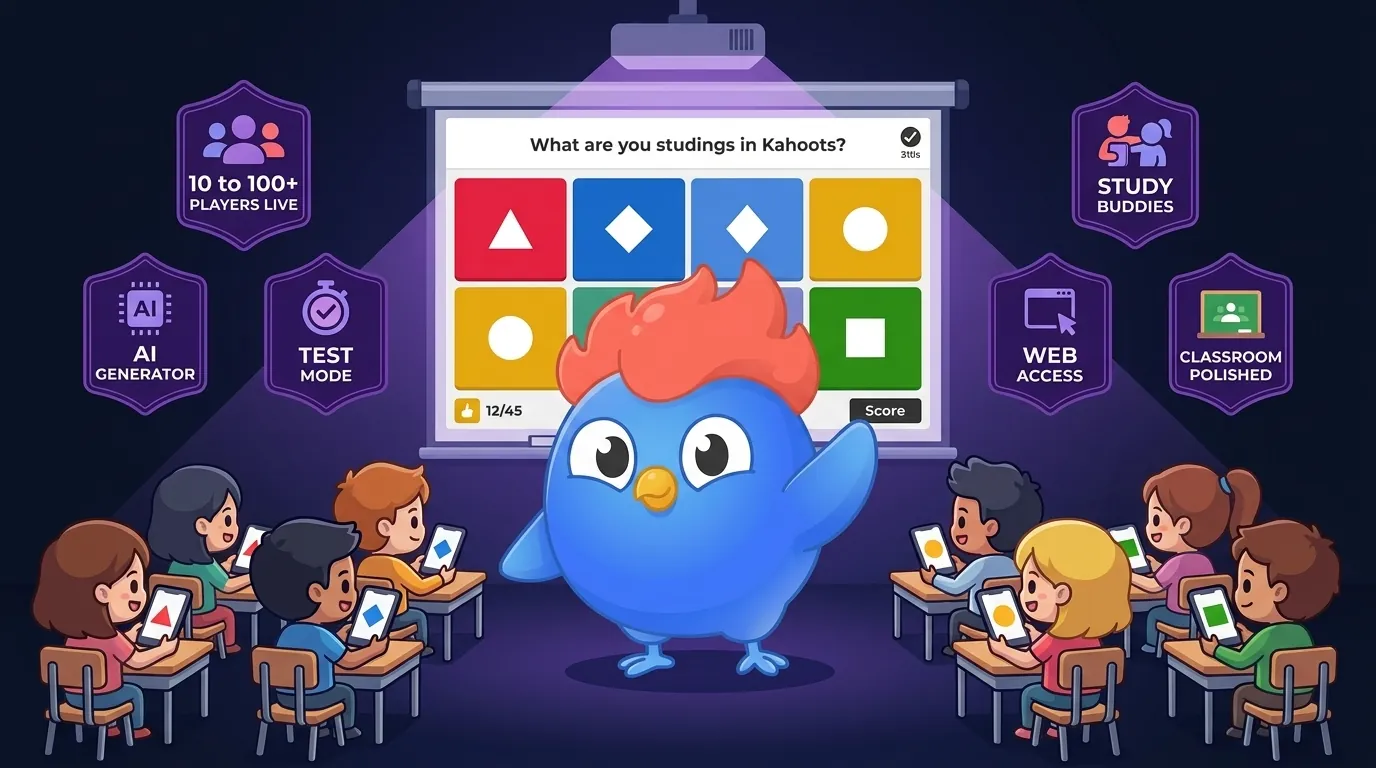
- Run live sessions for a room: classrooms, training days, events (10 players free, 40 for verified teachers, thousands on paid tiers)
- Want a shared projector screen with a host driving the pace
- Need team modes, Accuracy mode, or lecture mode for mixed-ability groups
- Want browser play with no app install
- Want a huge community library of ready-made kahoots, plus AI generation from PDFs and notes on paid plans
For adjacent matchups, see Kahoot vs Quizlet, our 10 best Kahoot alternatives, the wider best trivia apps of 2026, or LearnClash vs Quizizz for another classroom contender.
Here is the honest version, from the person who builds the competitor. Teachers sometimes ask me whether LearnClash can replace Kahoot for a Friday review session, and the answer is no. We made a deliberate design decision early: LearnClash is asynchronous 1v1 with skill matchmaking, so there is no host role, no shared screen, and no way to push thirty people through the same question at the same second.
Kahoot is host-led and synchronous by design, and per its own July 2026 help pages a free account still hosts a 10-player room the moment you have a PIN and a projector, with 40 on a verified teacher account. For a classroom on a Friday afternoon, or a birthday party clustered around a TV, Kahoot is simply the better pick. Recommending anything else would be selling you something.
What I will claim is everything after the room goes quiet. A Kahoot podium evaporates when the host ends the session, while a LearnClash duel leaves behind a rating that carries into the next match and a review queue that keeps re-serving whatever you missed until you own it. Choose by what you want left over when the game is done.
Frequently asked questions
Is LearnClash a good Kahoot alternative for friends?
For 1v1 ranked play between friends, LearnClash is purpose-built where Kahoot is not. LearnClash runs asynchronous 18-question duels with ELO matchmaking and a 72-hour turn window. Kahoot is designed for live group sessions on a shared screen and caps free play at 10 players per session (40 for verified teachers).
Does Kahoot have AI-generated questions like LearnClash?
Yes, since 2023, expanded with the September 2025 study-tools pack, but the Kahoot AI Generator is gated to paid plans. LearnClash generates fresh validated questions on demand, free on every tier. The cheaper classroom-friendly path is Khanmigo's free Blooket Generator, live since January 21, 2025, which builds AI quizzes with no usage cap.
What is the cheapest way to get free AI quiz generation in 2026?
Two free options outrank Kahoot's paywalled AI Generator in 2026. Khan Academy's Khanmigo + Blooket integration (live since January 21, 2025) builds quizzes on any topic and exports to Blooket free with no usage cap. LearnClash generates fresh validated questions in the free tier, no setup.
Is Kahoot 360 Spirit AI worth the 25-license minimum?
Kahoot published Spirit AI at $20 per license per month with a 25-license minimum, a $6,000-a-year floor ($7,500 for Spirit Premium at $25 per license); since spring 2026 the tier is quoted through sales rather than public pricing. For individuals or sub-25-person teams, LearnClash Premium at $7.99/month gives every Premium feature.
Is LearnClash free compared to Kahoot?
Both apps have free tiers. LearnClash free includes free daily duels, all topics, ELO rankings, full spaced repetition, and zero ads. Kahoot free limits live hosting to 10 players (40 on the free teacher plan) and gates AI generation to paid plans. LearnClash Premium costs $7.99/month or $59.99/year, with a 7-day free trial on the annual plan.