
11 Games Like Gimkit: Classroom and Study Options
Compare 11 games like Gimkit for classes, homework, flashcards, and personal duels. See listed limits and choose the right format.

A class of thirty needs a different game from two friends who want a rematch. That distinction matters more than whether a tool looks like Gimkit.
These eleven options cover classroom games, assignments, flashcards, presentations, and personal quiz practice. Start with the task you need to run, then check the account and device needs, because a free label alone does not tell you whether the whole class can join with the phones, school tablets, or shared screen you plan to use. Check the fit first.
I build LearnClash. It appears here as an unranked personal-practice option, with its limits stated below. This September 22, 2026 correction uses vendor help pages and our product records. It removes the earlier unsupported number-one ranking, head-to-head learning claims, and claims of superior resistance to cheating. We did not conduct a controlled comparison of these products.
Eleven Options, Different Jobs
The table groups tools by their listed format. It is not a leaderboard. Start with the first column, because a classroom reporting system and a personal quiz app solve different problems even when both ask multiple-choice questions.
| Your main task | Options to inspect | Important detail |
|---|---|---|
| Host a classroom game | Blooket, Kahoot | Check the mode, account type, and player cap |
| Assign work and inspect responses | Wayground, Quizalize | Reports and accommodations depend on plan and region |
| Run a collaborative STEM activity | Mission.io | Inspect the mission, age range, setup, and access offer |
| Reuse questions in different activities | Wordwall | Basic creation allowance is small |
| Play from one shared screen | Baamboozle | Teacher-led team play differs from individual assessment |
| Study with flashcards and practice | Knowt, Quizlet | Access varies by feature and account or class setup |
| Poll a meeting audience | Mentimeter | Presentation response is not a school mastery report |
| Play personal skill-rated quiz duels | LearnClash | Ages 13+, not a classroom host or assignment system |
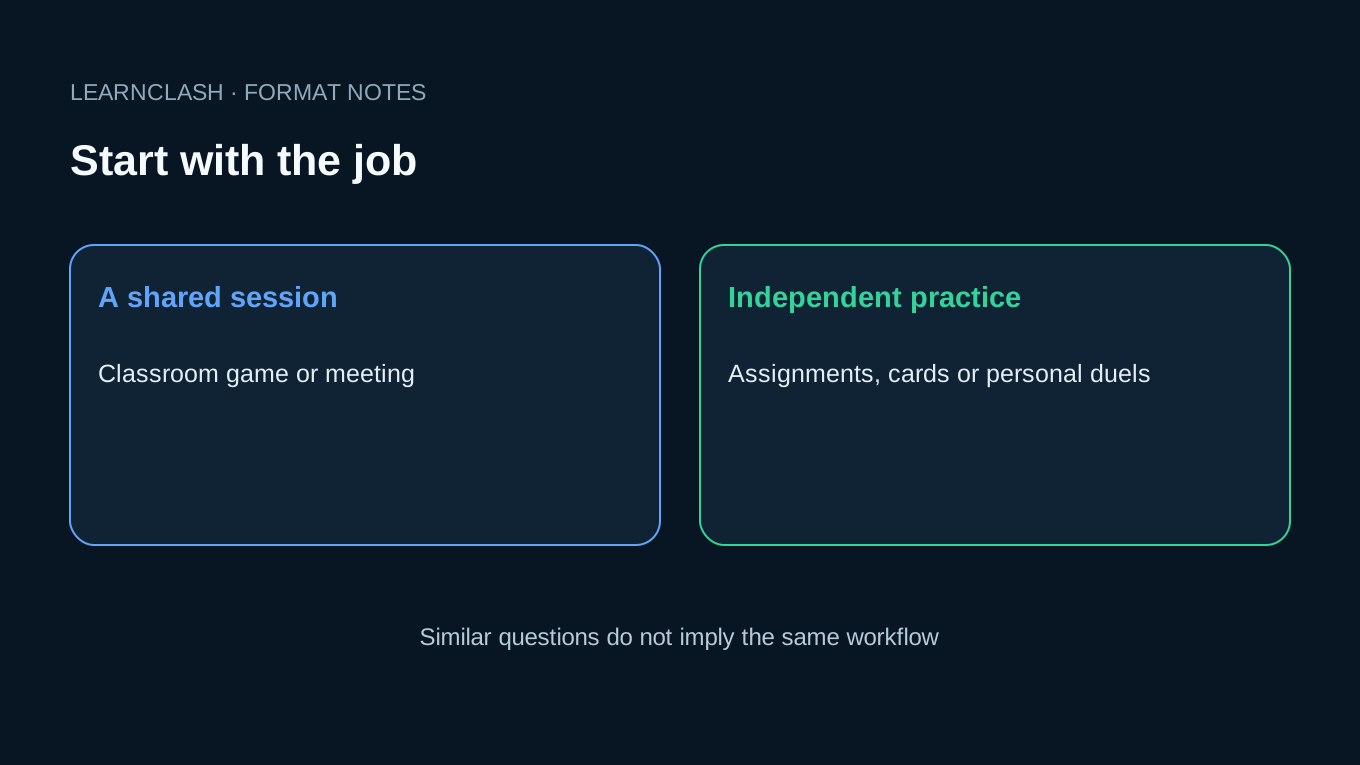
All eleven remain in the list because they answer at least one of those jobs. Inclusion does not mean we have tried every mode or that one product delivers stronger learning outcomes. Where the current help pages do not establish a comparison, we leave the comparison open.
A useful first filter is the device situation. One classroom screen points toward a hosted team activity, a device per student opens more solo routes, and two phones after work point toward something else again, so the first thing to count is what the group has and how it wants to play. Start with the room. Do that filter before comparing prices, otherwise a cheap subscription can still be the wrong purchase.
Check Gimkit’s Actual Limit Before Switching
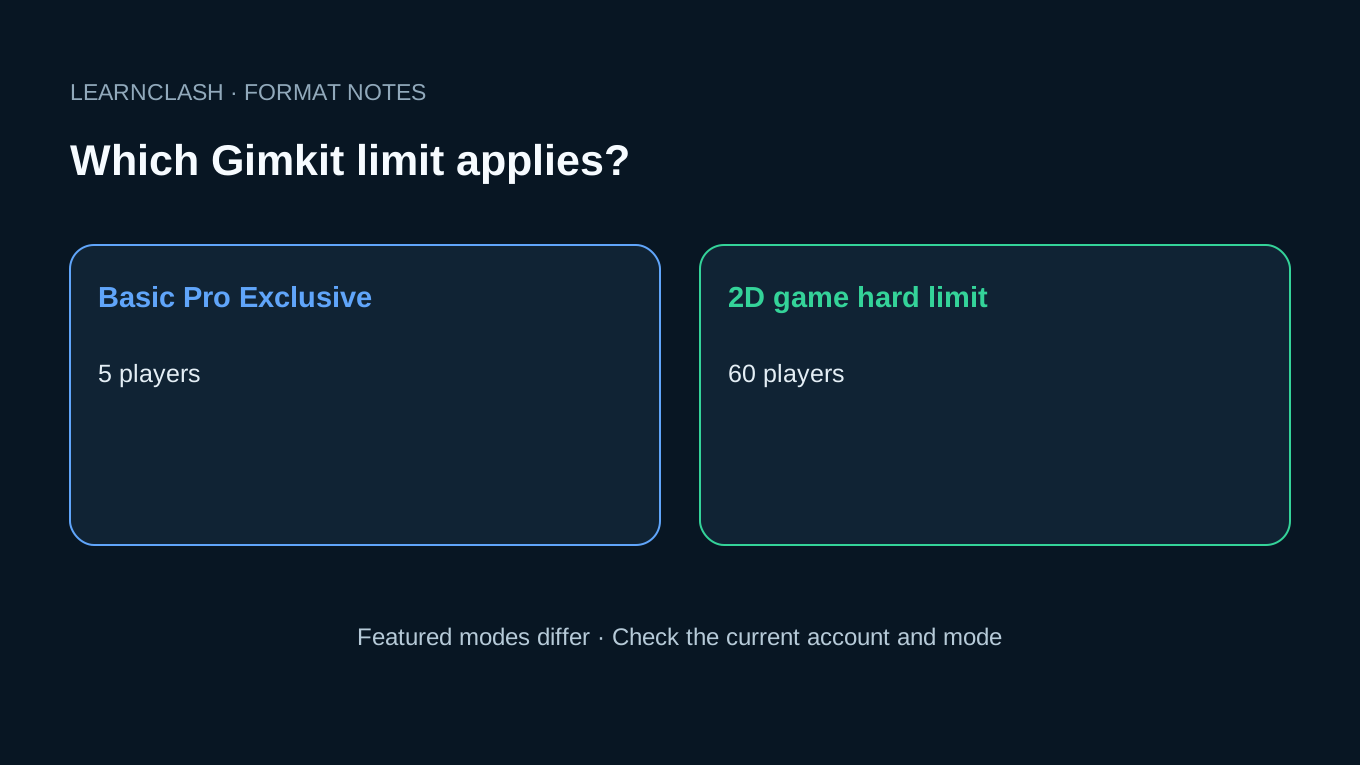
Gimkit Basic is not simply a five-player product. Its Pro FAQ distinguishes rotating featured modes from Pro Exclusive modes. The separate player-maximums page lists a five-player Basic limit for Pro Exclusives, a sixty-player hard limit for 2D modes, and a five-hundred-player overall live limit.
That distinction changes the decision. If the featured mode already works for your group, you may not need an alternative. If you need a particular paid mode every week, compare the cost of Pro with the cost and preparation involved in moving your question sets elsewhere.
The current FAQ lists Pro at US$14.99 monthly or US$59.88 annually. Those are different billing commitments. Its annual-plan explanation contains a conflicting US$59.98 example; use the explicit plan listing and confirm the checkout total before purchase. Local taxes and currency can change what you pay.
Our earlier article treated a seasonal cosmetics pack as a reason to choose a learning workflow. That was not useful for this decision. We have removed the expired season timeline. The questions to ask are simpler: can your group join, can you use the intended mode, and can you retrieve the results you need afterward?
Keep or switch?
Say your class has thirty pupils, you have one lesson left this week, and the free mode already lets the whole group join with the questions you want to use: in that case, try the lesson you planned before you pay for a new tool or move every set. Start there.
For a more focused account of the product, see our Gimkit review. Treat any price there as dated evidence too; the current vendor account and checkout are what determine your available plan.
Blooket: A Classroom Arcade Route
Blooket’s free-plan help page lists unlimited question-set creation and games with up to sixty people. Plus supports more players in many modes, with exceptions. The free allowance can therefore fit a class that cannot use its preferred Gimkit Pro Exclusive mode on Basic.
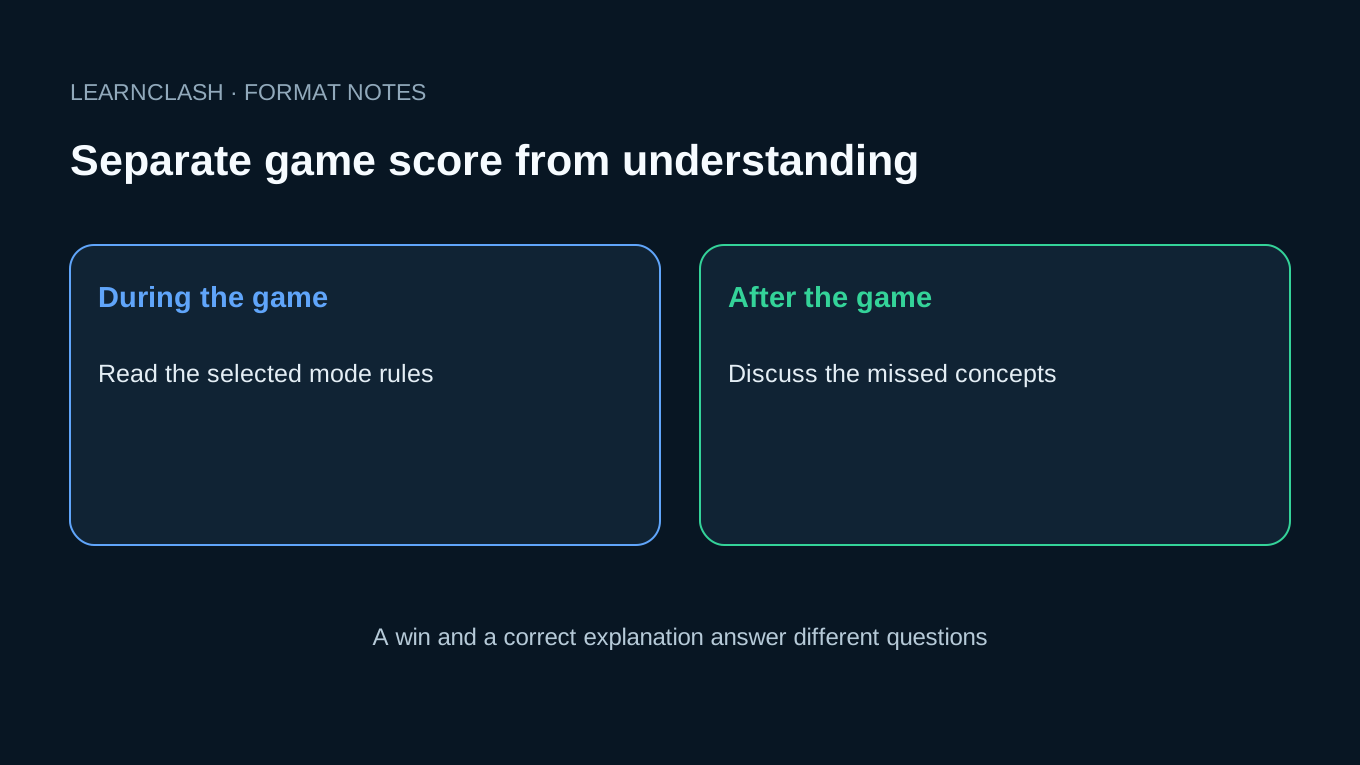
Mode matters. A game can reward answering questions while also rewarding choices inside its arcade rules. Before using the final score as an assessment, check what contributes to it. A student winning a game and a student understanding every question are not always the same result.
For a first lesson, use a small set of questions you already know well. Read the answer choices yourself, run the joining flow, and decide when you will discuss mistakes. If the game consumes your whole time slot, reserve that discussion for a separate activity. That is a planning choice, not a measured disadvantage of Blooket.
Our previous table marked rivals’ review functions as absent or manual without enough evidence for each mode and plan. Those blanket cells are gone. If reviewing mistakes next week is essential, inspect the exact homework or practice workflow you intend to use and make it part of your lesson plan.
Leave time for the answer
For a ten-minute round with a class, choose a set you can read and discuss before the bell, then keep one missed question on the board so each child can say why an answer fits instead of just watching the game announce who won. The score is a start.
Blooket belongs on the shortlist for teachers who want a shared game with a large free player allowance. It is a less direct match for someone who specifically wants a personal skill ladder on a phone. The Blooket and Gimkit comparison covers that classroom choice in more detail.
Wayground and Kahoot: Decide Who Controls the Pace
Wayground, formerly Quizizz, offers live and assigned activities alongside reports. Its Starter-plan help page warns that feature availability can vary by region. Check your actual teacher account before planning a lesson around a particular accommodation, question type, or report.
The practical question is what students do while others are still answering. Do they wait for a host, continue at their own pace, or work through an assignment later? Then ask what the teacher sees afterward. A list of scores may be enough for a casual review, while a lesson intervention needs detail about which concept caused trouble.
Kahoot supports hosted games and solo study. Its mobile-app page includes flashcards and individual practice, so describing it as live-only would be wrong. A group session is only one part of its format.
Kahoot’s player guide, updated September 17, lists ten players for the personal Go plan and forty for K-12 Go. Business accounts have different restrictions. Do not carry the personal limit into a teacher comparison or assume a school plan covers a company event.
Plan for the early finisher
If one pupil answers the first question while a friend is still reading it, decide in advance whether the first child waits, moves on, or sees a short task, because the flow you choose should give both children useful work without forcing the slower reader to guess. Ask what they need.
Check the scoring settings too. A visible timer, a time-based bonus, and a deadline are different things. Read the mode’s rules before promising a pressure-free activity. We have not compared stress or answer speed across these apps. Choose the setup that fits your group and allow time to explain it.
Quizalize and Mission.io: Start With the Lesson
Quizalize combines quiz activities with teacher-oriented progress features. Its published Basic allowance includes twenty students in one class and five saved quizzes. A teacher with more students should check the paid plan before committing to the format, rather than discovering the limit while everyone is joining.
When considering a mastery dashboard, look past the label. Try the question types you need, find the response view, and work out what action you would take from it. If the lesson objective is distinguishing two similar concepts, a score alone may not show why a student chose the wrong one. You still need a useful question and an explanation.
Mission.io takes a different route: collaborative, story-led STEM missions. That can suit a planned group activity more closely than a quick replacement for a familiar quiz. Inspect a sample mission and its setup needs before treating it as a drop-in Gimkit substitute.
Mission.io’s own evidence page reports ESSA Level II validation by Instructure in June 2026. This is an attributed vendor evidence claim. It is not a LearnClash-versus-Mission.io experiment or proof that every activity will produce the same result in every school.
Choose the evidence you need
Suppose the class needs to learn why ice floats: a team may reach the right answer after a good debate, but if your next lesson depends on what each child knows alone, ask each one for a brief answer before you turn that team result into a mark. Two tasks, two views.
Both tools belong in a classroom decision. Neither should be selected merely because its screenshots look more like a game. Compare the lesson, devices, access, and reporting you actually need, and ask whoever will run the activity whether the setup fits the timetable.
Wordwall and Baamboozle: Preparation and Shared Screens
Wordwall turns content into activity templates. Its Basic-plan explanation sets a maximum of three created activities, including activities later deleted. Editing an existing activity is different from gaining a fresh creation allowance.
That detail matters if you plan a new resource for each lesson. Before subscribing, make one sample activity and see whether the available template handles your answer format. A vocabulary matching exercise, a question with several correct answers, and a short written response are different needs. A large template catalogue does not guarantee that the free template you need is available.
Baamboozle is worth inspecting for a shared-screen team game. The teacher leads the display and teams respond together, so the practical attraction is a room that does not need a separate active device for every student. Confirm the selected game’s controls and plan in the classroom you will use.
There is a trade-off to make explicit. A team discussion can be valuable, but the team’s answer does not tell you what every individual knew before the discussion. If you need individual evidence, add a short individual response outside the team game. That applies to any shared-answer format, not just Baamboozle.
One screen can be enough
When a room has one screen and no spare tablets, a game led by the teacher can still give each team a turn, as long as you make space for the quiet child to speak and do not let the fastest voice give every answer for the group. Set that rule first.
For a teacher with a short preparation window, these tools answer a more concrete question than “which app has the most modes?” They offer ways to use content with the devices and time already available. Our quiz creation guide discusses the content side.
Knowt and Quizlet: Study Sets Beyond the Live Round
Knowt offers flashcards and practice tools. Quizlet offers study sets, Learn, Test, and other study formats. They belong here for the reader whose real goal is solo practice after class, even though flashcard study does not reproduce Gimkit’s strategy loop.
Start with the material. Can you find or create a set that matches your course? Are the definitions specific enough, and do the questions require recall rather than recognition of a familiar phrase? Check several cards against your actual notes before trusting a shared set. A polished presentation does not validate the answers.
Quizlet access needs an important detail. Its classroom-access guide says logged-in students can receive unlimited, ad-free Learn and Test access when they belong to a teacher-managed class and open the class’s sets from the class page. That is different from an unaffiliated free user’s access.
We have not established equivalent limits across every Knowt and Quizlet plan, and we do not label unlisted functions as missing. Inspect the intended workflow in the relevant account. If you need offline access, a particular practice mode, or a file import, check that exact requirement before paying.
Inspect one useful set
Take five terms from the notes you will need next week, write what each one means in your own words, then check the set against those notes before choosing a paid mode, because a smart study tool can still help you rehearse a wrong answer if the source set is wrong. Content comes first.
These tools are plausible options when the learner wants to return to a defined set of material. The decision is about control over that material and the practice format. It is not evidence that one app produces a measured retention advantage over the others.
Mentimeter: When the Room Is a Meeting
Mentimeter is a presentation and audience-response tool. Polls and interactive slides can be a better match for a meeting than a classroom arcade game. It remains in this list because some readers searching for Gimkit alternatives are really looking for a way to involve an audience.
Check the current plan’s response accounting. A monthly audience allowance, a cap per presentation, and a cap per live session are different restrictions. We are not treating an older “fifty players” figure as a universal current limit, because the useful number is the allowance attached to your actual account and event format.
For a meeting, define what you will do with the answers. If you want to collect opinions, an anonymous poll may fit. If you want to check a shared fact, explain the correct answer afterward. If the response will affect an employee evaluation, a casual game is not a substitute for an appropriate assessment process.
Also plan for the person who cannot join immediately. Display the question, allow time for the connection, and decide whether a spoken or written response can be included. These are hosting decisions that a tool catalogue cannot make for you.
Know what a vote means
If the room votes on which task to tackle next, keep that vote separate from a quiz with a right answer, make clear who will see the result, and tell people how their choice will be used so the poll does not feel like a hidden check of their work. Keep the purpose clear.
Mentimeter is not the same kind of purchase as a flashcard subscription or a personal quiz app. Compare it with the meeting you need to run, including the host’s presentation flow and the way players will respond.
Where LearnClash Fits, and Where It Does Not
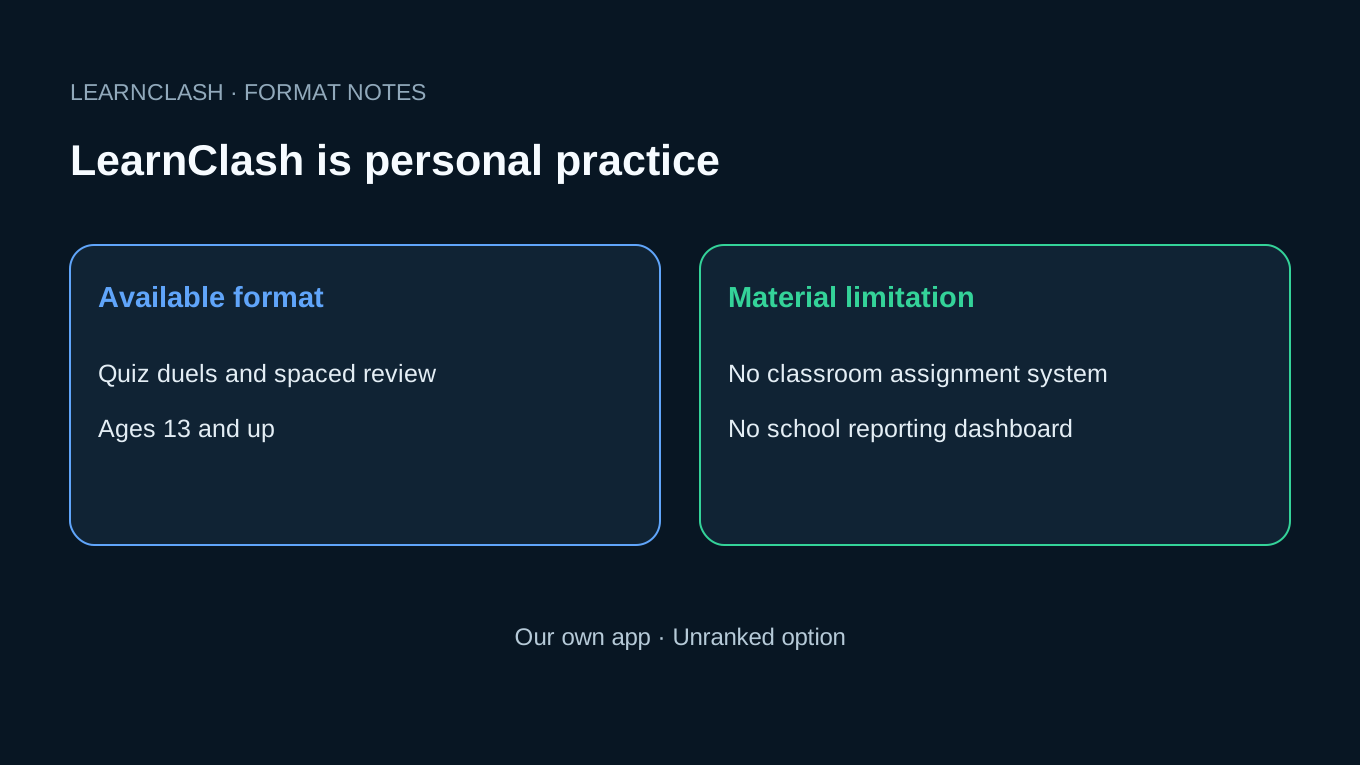
LearnClash is our own app for personal competitive practice, ages thirteen and up. Two people play a quiz duel on chosen topics. A standard duel contains six rounds of three questions per player; ordinary turns allow up to seventy-two hours. Correctness drives the score, but questions still have a time limit. “No speed bonus” must not become “no timer.”
The app combines an ELO skill rating with spaced repetition. Missed questions can return for review through its learning system. That describes product behavior, not a measured improvement over Gimkit, Kahoot, or a teacher’s lesson. We removed the earlier claim that LearnClash is the only option that helps with later practice.
The free tier includes daily duels, all topics, and Solo with a daily session allowance after the starter sessions. Premium expands Solo and other features. Both tiers have resource limits and neither contains ads. “All topics” does not mean unlimited topic creation, unlimited play, or unrestricted tutoring. The pricing page explains the current offer.
What it does not provide is just as relevant: LearnClash is not a teacher-managed classroom lobby, a roster-and-assignment system, or a replacement for a school reporting dashboard. It also is not an app for younger children. For those needs, start with the classroom options above.
Try the format that interests you
If you want a short quiz with a friend after work, pick a topic you both like and finish a duel before deciding whether the score and review make you want another round, rather than buying a plan on the strength of a claim that one app is best for all learners. See how it fits.
For an individual who enjoys choosing a topic, playing an opponent, and returning to missed questions, try LearnClash. For a teacher preparing tomorrow’s class, begin with the player flow and the lesson objective. The right choice is the one that fits that specific job, with limits you understand before the first round.
Frequently asked questions
Which game like Gimkit should I choose?
Choose by task: hosted classroom play, assignments, flashcards, presentations, or personal practice. The list has no overall winner. LearnClash is our own app and appears as an unranked personal option.
What changed in this comparison?
The September 22, 2026 correction removes unsupported self-ranking, learning comparisons and anti-cheating claims. It distinguishes listed features, account limits and facts not verified.
Can a whole class use Gimkit for free?
It depends on the mode and account. Basic featured modes differ from Pro Exclusives, which have a five-player Basic limit. Gimkit also documents separate hard limits for 2D and overall live games.
Which free alternatives work in a classroom?
Blooket and Kahoot are worth checking for live games; Wayground and Quizalize for teacher workflows. Check the precise account, mode and class size first. LearnClash is personal practice, not a classroom host.
Which game is hardest to cheat on?
We have not conducted a head-to-head security or cheating-resistance assessment. A private or asynchronous game is not proof of immunity. Do not use this article to select a high-stakes assessment platform.