
How to Study Effectively [9 Methods Ranked]
How to study effectively with 9 ranked methods. See why testing and spacing beat rereading, plus a 3-minute LearnClash routine.

Your notes can feel familiar and still vanish on test day.
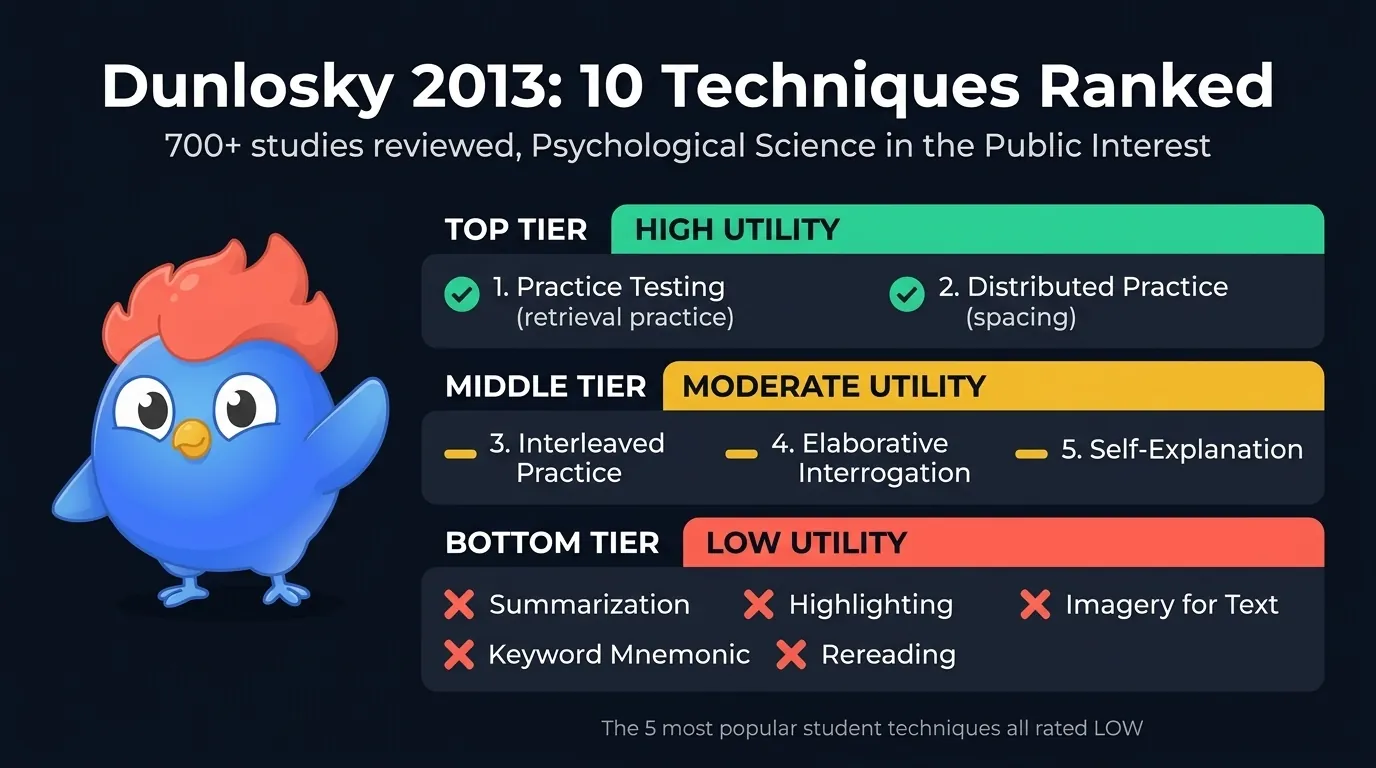
Studying effectively means ranking your study time by evidence, not effort. Start with retrieval practice and spaced practice, the only two techniques Dunlosky et al. (2013) rated high utility in their review of 10 study methods. Then add interleaving, Feynman explanations, dual coding, focus blocks, exam relearning, sleep, and exercise.
This guide ranks 9 methods by research strength and shows where LearnClash fits: 18-question duels, 6-question Solo sessions, and a 3-stage SRS that brings misses back at 7 and 90 days. Try the routine in a 3-minute study-techniques duel →
Learning sticks when a session makes you recall something effortfully, shows you where you were wrong, then asks again after a gap. Another smooth read of familiar notes does none of that, however productive it feels while you do it.
| # | Technique | Utility Rating | Time Cost | What To Do |
|---|---|---|---|---|
| 1 | Retrieval practice | High | Low | Close the book, try to recall |
| 2 | Spaced practice | High | Low | Review at expanding gaps |
| 3 | Interleaving | Moderate | Low | Mix topics in one session |
| 4 | Feynman technique | Moderate | Medium | Explain it like you’re teaching a 10-year-old |
| 5 | Dual coding | Moderate | Medium | Pair text with diagrams |
| 6 | Focused blocks | Strong | Low | 25 or 50-minute blocks, no phone |
| 7 | Successive relearning | Very High (exams) | Medium | Alternate test plus study |
| 8 | Limited-time study windows | Strong | Low | Short, dense sessions beat skipped long ones |
| 9 | Sleep + exercise stack | Strong | Built-in + Low | Review before bed, walk before study |
What Is the Best Way to Study?
The strongest study pattern is: test yourself, check feedback, and revisit the same material after a delay. That pair, retrieval practice plus distributed practice, has the best evidence across Dunlosky et al.’s review, and it is the pattern LearnClash automates as 18-question duels, 6-question Solo sessions, and SRS reviews at 7 and 90 days.
The popular methods fail for one reason: they manufacture a feeling of knowing without building any real recall. Highlighting, rereading, and summarizing produce what Robert Bjork calls an illusion of competence. Text that looks familiar tricks your brain into thinking it’s stored, when nothing was ever pulled back out.
The gap between what students do and what works has been measured directly. Karpicke, Butler, and Roediger (2009) surveyed 177 college students about their study strategies. 83.6% listed rereading notes or textbook, 54.8% named it their number one strategy, and only 10.7% reported practicing recall by testing themselves. Hartwig and Dunlosky (2012) later found that self-testing was positively associated with GPA. That gap is exactly why Dunlosky’s ranking matters:
| Rating | Technique | What It Means |
|---|---|---|
| High | Practice testing | Self-quizzing, flashcards, recall attempts |
| High | Distributed practice | Spacing reviews across days and weeks |
| Moderate | Interleaved practice | Mixing subjects within a session |
| Moderate | Elaborative interrogation | Asking “why?” and “how?” while studying |
| Moderate | Self-explanation | Walking through material step by step |
| Low | Summarization | Writing summaries of what you read |
| Low | Highlighting | Marking text with a highlighter |
| Low | Keyword mnemonic | Linking words to mental images |
| Low | Imagery for text | Creating mental pictures while reading |
| Low | Rereading | Reading the same text multiple times |
Read the table as a sorting test. A good habit makes you retrieve, explain, discriminate, or sleep on the material. A weak one skips all four and still feels productive.
“Practice testing and distributed practice received high utility assessments because they benefit learners of different ages and abilities and have been shown to boost students’ performance across many criterion tasks and even in educational contexts.” Dunlosky, Rawson, Marsh, Nathan, & Willingham, Psychological Science in the Public Interest (2013)
The research keeps landing in the same place: active retrieval at spaced intervals. Every other technique below either feeds those two or loses to them.
1. Test Yourself Instead of Rereading
Forced recall strengthens memory whether you answer right or wrong, because the retrieval effort itself creates the trace. The landmark experiment looks almost too simple to matter. Karpicke and Roediger (2008) had students learn Swahili word pairs, then either keep testing themselves on every pair or shift pairs to restudying once learned. All groups looked identical during learning, and all predicted they’d remember about half. A week later, the repeated testers recalled about 80% and the restudy group 36%.
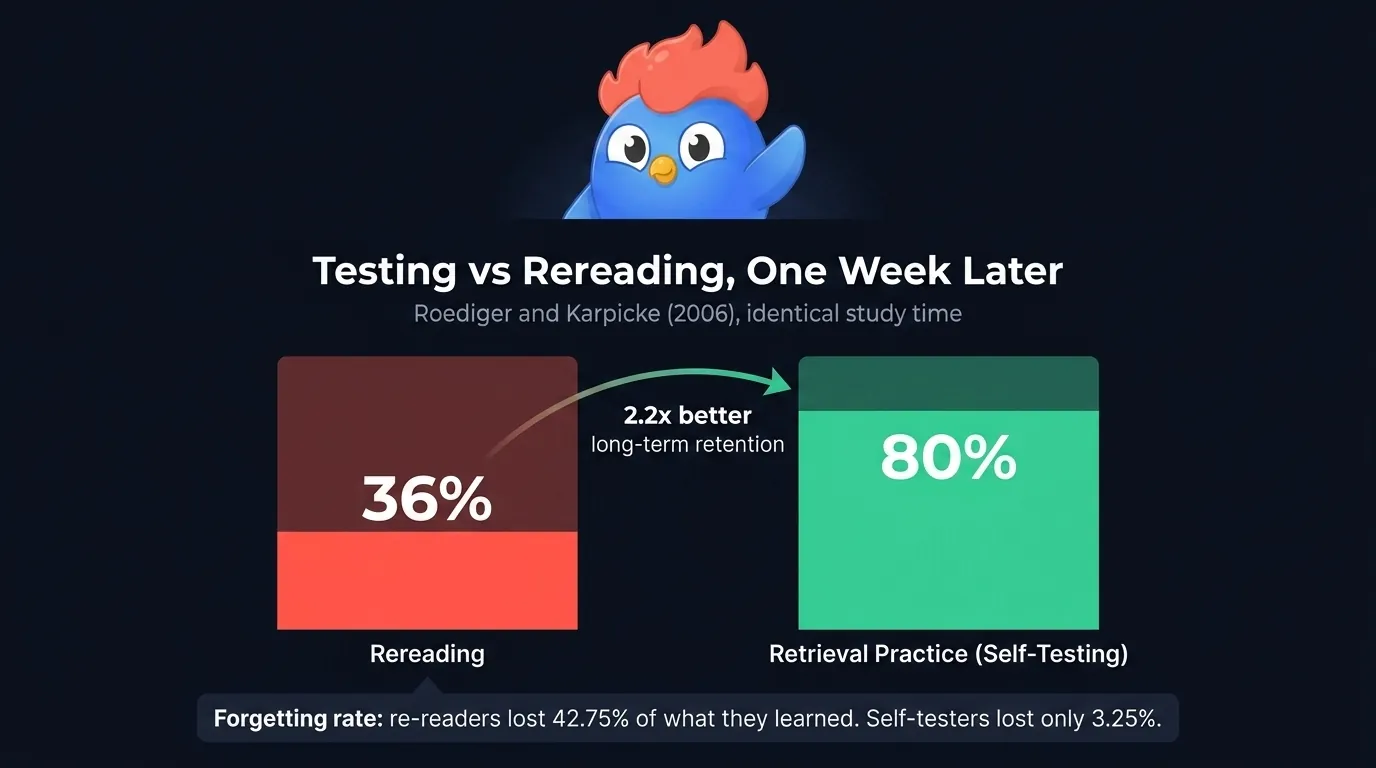
The same lab had already shown the mechanism a year earlier. In Karpicke and Roediger (2007), repeatedly recalling already-learned words improved one-week retention by more than 100% compared to dropping those words from further testing, while repeatedly restudying them added almost nothing. Extra reads of known material were close to worthless; extra recalls of the same material doubled what survived.
Rereading feels convincing for a reason. The text looks known, the ideas seem clear, and you close the book sure you’ve got it. But recognition and recall run on different machinery: you can recognize a face and still blank on the name. Recall flips the job, forcing you to rebuild the whole answer from memory with nothing on the page to lean on, and that rebuilding effort is the learning.
In LearnClash, every duel is 18 forced recall attempts and every Solo session is 6 more, so the testing happens without a separate flashcard stack. For the full mechanism, see why quizzes beat rereading. And for a playful production-data version of hypercorrection, 12 questions people get wrong shows how confident misses become sticky memory hooks.
2. Space Your Reviews Over Time
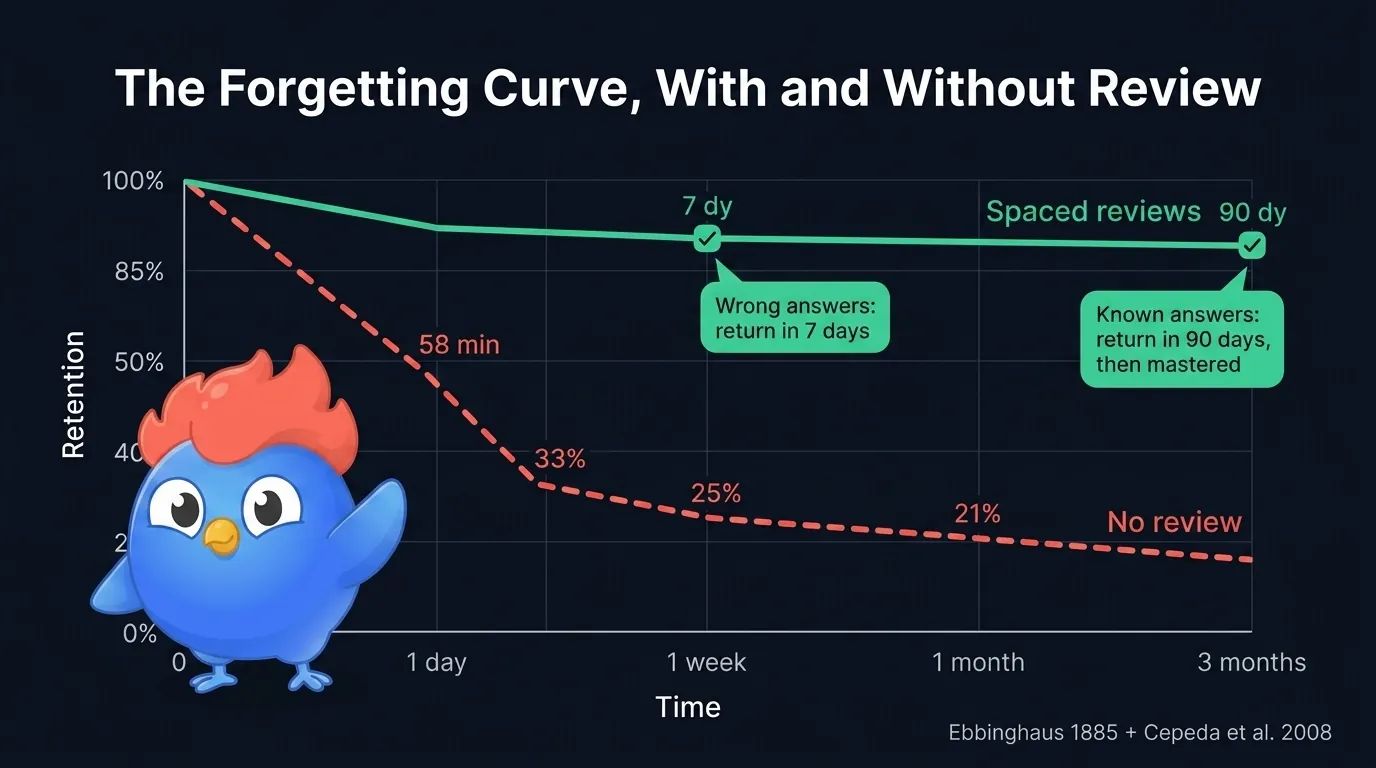
Spaced practice works because each review lands after some forgetting has set in, which turns the review into another effortful retrieval instead of a comfortable repetition. One number anchors the whole topic. Cepeda et al. (2008) tested over 1,350 people across gaps up to 3.5 months, with final tests up to a year out. The optimal gap shrank as a share of the delay, from roughly 20 to 40% of a one-week test window down to 5 to 10% of a year; the flat 10-to-20% figure you’ll see quoted is a rule of thumb distilled from that data. The practical translation holds either way: for a test next week, review after 1 to 2 days. To hold material for a year, put the first review at 3 to 4 weeks.
| Retention goal | Optimal first review | Second review | Third review |
|---|---|---|---|
| 1 week (next exam) | 1 to 2 days | 3 to 4 days | Day 6 |
| 1 month | 3 to 5 days | 10 to 14 days | Day 25 |
| 1 year | 3 to 4 weeks | 8 to 12 weeks | 6 months |
| Permanent | 1 month | 3 months | 6+ months |
That scaling rule is also the fair verdict on the 3-5-7 method and its sibling, the 1-3-5-7 rule, both trending on study TikTok. They borrow the spacing principle and pin it to fixed day gaps, which works fine for an exam about 10 days out and runs far too tight for a semester. The principle is sound; the specific numbers are arbitrary.
The evidence base behind all this is unusually deep. Cepeda’s team pooled 184 articles on the spacing effect (Cepeda et al., 2006) and found spaced practice beat massed practice across the overwhelming majority of comparisons, which makes spacing one of the most replicated results in cognitive psychology. Strip the spacing out and you get cramming: dozens of repetitions crushed into one night, no forgetting in between, so your brain never once has to fight to retrieve anything, which is why crammed material rarely survives into the next semester.
LearnClash handles the scheduling through a 3-stage SRS. A missed question returns in 7 days, a known question in 90, and a mastered question rests until a miss brings it back down a stage. For the complete science plus the SM-2 algorithm story, see the spaced-repetition guide; for LearnClash’s own 7-day and 90-day retention data, the SRS retention curve. Tool shoppers can compare Anki and Quizlet or check whether Quizlet’s free tier really has spaced repetition.
3. Mix Topics Instead of Blocking Them
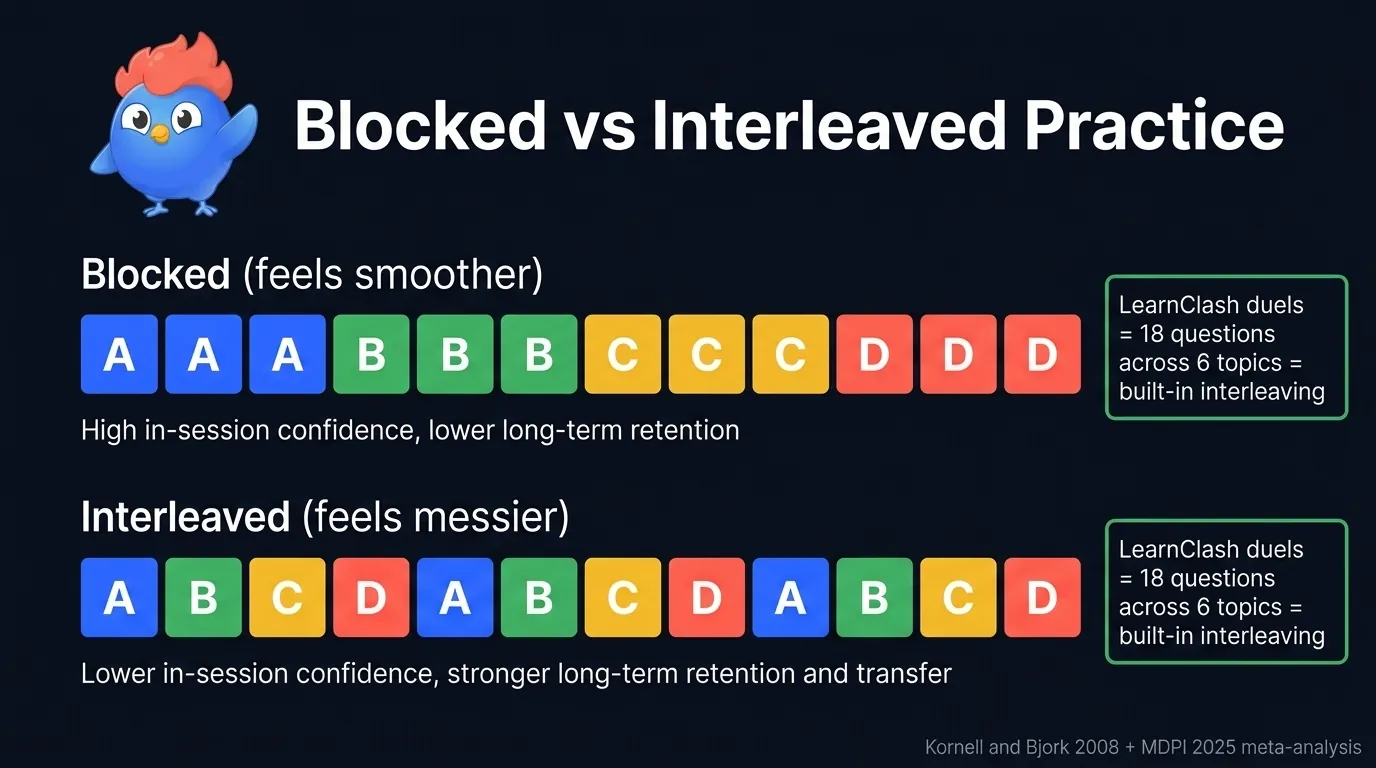
Mixed practice feels harder than blocked practice and works better. Kornell and Bjork (2008) showed interleaved practice produced better test scores even though students rated those mixed sessions as worse learning. The within-block repetition of blocked study feels smooth while you do it, then fails you at recall.
| Practice type | In-session confidence | Test performance (delayed) |
|---|---|---|
| Blocked (AAA, BBB, CCC) | High | Lower |
| Interleaved (A, B, C, A, B, C) | Lower | Higher |
The mechanism is mechanical rather than mystical. Every context switch forces a reload from memory, and that tiny effort of pulling up the right rule for a new kind of problem is itself a hidden round of retrieval practice. Blocked study skips the reload, letting you coast on short-term recall that never encodes.
One honest caveat: interleaving is not universal. A 2025 experiment in Behavioral Sciences found the winner depends on your learning strategy. Interleaving wins when you memorize similar items you’ll need to tell apart later, like which painter produced which style; blocking wins when you hunt for a single rule across examples. For most exam prep, which is discrimination-heavy, interleaving holds.
You don’t have to engineer any of this yourself: a standard LearnClash duel deals 18 questions in six rounds, each round bringing a fresh topic pick, so your brain keeps switching subjects inside a single match. A July 2026 production export, analyzed in the interleaving deep dive, found four out of five completed duels spanned six distinct topics; the rest used the topic lock to block on one subject deliberately.
4. Teach What You Learn
Explaining a concept in plain words is the fastest way to find out whether you actually understand it. The Feynman technique, named after the physicist though built from ordinary elaboration research, runs in four steps:
- Choose a topic. Something you just studied or want to test your understanding of.
- Explain it out loud in simple words. Write it down, record a voice memo, or explain it to a friend. No jargon allowed.
- Find the gaps. Wherever you stumble, get vague, or reach for a technical term you can’t unpack, that’s a gap. Flag it.
- Go back and simplify. Re-study the gap until you can explain it without the jargon. Loop back to step 2.
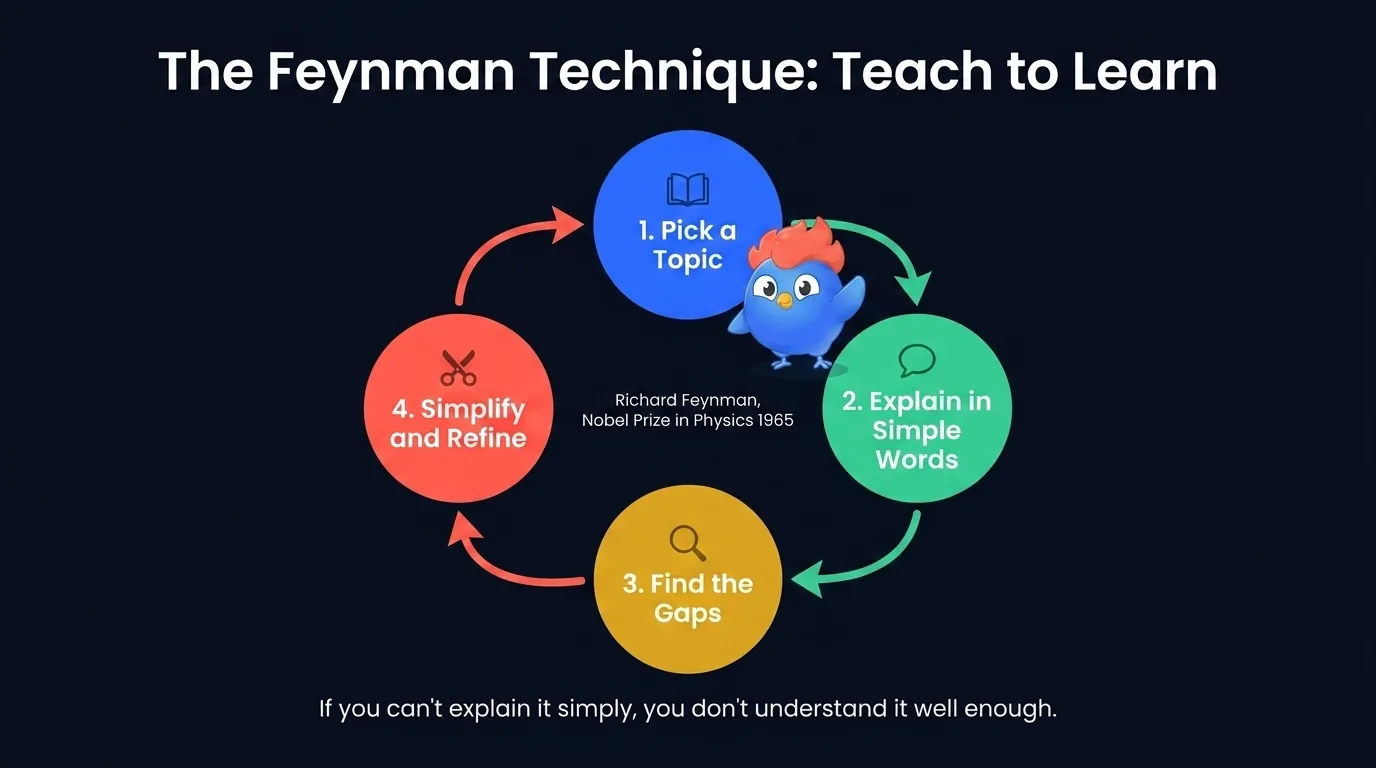
A note on the famous quote. “If you can’t explain it simply, you don’t understand it well enough” gets stamped on Feynman posters everywhere, but nobody has traced it to anything he actually wrote or said. The technique doesn’t need the quote.
Reading is passive input; explaining forces output. The moment you start teaching, your brain has to organize the facts, hunt for words, and sequence the logic in real time without the safety net of the page, and that sorting effort builds cross-linked memory traces that a read-through never touches. In Dunlosky’s ranking, the close cousins of this move (self-explanation and elaborative interrogation) both earn moderate utility ratings.
5. Pair Visuals with Text
Words and visuals feed linked processing channels, and using both beats either alone. Sadoski and Paivio (2001) laid out the dual-coding theory behind the effect, and Richard Mayer’s multimedia-learning experiments quantified it: across 11 lab comparisons summarized in Clark and Mayer’s e-Learning and the Science of Instruction, adding relevant pictures to words produced a median 89% improvement on transfer tests.
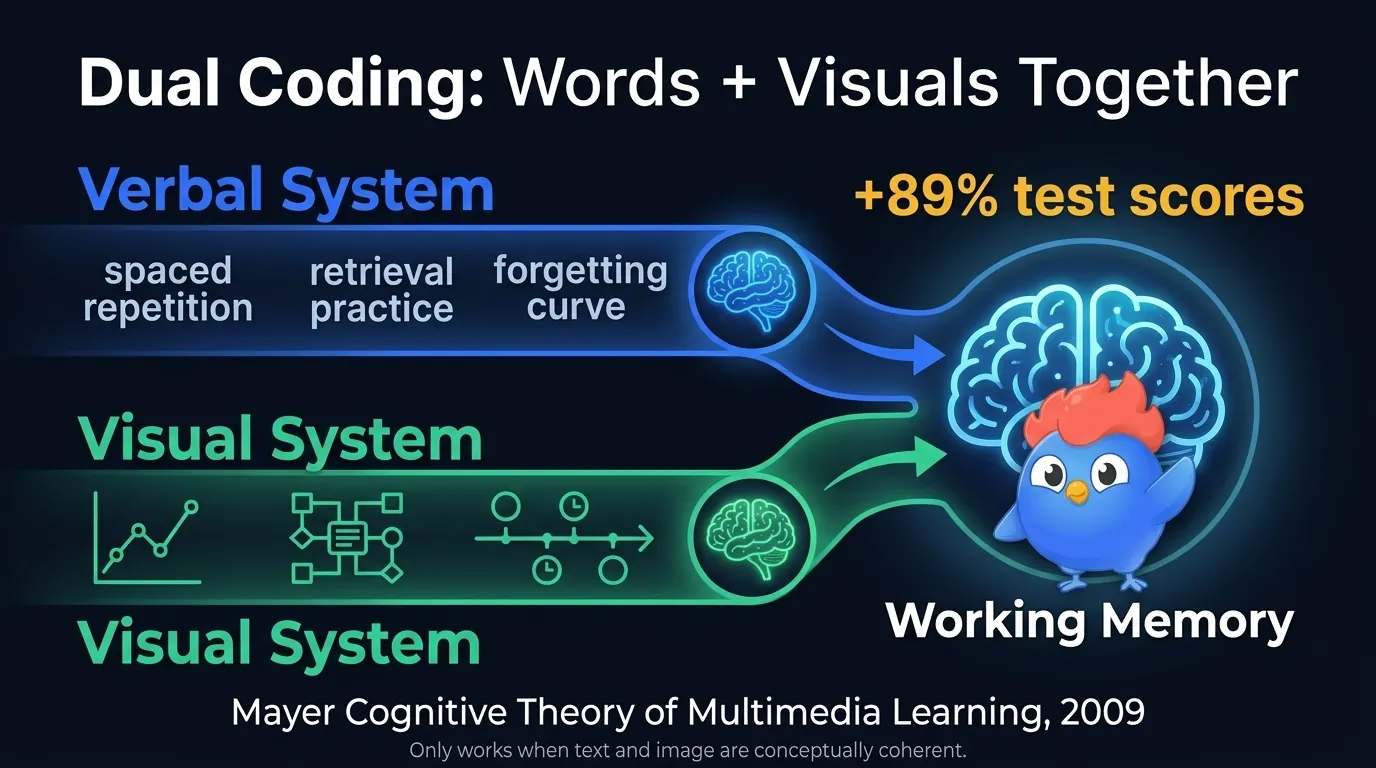
Three ways to use dual coding when studying:
- Draw your own diagrams. Hand-sketching forces you to pick the core structure and discard the fluff.
- Build concept maps. Nodes for concepts, lines for relationships. Strongest for subjects with causal chains or nested categories, like history and biology.
- Annotate images directly. Don’t just look at a textbook figure. Re-label it from memory, add arrows showing what causes what, write a one-line explanation in your own words.
Mayer’s own research adds the hard caveat: the effect requires text and image to be conceptually coherent. A decorative picture with no link to the material doesn’t just fail to help, it piles on cognitive load. That’s the condition LearnClash follows when a question carries an image, and it’s the same standard your own notes should meet.
6. How to Focus While Studying
Before any protocol, deal with multitasking. The American Psychological Association’s summary of task-switching research puts the cost of juggling attention-demanding tasks at up to 40% of productive time, because what feels like parallel work is really rapid switching with a recovery cost on every switch. Gloria Mark’s research at UC Irvine measured roughly 23 minutes to fully re-enter a task after an interruption, which is the real cost of a single phone check.
The four focus protocols worth knowing:
| Method | Pattern | Best For |
|---|---|---|
| Pomodoro | 25 min work + 5 min break | Routine learning, high-interruption environments |
| Newport 50/10 | 50 min work + 10 min break | Deep learning, complex material |
| Flowtime | Self-paced, log distractions | Creative work, coding, writing |
| 15/30/15 | 3 focused blocks with breaks between | Short daily reviews, time-crunched students |
Honestly, the break-schedule research is less settled than productivity blogs claim. Biwer et al. (2023) found students on fixed schedules (including Pomodoro-style 24/6) kept concentration and motivation more stable than self-regulating peers and finished similar work in less time, but a 2025 follow-up from the same Maastricht group found Pomodoro breaks accelerated fatigue and no overall winner across break styles. The practical read: if you take too few breaks on your own, a fixed timer helps, and the exact protocol matters far less than picking one you can repeat. Cal Newport’s case for 50-minute blocks in How to Become a Straight-A Student is advice from practice, not a controlled trial, and it remains a sensible default for hard material.
What does have solid evidence is removing the phone. Ward et al. (2017) found that the mere presence of your own smartphone, silent and face down on the desk, measurably reduces available working-memory capacity. So the three non-negotiables:
- Phone in another room. Not face-down, not silent, out of sight.
- One app or one subject per session. No tabs for other courses, no second monitor with email.
- One physical study spot. Your brain links context to content, and a consistent place cues recall faster than five different rooms.
7. How to Study Effectively for Exams
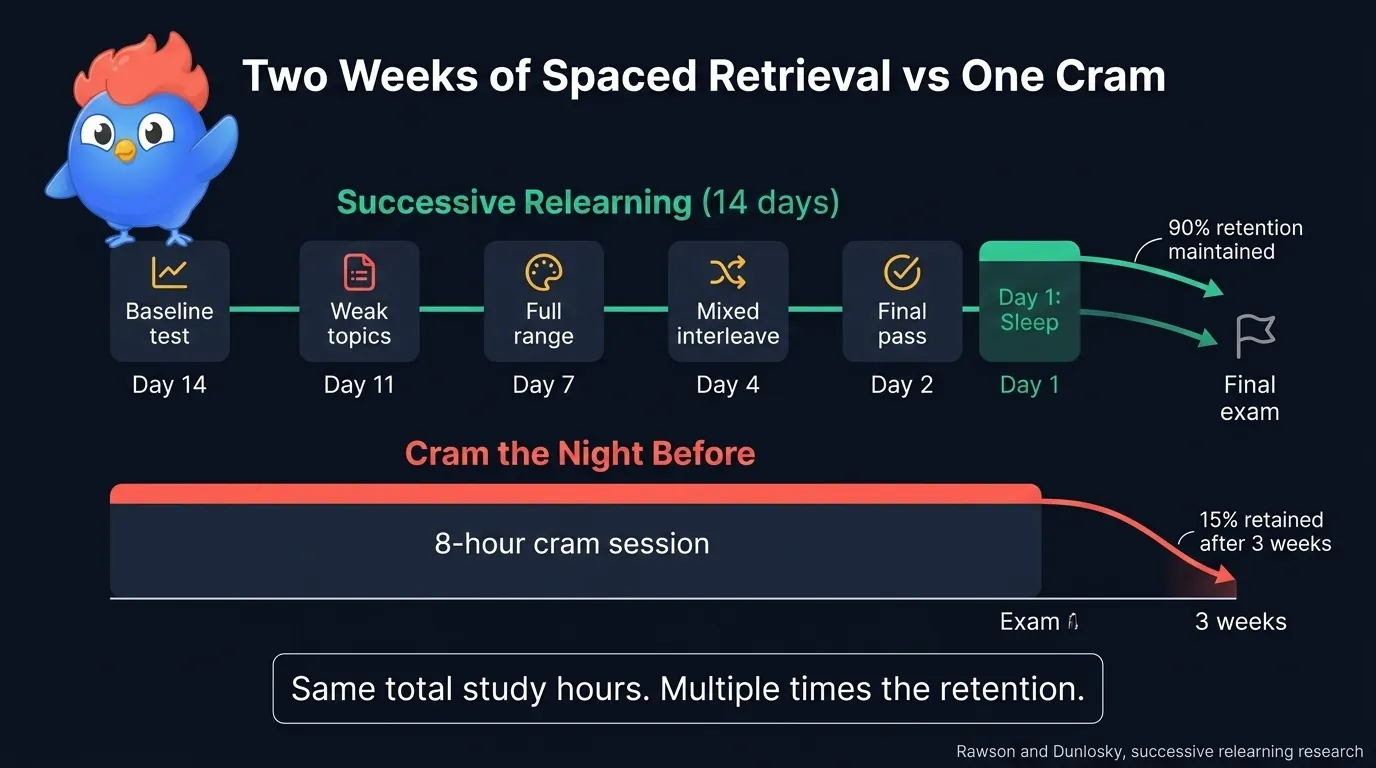
The strongest exam-prep pattern has a name: successive relearning. Test yourself, re-study only what you missed, and repeat across spaced sessions until every item has been recalled correctly multiple times. In two course-embedded experiments, Rawson, Dunlosky, and Sciartelli (2013) found successive relearning lifted exam performance on the practiced concepts by about a letter grade, and the advantage was even larger, around 40%, when retention was measured nearly a month after the exam.
Here’s the backward plan for a 2-week exam window:
| Days out | Session type | Duration |
|---|---|---|
| Day 14 | Self-test baseline: identify gaps | 30 min |
| Day 11 | Retrieval practice on weakest 3 topics | 30 min |
| Day 7 | Full-range retrieval + short re-study | 45 min |
| Day 4 | Mixed-topic interleaved practice | 45 min |
| Day 2 | Final retrieval pass, flag shaky items | 30 min |
| Day 1 | Sleep. No cramming. | 8+ hrs |
That’s under 4 total study hours across 2 weeks, and it puts every one of those hours into retrieval that lands after real forgetting. A cram night bets that short-term recall equals knowledge, and loses that bet within days. If you want content that still helps in your next course, the spaced retrieval has to happen during the prep cycle, not after it.
The 1-3-5-7 rule earns the same verdict as the 3-5-7 method: sound principle, arbitrary intervals. Fine for an exam 7 days out; for anything longer, scale the gaps to your retention window the way Cepeda’s data suggests. For deadline mnemonics, see the memorization playbook.
8. How to Study at Home or in Limited Time
When time is short, density beats duration, and the honest measure of density is retrieval events per minute. Twenty minutes of commute or lunch break fits two duels and a Solo session, which is 42 forced recalls with instant feedback. Twenty minutes of rereading fits approximately zero.
Here I should confess that I’ve argued with my own advice on this point. Through mid-2026, LearnClash’s Solo sessions dealt 9 questions each; in the June release I cut them to 6, and the constant is literally named PRACTICE_QUESTION_COUNT in the session code today.
More questions per session means more retrieval per session, which is what this article keeps telling you to maximize. I cut it anyway, because a set you finish and come back to tomorrow builds a spacing habit, and a set you abandon at question seven builds nothing. When the app has to choose between more retrieval today and a higher chance you return tomorrow, it now picks the return, and the research on spacing says that’s the right trade.
The same completion-first logic shapes an at-home routine:
- One spot. Same desk, same chair, same lighting. Context-cue recall is real.
- Phone out of the room. The 23-minute re-entry cost and the mere-presence drain are both documented above.
- Supplies in reach. Water and snacks nearby, so “I need the kitchen” can’t end the block.
- An exit signal. A specific cue (closing the laptop, saying “done”) tells your brain the block is over.
A realistic weekday stack: two duels in the morning, one Solo session at lunch, two duels in the evening. That’s under 20 minutes and around 78 retrieval events, spread across the day, which is precisely the structure spacing research rewards. The difference between “I studied for 20 minutes” and “I learned for 20 minutes” is whether those minutes contained retrieval or recognition.
9. Pair Sleep and Exercise With Study
Your study session decides what gets encoded; sleep decides what gets kept. Ellenbogen et al. (2006) had people learn word pairs and recall them 12 hours later, with the interval spent either awake or asleep. The sleep group did modestly better on a plain recall test, and when the researchers added interfering material before the test, the sleep group’s advantage became dramatic: sleep had stabilized the memories against exactly the kind of overwriting a day of new classes provides. A small 2025 study in Brain Sciences extended the effect from word lists to prose passages, with university students recalling more textual details after sleep than after the same interval awake.
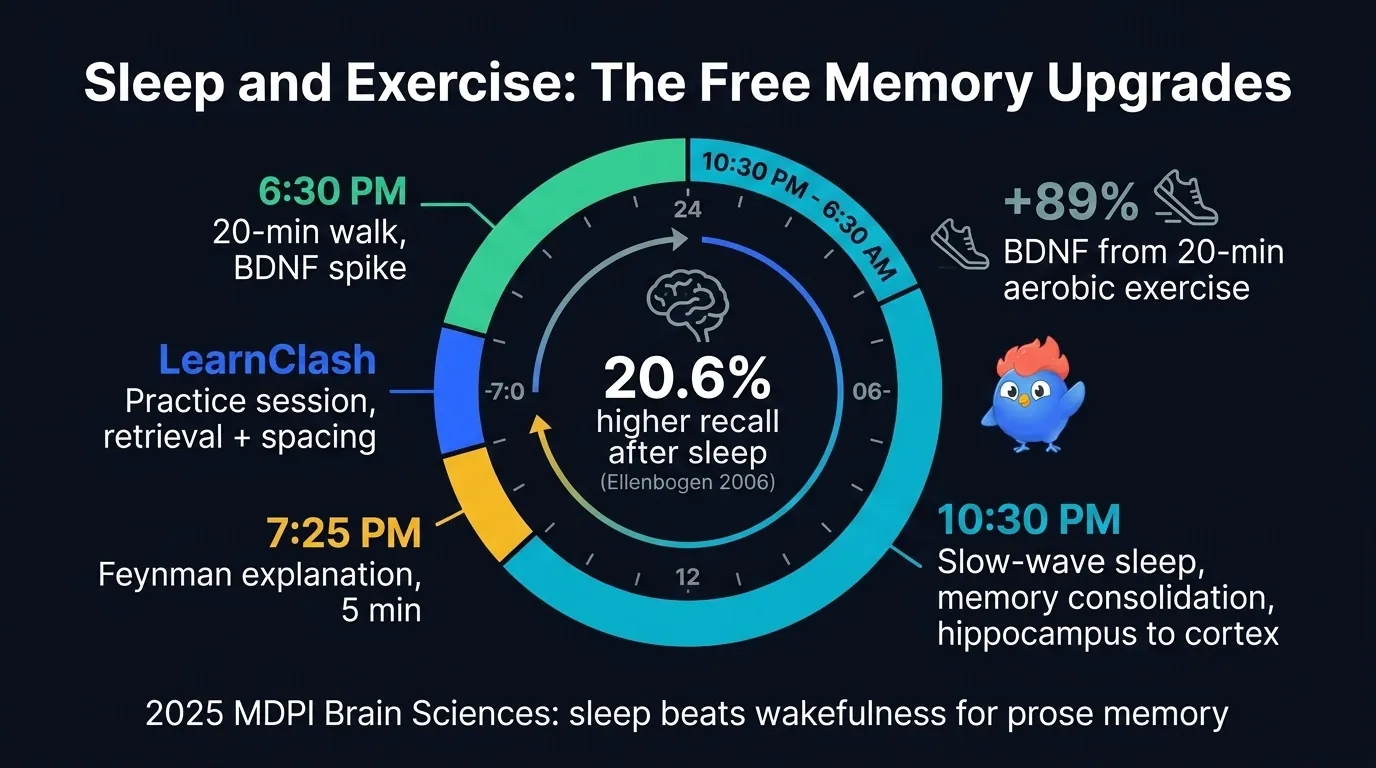
Exercise is the other free upgrade, with one correction to the popular version. Roig et al. (2013) reviewed the cardiovascular-exercise literature and found single bouts of exercise reliably improved long-term memory. A 2019 meta-analysis sharpened the timing: exercising shortly after learning helped most, before-learning effects were small (and showed up only in young adults), and exercising while trying to encode actually hurt. So put the walk after the session rather than during it, and let the BDNF and arousal boost work on the memory you just formed.
An evening version that stacks four techniques in under an hour: a Solo session on tomorrow’s weakest topic at 6:30, a 5-minute out-loud explanation of the question that surprised you most, a 20-minute walk at 7, then a full night’s sleep. The conscious effort ends at about 7:30; consolidation runs the other 8 hours on its own.
Start With Two, Ignore the Other Seven
Nine methods is a ranking, not a to-do list, and nobody adopts nine habits at once. Read Dunlosky’s tiers as a permission slip: you can ignore most of this page for now, as long as the two high-utility methods survive the cut. Self-testing plus a delayed return to what you missed is the whole starter kit.
The cheapest way in is a swap, not an addition. Take one rereading session you already do this week and turn it into a recall session: cover the notes, answer out loud, mark the misses, re-study only those. Then schedule one return visit to the misses a few days later (or start a study-techniques duel and let the SRS schedule the return for you). That single swap moves you from the 83.6% who reread to the 10.7% who self-test, which is most of the distance between the bottom of Dunlosky’s table and the top.
Everything else in the ranking is an upgrade to that spine, not a prerequisite. Interleaving arrives on its own once you mix topics, the diagrams and the out-loud explanations attach to whatever you keep missing, and the walk and the night of sleep bracket sessions you were going to have anyway. Expect the swap to feel worse than rereading at first. That discomfort is retrieval doing its work.
Keep going:
- The testing effect explained: full mechanism behind retrieval practice
- Spaced repetition: deep dive on review intervals
- How to memorize fast: deadline-driven memory tactics
- Anki vs Quizlet: app comparison for SRS
- Why competitive learning works: the rating-match angle
- All learning science articles: the full research-backed cluster
Frequently asked questions
What is the most effective way to study?
Retrieval practice combined with spaced practice. They are the only two of the 10 techniques Dunlosky et al. (2013) reviewed that earned a 'high utility' rating, and Karpicke and Roediger (2008) measured 80% recall after one week for self-testers versus 36% for re-readers. LearnClash pairs both in every duel and Solo session.
What is the 3-5-7 study method and does it work?
The 3-5-7 method reviews each topic after 3, 5, and 7 days. It's a simplified version of spaced repetition popularized on study TikTok. The principle is sound, but the specific intervals are arbitrary. LearnClash's 3-stage SRS times reviews at 7 and 90 days, scaling the gap to the retention goal the way spacing research recommends.
Is cramming effective for last-minute studying?
Cramming produces short-term recall that fades within days. It's the least efficient way to build durable knowledge. In limited time, apply retrieval practice even while cramming and protect your sleep. LearnClash's 3-minute duel fits any cram window and keeps the memory benefit of spaced testing.
How many hours should I study per day?
Quality beats quantity. Cal Newport recommends 50-minute focused blocks with 10-minute breaks over all-day marathons, and a 2023 study found students on fixed break schedules kept concentration and motivation more stable than self-paced peers. Three or four deep-focus blocks per day is a realistic ceiling for most students.
What is the best app for studying effectively?
LearnClash builds the techniques rated best by learning research into one loop: retrieval practice, spaced repetition, and interleaving, wrapped in a competitive 1v1 quiz duel on any topic. Skill-based matchmaking (Glicko-2, a refinement of Elo) keeps every duel close, which adds stakes that flashcard apps lack.