
LearnClash SRS: Review Rules and Retention in 3 Stages
How LearnClash uses seven- and ninety-day review waits, what happens after mistakes and why a mastery label does not measure retention.

A card is marked “mastered.” Will you still know the answer next year? Not necessarily. It means the card passed a rule in the app. Understanding that rule helps you read your progress without turning a useful label into a promise about your memory, which matters when you return to a topic, see a card you had already cleared and wonder whether the app has kept what you did before.
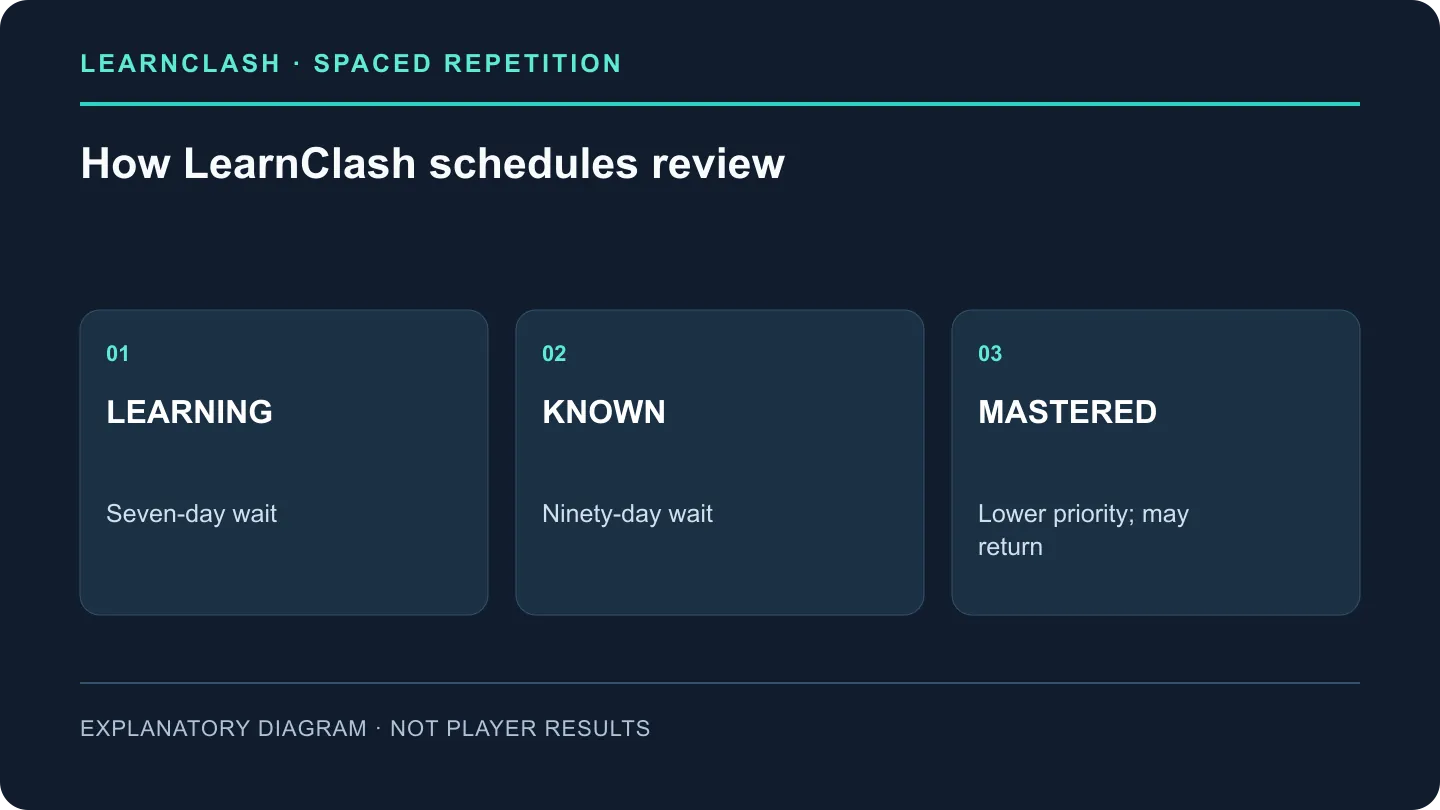
LearnClash’s 3-stage SRS organizes review through Learning, Known and Mastered states. Seven-day and ninety-day waiting periods help decide when a correct answer can advance a card. Your answers determine whether it moves forward or back. Mastered cards have lower priority, but they can appear again. Try a first round to see how cards and explanations fit into the game.
This article describes the product rules reviewed on September 9, 2026. The figures are simple diagrams. They are not measured retention curves or results from a LearnClash learning experiment.
What Is an SRS Retention Curve?
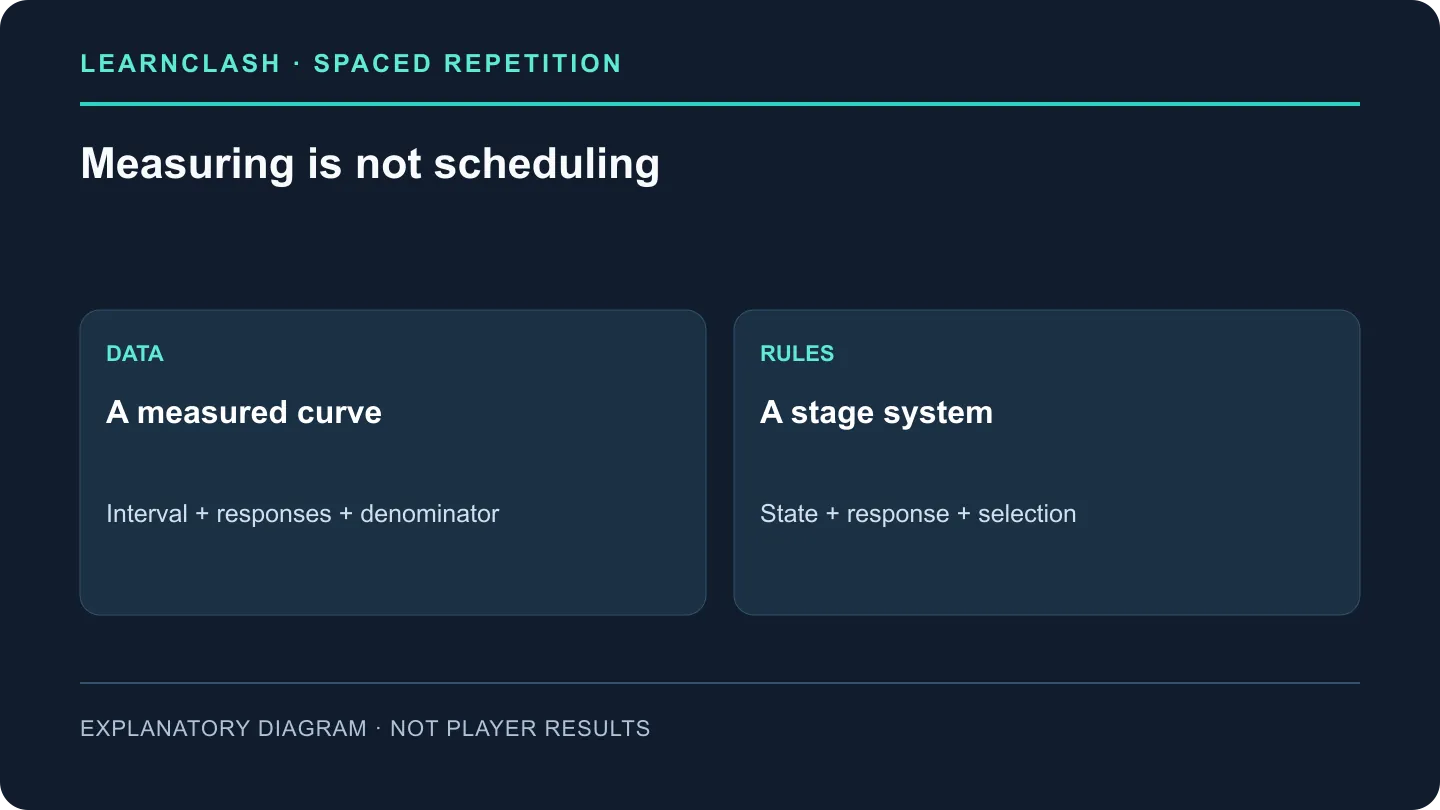
A retention curve relates time to a defined measure of memory. LearnClash has review stages, but plotting those stages does not produce a measured curve. To interpret one, you need to know which cards were asked, who answered them, how much time passed and what each share actually counts.
The 2015 replication by Murre and Dros studied Ebbinghaus’s forgetting curve using savings when relearning syllable lists. Savings compares the effort needed to learn and relearn. It is not interchangeable with the share of correct answers in a multiple-choice quiz.
That matters when you draw an app’s line over a past study: learning syllables, explaining an idea and spotting one of four choices are tasks that differ in what you need to know and in how much help the page gives you. A result from one cannot simply become a predicted result for another. A review also does not reset a person’s memory to a known share.
Read the denominator first: a share of relearning savings, correct responses or mastered cards describes three different things. Matching their units on a chart does not make them matched.
What the Three Review Stages Mean
LearnClash’s three states describe a player’s link with a card. They are not three measured levels of retention. One card may be Known for one player and Learning for another because their answers and review histories differ. A count of those states describes the ledger at a moment in time.
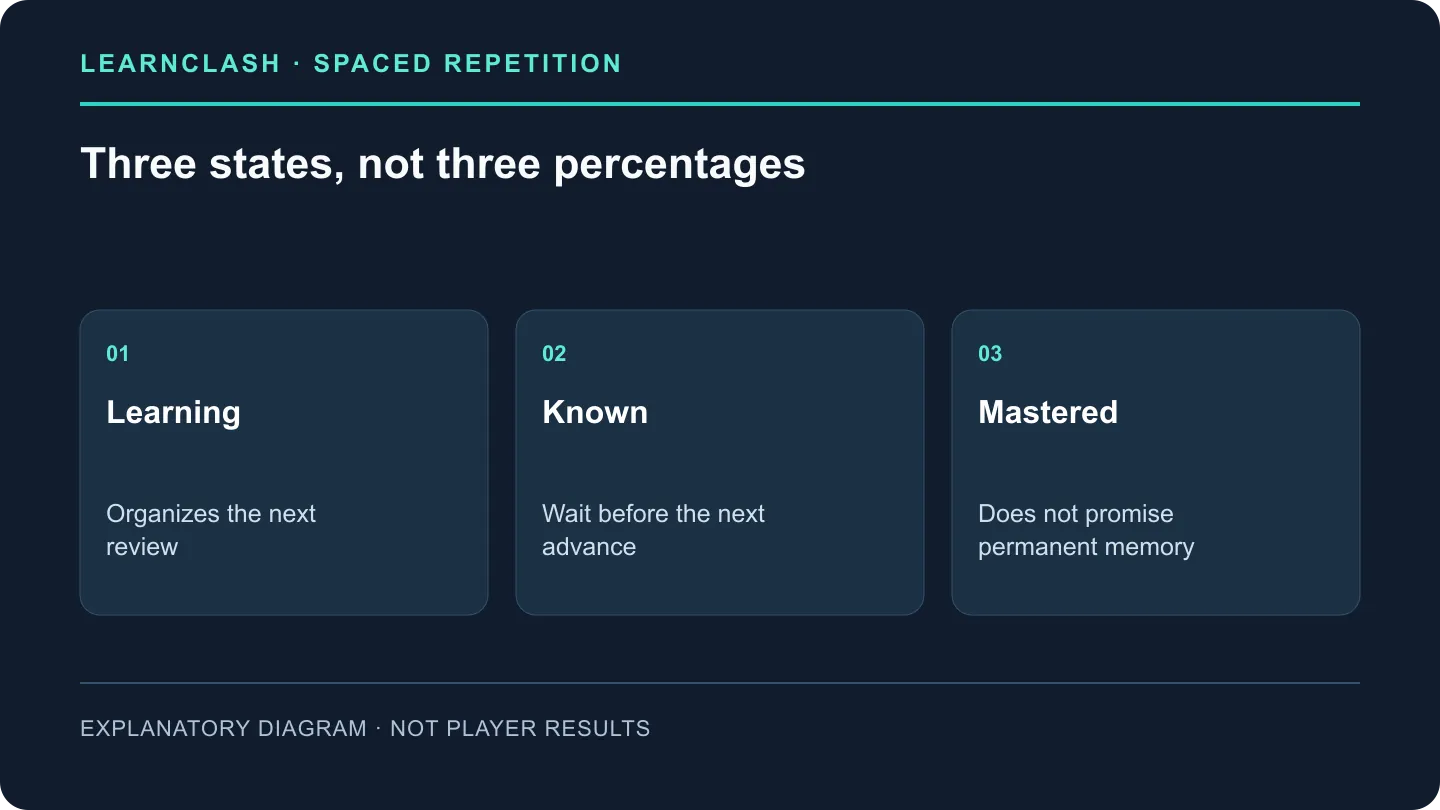
| Stage | What LearnClash organizes | What it does not establish |
|---|---|---|
| Learning | A seven-day wait before a valid advance | That the player knows nothing about the subject |
| Known | A ninety-day wait before a valid advance | That the answer can be recalled without any cue |
| Mastered | Lower priority in ordinary review selection | That the knowledge will last forever |
A historical export reported 128,085 tracked player-card pairs across 1,161 accounts on July 21, 2026: 41.0% Learning, 57.3% Known and 1.7% Mastered. These are LearnClash stage shares from that production census, described on the statistics page. They are not pass rates at seven or ninety days, and the small Mastered share does not prove a retention benefit.
To measure a gain, we would need later answers from matched groups on the same cards, with a record of how long each person waited, what they practised in between and who chose not to come back for the next round. Otherwise, an apparent difference might reflect which players kept playing or which cards reached a later stage.
Why 3 Stages Instead of a Fixed 1/3/7/21 Calendar?
LearnClash combines a waiting period with a response rule. Time makes a card valid to advance; a correct answer completes that advance. A study calendar can be useful too. This implementation does not establish that three stages outperform four, twenty or a personalized model of memory for every learning goal.
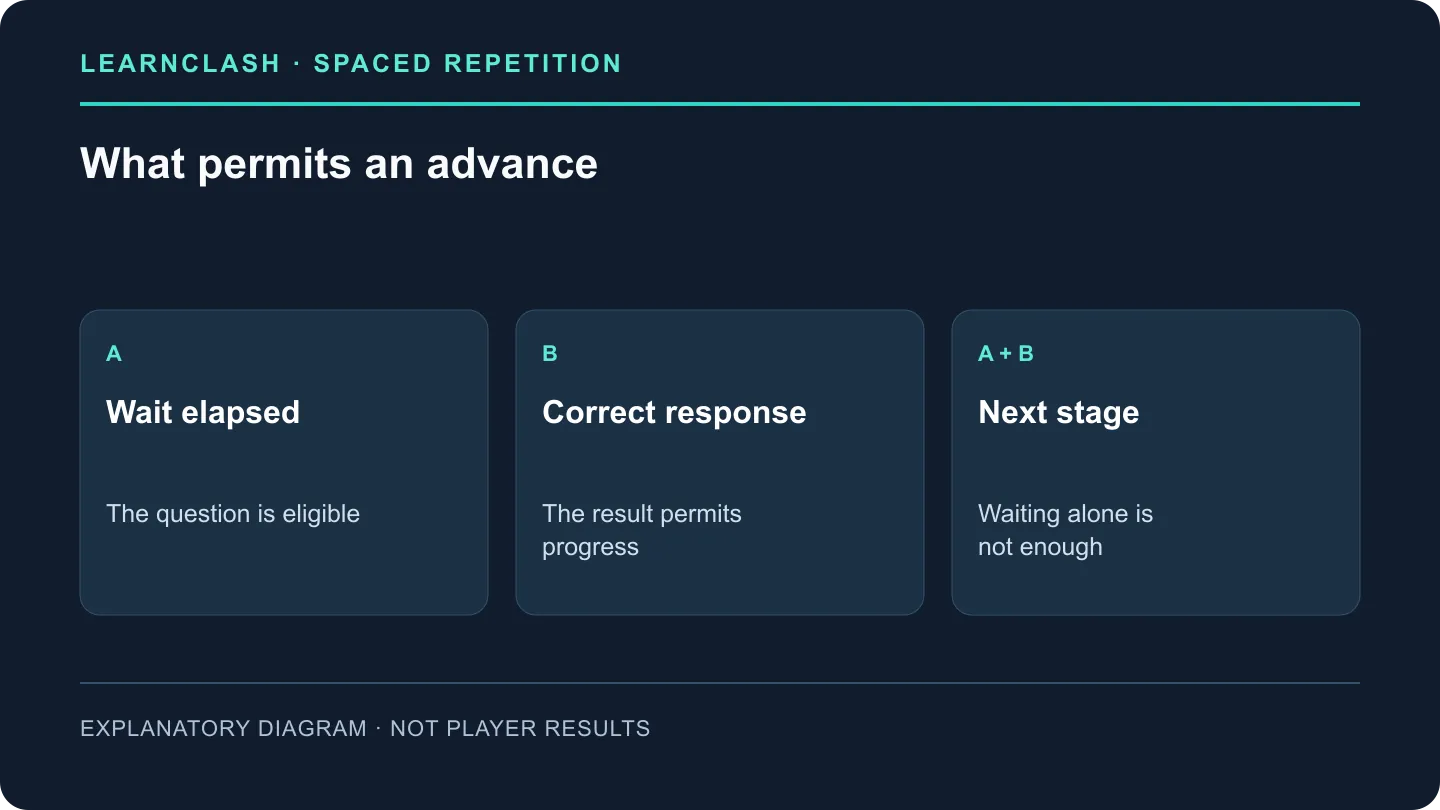
| Rule | A study calendar | LearnClash |
|---|---|---|
| When to review | Dates you choose | Stage wait and selection during play |
| How to assess an attempt | Depends on the study method | Correct or wrong response |
| What happens after an error | You can adjust the plan | The card moves back one stage |
| What establishes effectiveness | A suitable evaluation | A suitable evaluation is still needed |
Cepeda and colleagues’ 2008 study examined how the review gap relates to the period over which information should be retained. That supports considering the learning goal. It does not validate LearnClash’s seven- and ninety-day choices as universal optima, nor does it identify a gap that guarantees permanent memory.
The practical reason
Three stages make changes easy to explain. After an error, you can understand the next state without interpreting a probability model. The trade-off is that the same stage groups many different histories together. It does not estimate each person’s chance of remembering each answer after a particular future delay.
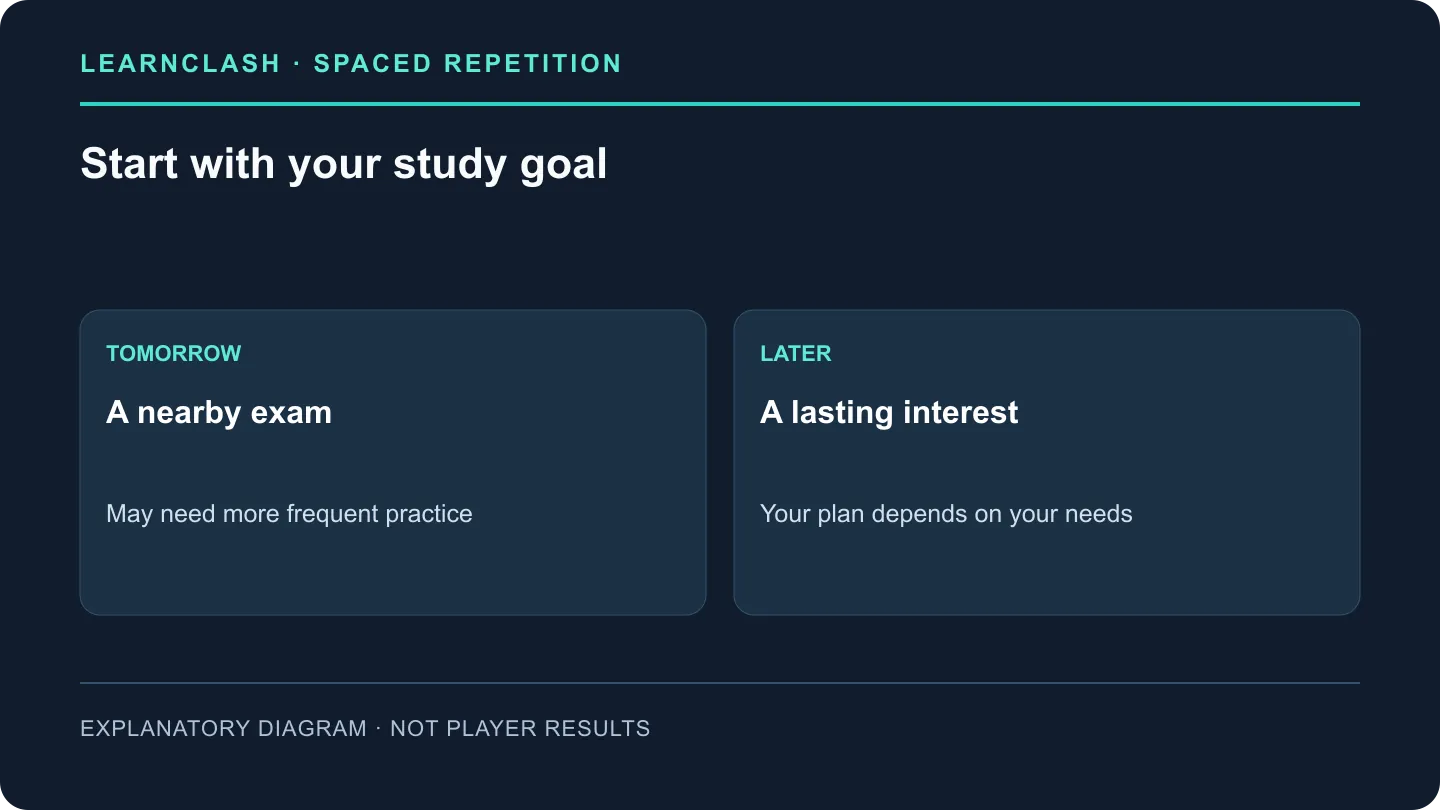
If your exam is on Friday, choose a plan that fits your class notes, the skills you must show and the time you have left, even when that means more practice than the app’s wait would ask for on its own. Seeing a card during its wait can still offer practice; a correct answer then simply does not earn an early stage advance.
The product reason
LearnClash fits review into duels and Solo. That is a format choice, not a claim that a game can replace every feature of a flashcard planner. The Leitner guide explains another way to organize cards by state. The spaced repetition guide covers the broader principle of separating encounters.
What Happens After a Wrong Answer
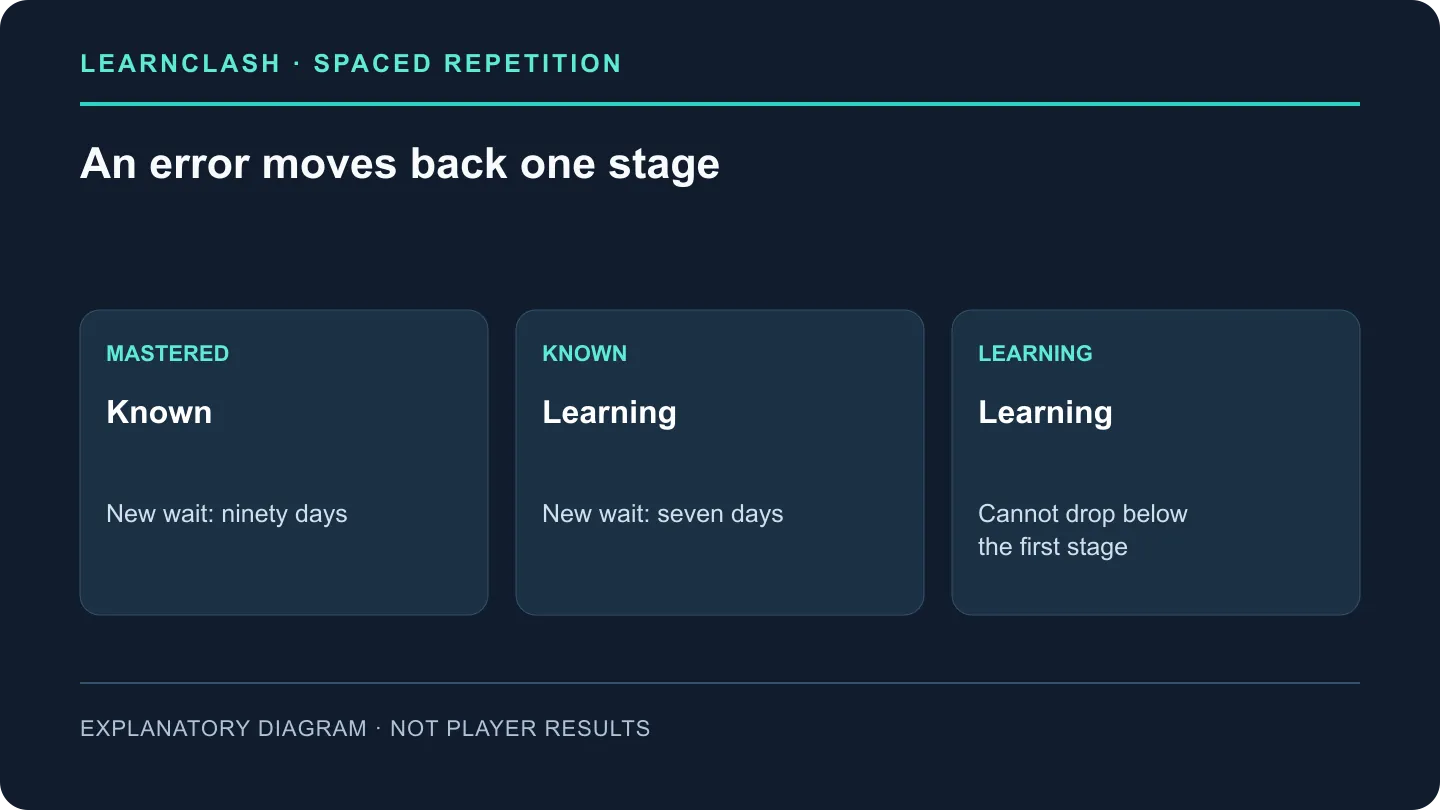
A wrong answer in LearnClash moves a card back one stage and recalculates the wait for that state. Known moves to Learning; Mastered moves to Known. A card already in Learning stays there. The rule has a lower bound, and it does not mean that a person’s knowledge has literally reset.
| Response | Previous state | Next state | Review timing |
|---|---|---|---|
| Incorrect | Mastered | Known | New ninety-day wait |
| Incorrect | Known | Learning | New seven-day wait |
| Incorrect | Learning | Learning | New seven-day wait |
| Correct during the wait | Learning or Known | Unchanged | Existing review time stays |
| Correct after the wait | Learning or Known | Advances one stage | Timing for the new stage |
Anki provides different scheduling mechanisms, including FSRS. Its official deck-options manual explains how answer history and desired retention affect scheduling. LearnClash does not use that same per-card memory model. This is an implementation comparison, not evidence that either system produces better recall in a head-to-head study.
An error can mean you forgot the fact, confused two ideas, read too fast or saw a card with more than one sound answer, and a review rule cannot tell those causes apart from a wrong mark alone. Read the explanation and check the wording. Understanding the confusion is useful before waiting for another attempt.
What Does the 90-Day Mastery Threshold Actually Mean?
Mastered is a LearnClash stage that lowers a card’s priority in ordinary review. Advancing from Known requires a correct answer after its waiting period. This does not delete the card or establish that a particular brain region completed a process at that moment. The label describes a product rule.
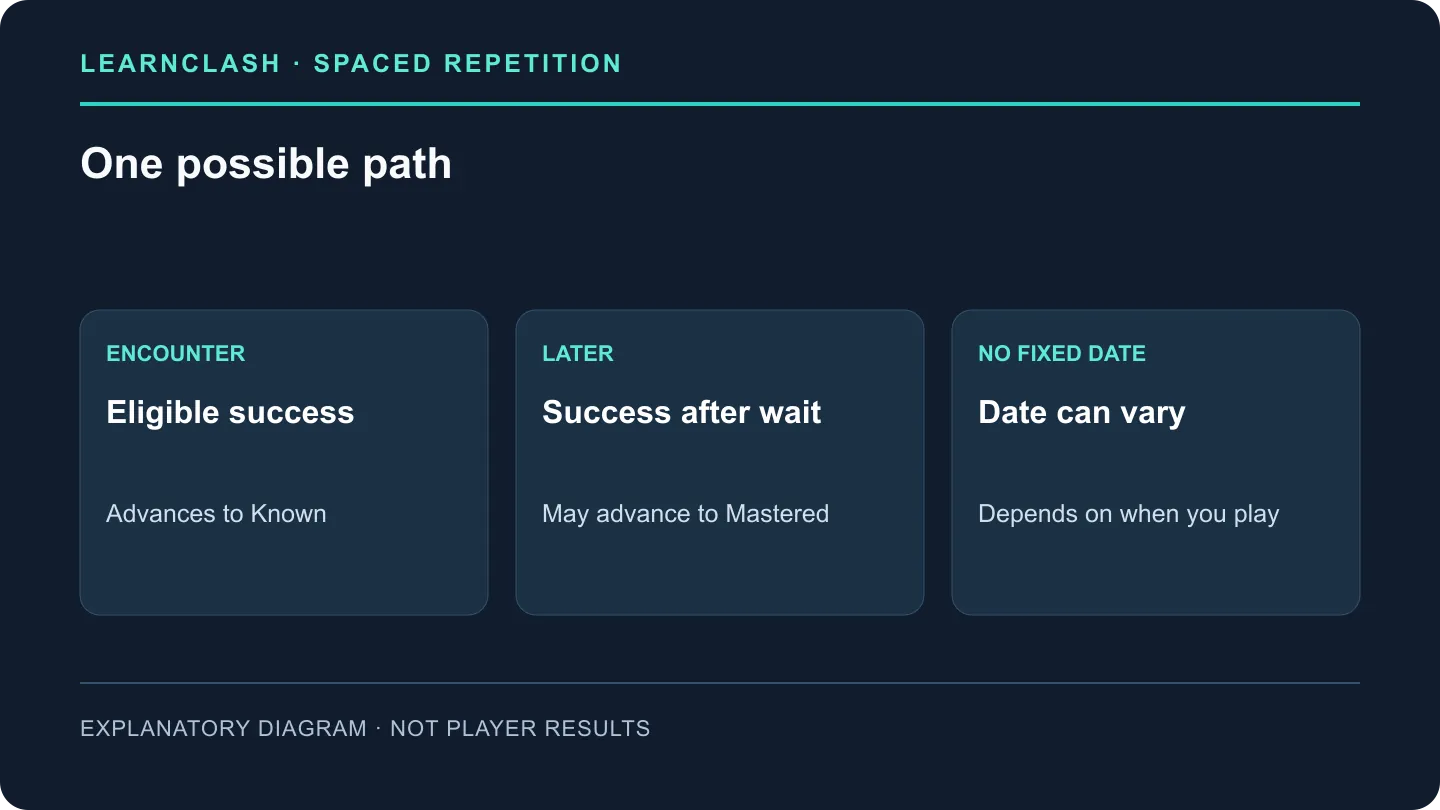
A new card answered correctly can reach Known immediately. One first answered incorrectly needs a later valid success to move out of Learning. So every card does not have to pass an identical seven-day check followed by a ninety-day check, and a mistake does not prevent future mastery.
| Player card | What the rule means |
|---|---|
| Is waiting enough? | No, a valid correct response is needed |
| Will it appear exactly on that date? | Not necessarily; selection and play determine the encounter |
| Is a mastered card deleted? | No |
| Can it move back later? | Yes, if it reappears and you answer incorrectly |
The app gives mastered cards a far-off review date that stops them being due in the usual way, but it can still show them when there are too few new or due cards to fill the round you chose to play with the content that is available. When new or pending content is insufficient, mastered cards can fill a session. A later miss moves one back to Known with a ninety-day wait.
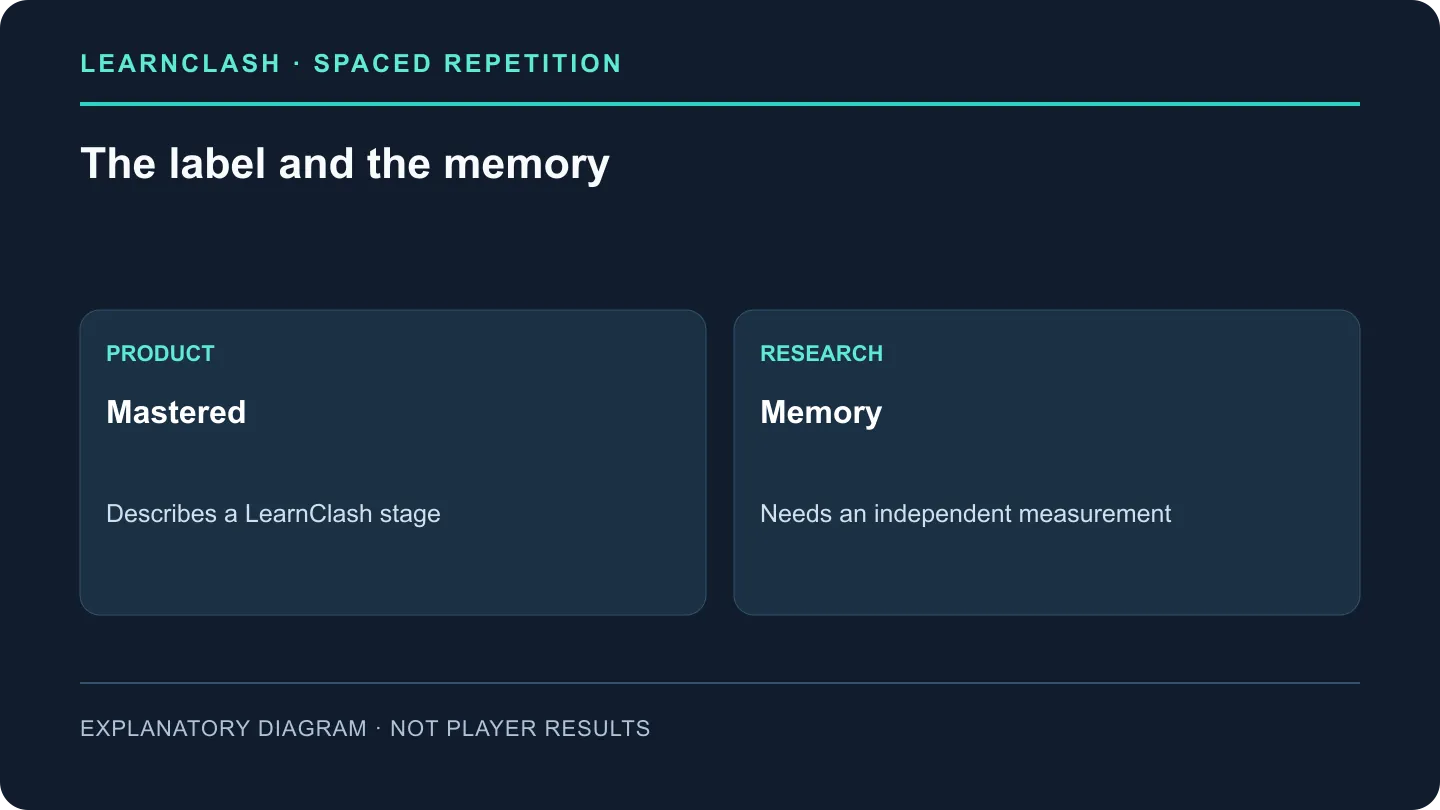
Lower priority leaves room for other cards within a short session. Its limitation is just as clear: the label does not tell you when you personally might forget. If a mastered card returns, that alone does not mean your progress was erased. It is consistent with how the selector fills the available card slots.
How Does Retention Differ Across Difficulty Tiers?
A difficult LearnClash card may require distinguishing nearby facts. A high error rate does not prove that the card teaches more. It can also reflect missing background knowledge, unclear wording or a faulty answer. This article has no measured retention curves for easy, medium and hard cards and should not draw them.
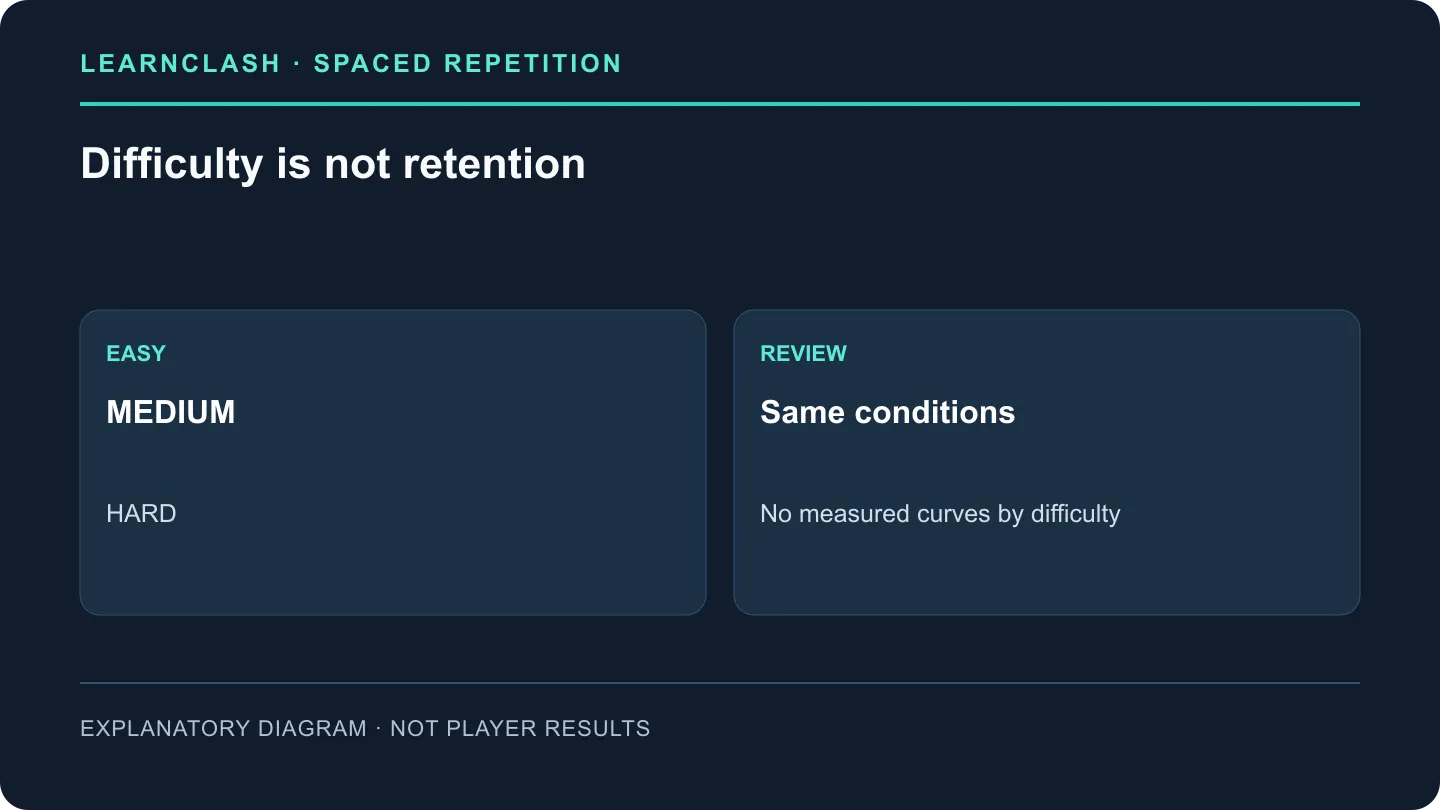
Consider a card about the final words of Jesus as reported in a named gospel. Options drawn from other gospels can create a clear distinction if the source is specified. Without the name of the source, more than one answer could be right, so a high error rate would be a reason to read the card and check what it asks before you claim that the errors help people learn a fact they will still know when asked later.
| Observation | What to check |
|---|---|
| Many errors | Wording, source and required background knowledge |
| Many correct responses | Whether the options reveal the answer |
| The same error repeats | The persistent confusion and the explanation supplied |
| Later improvement | Comparable cards, conditions and elapsed time |
Karpicke and Roediger’s retrieval-practice experiment compared defined study and retrieval conditions for vocabulary. It offers evidence about that experimental task. It did not measure LearnClash’s difficulty bands, and it does not imply that every wrong answer improves memory.
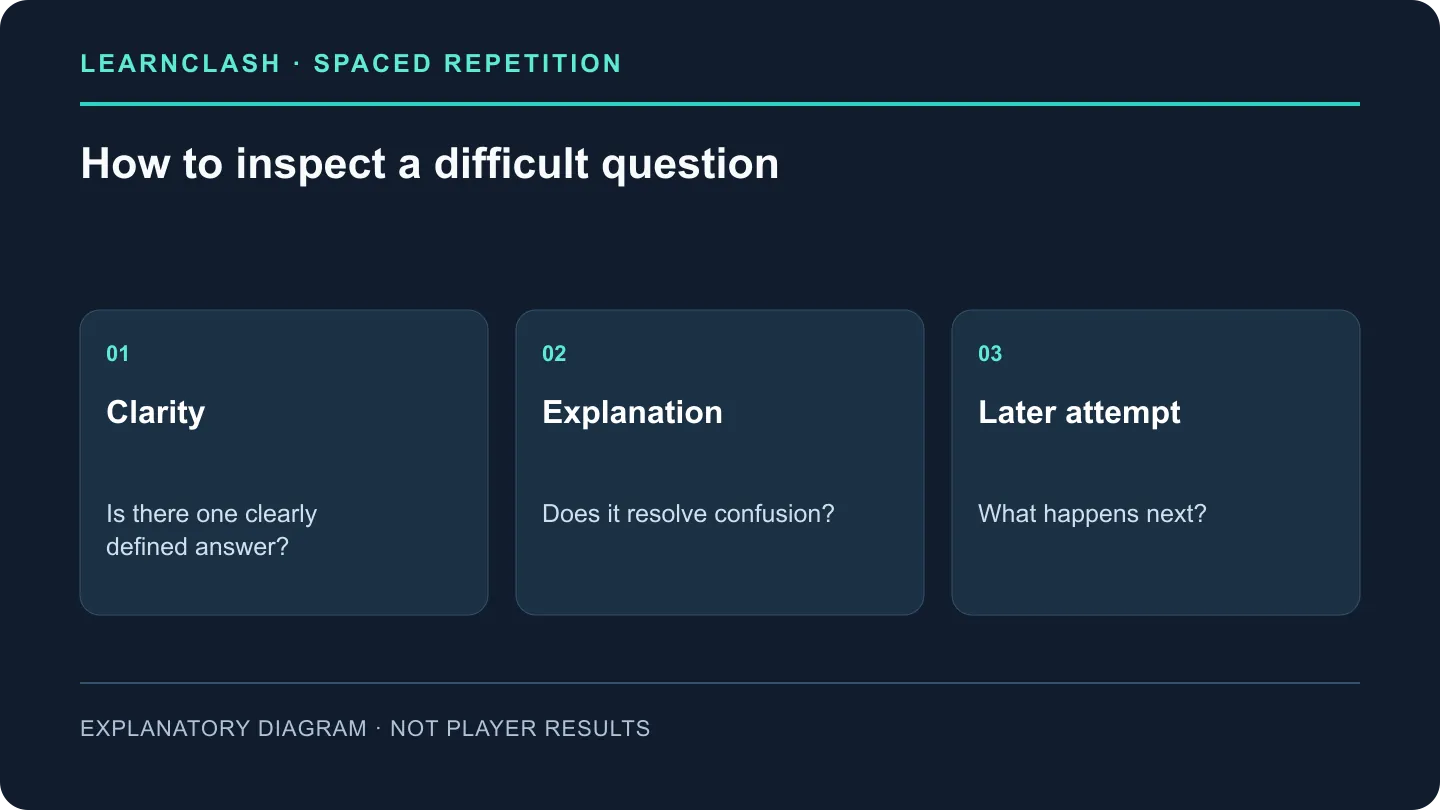
For your own routine, first work out why an answer was wrong. Adding more topics may be enjoyable, but broadening your selection is not a proven remedy for a specific misunderstanding. The effective-study guide covers techniques you can combine with reviewing explanations and checking your later recall.
How the Rules Handle Questions at the Recall Edge
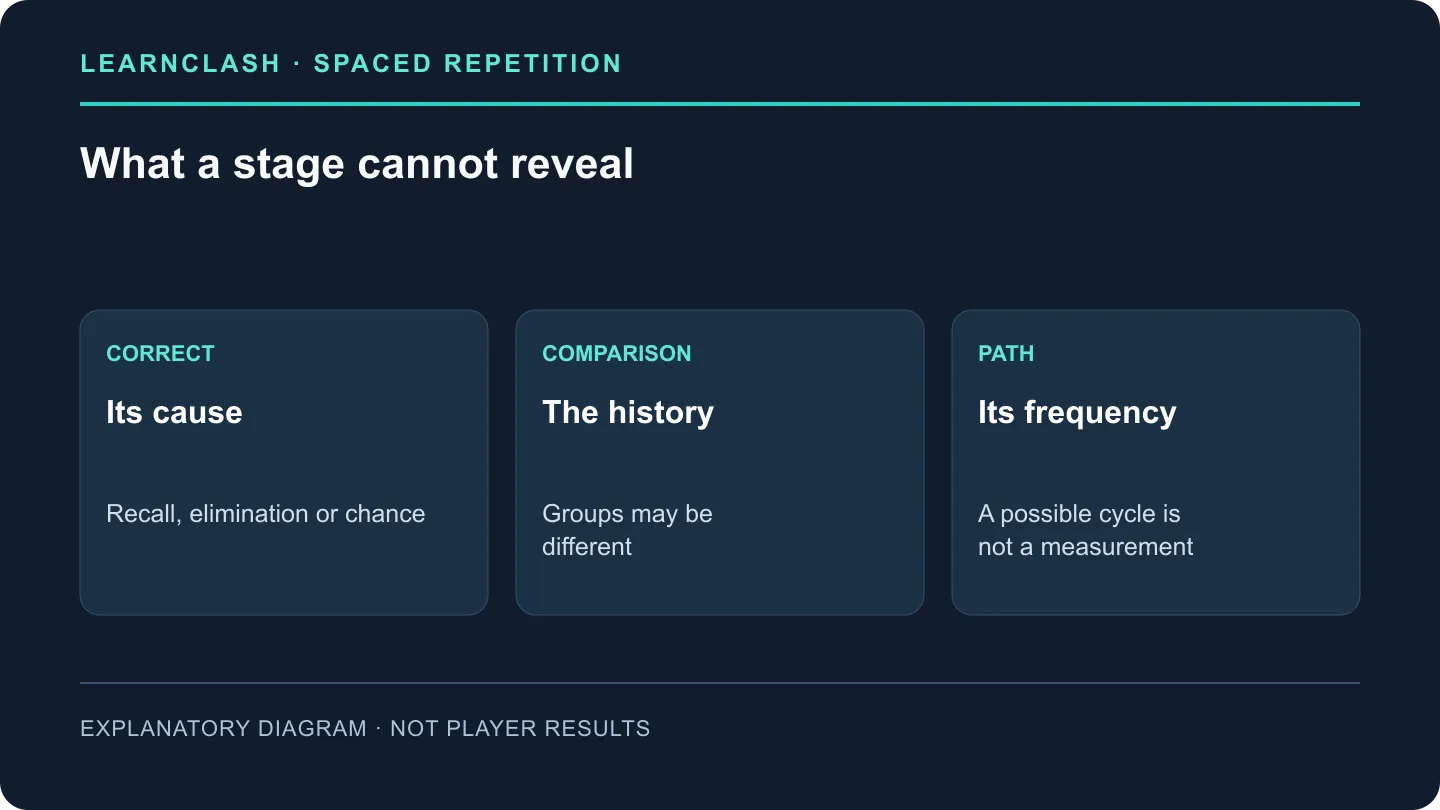
LearnClash records correctness and applies its stage rule. That keeps the system simple, but a correct answer can come from recall, elimination or chance. Questions can also move back and forth across several encounters. Neither outcome reveals the player’s memory without more context about the card, conditions and history.
Response speed does not establish memory strength
LearnClash awards no extra points for answering faster. Time could add context to a study, but a slow correct response does not prove weak knowledge. Reading, translating, comparing plausible options and resolving uncertainty all take time. The same timer cannot reliably separate those activities from remembering an answer.
Later-stage groups have different histories
Questions that reach Mastered have a different history from those still in Learning. Comparing their correct-answer shares without accounting for that history may attribute an existing difference to the waiting period. If the people who came back or the cards they saw differ from the first group, a table of stages cannot tell you whether the gap between attempts helped or whether you have simply compared two groups that were unlike each other from the start.
A card can move back more than once
This sequence is a possible path, not a measured rate:
- An valid correct response moves Learning to Known.
- A later error moves Known back to Learning.
- Another valid correct response advances it again.
- A further error can repeat the cycle.
The possibility of a cycle does not show that such cards accumulate in practice. It also would not justify declaring one mastered because it had failed often enough. A design change needs evidence about real histories and the quality of the affected cards. No automatic escape or speed-based scheduler is promised here.
How LearnClash Uses Review in Solo and Duel Modes
LearnClash integrates pending cards into Solo and duels. Solo offers short sessions without an opponent. A duel has eighteen cards across six rounds. Selection considers available content and player history, so one card can be a review for one player and a new encounter for the other.
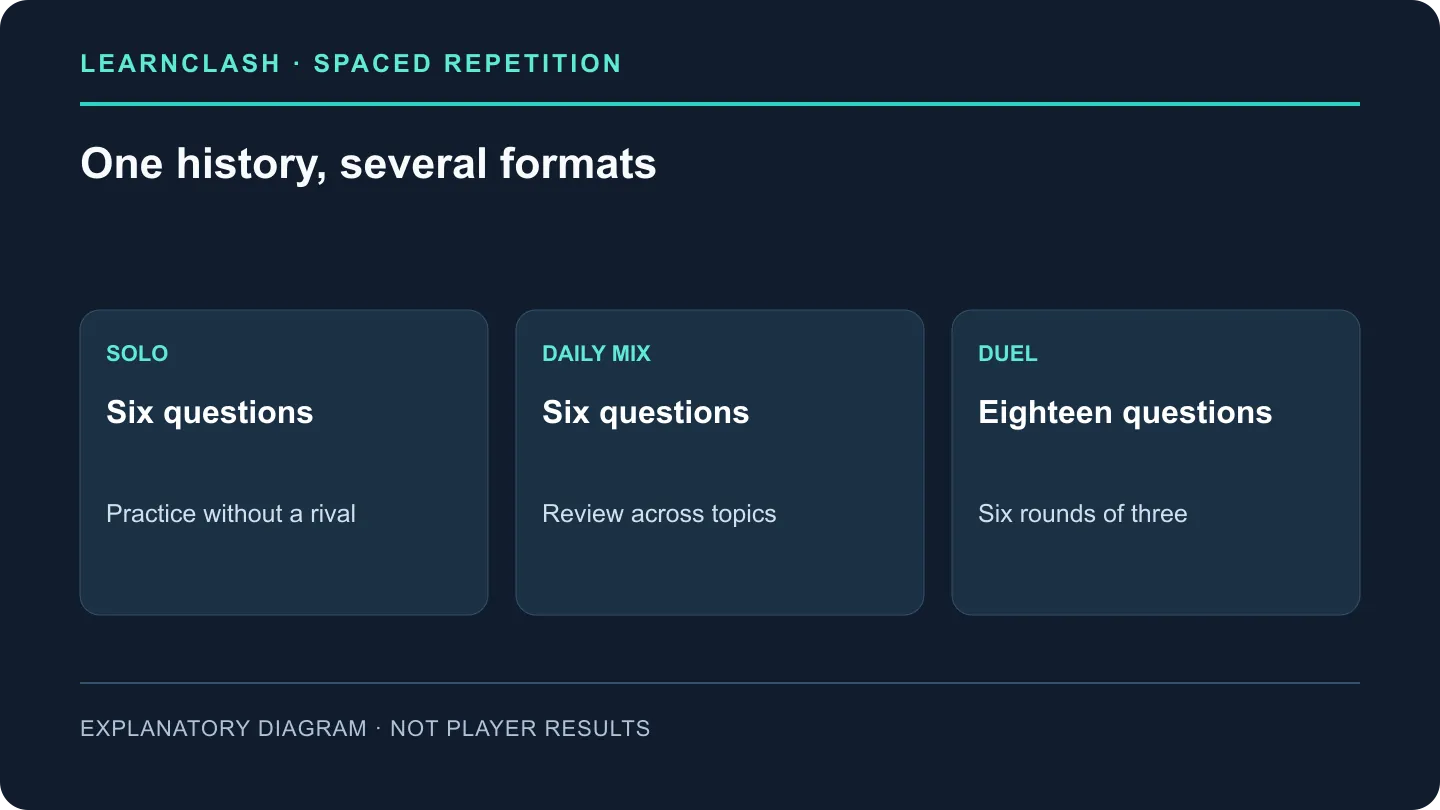
| Format | Planned size | Use |
|---|---|---|
| Solo by topic | Six cards | Practice one subject without an opponent |
| Daily Mix | Six cards | Combine reviews across topics |
| Duel | Eighteen cards | Compete in six rounds of three |
Solo selects due cards first and can fill remaining places with other available cards. Duels must also create a round both players can answer. A due date alone cannot tell you the next card you will see, because choosing a new topic can lead to new cards from that topic even when the due dates on cards in another subject have already passed.
A card encountered during its wait can offer useful practice without earning an early advance. Those are separate outcomes: what you read and think about during the encounter, and the state change allowed by the scheduler. The app records the latter; it does not directly observe everything you learned from the explanation.
Try this while reviewing: identify the fact you confused, read the explanation and notice what happens on a later encounter. If possible, formulate an answer before looking at the options. That is a study strategy to try, not a separate feature claimed for the app.
What You Can Conclude from the System
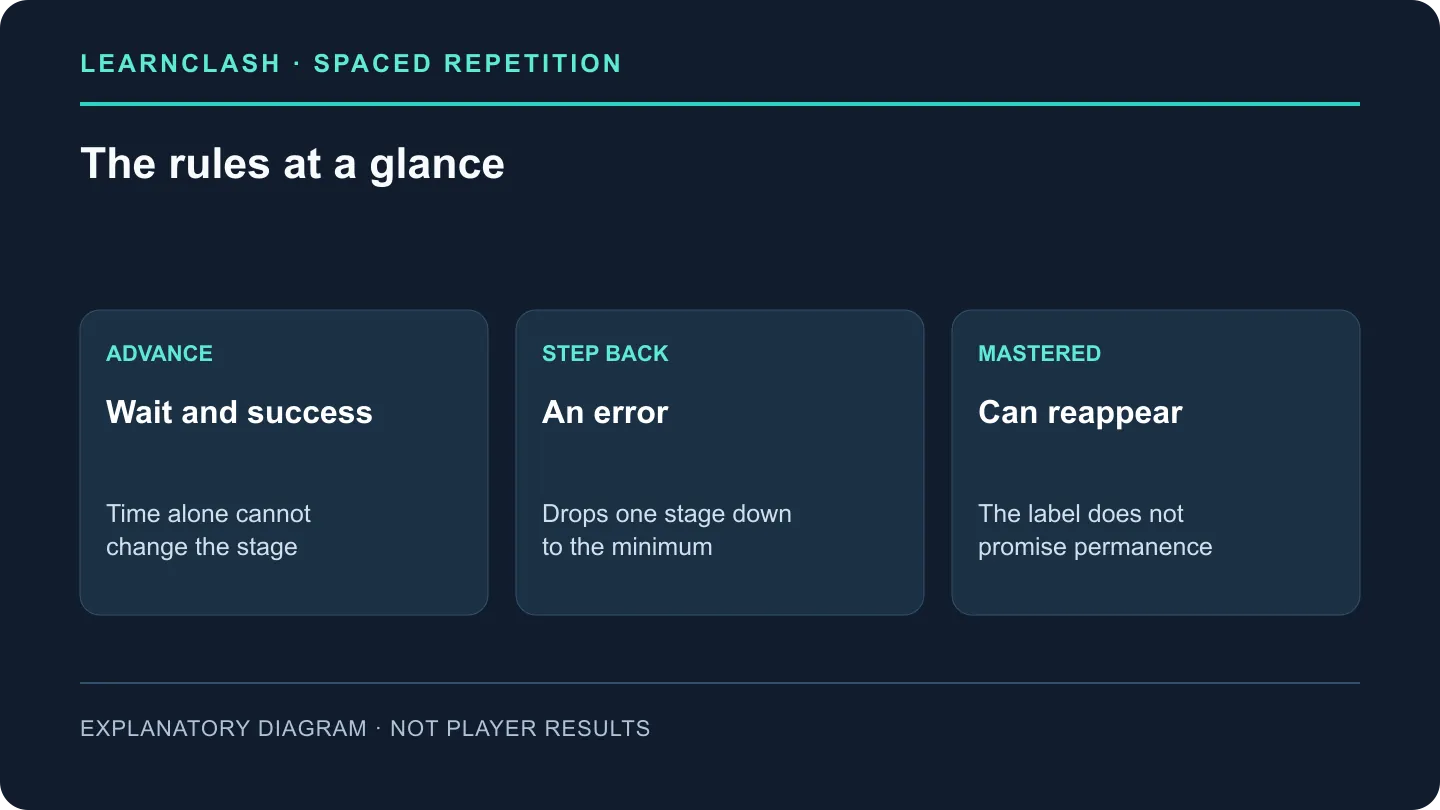
LearnClash offers an understandable review rule: three stages, seven- and ninety-day waits, progress after valid correct answers and a step back after errors. Mastered cards can return. This describes the product. A conclusion about retention needs follow-up evidence, not just a label or a drawing of the rules.
| If you want to understand | Continue with |
|---|---|
| Why to separate reviews | Spaced repetition |
| How to organize cards by state | The Leitner system |
| What a competitive rating measures | ELO ratings |
| How to build a study routine | Effective study methods |
Choose a topic you care about. When a card returns, try to recall the answer and read the explanation if you miss it. That gives you a concrete way to judge whether the format fits your routine, while keeping the meaning of a mastery label clear. You can start a round whenever you are ready.
Frequently asked questions
Does this article show a measured retention curve?
No. It explains LearnClash's review rules with diagrams. Measuring retention needs comparable follow-up responses after defined intervals; counts of review stages cannot supply that curve.
Why does LearnClash use seven and ninety days?
They are product-design waits. Spacing research supports separating encounters and considering the learning goal, but does not prove these two intervals are optimal for each LearnClash player or question.
What happens after an incorrect answer?
Known moves to Learning with a seven-day wait. Mastered moves to Known with a ninety-day wait. Learning stays at the first stage. A mistake cannot move below that stage.
Does a mastered question disappear forever?
No. It has lower review priority but can return when new or pending questions are insufficient. An error moves it back to Known. Mastered is an app stage, not a promise of permanent memory.
Do difficult questions teach more because they cause more errors?
Not necessarily. Errors can reflect difficulty, missing knowledge, ambiguity or faulty content. Evaluating learning requires checking the question and measuring comparable later responses.