
97 Pub Quiz Questions [6 Rounds, Answers, Tie-Breaker]
97 pub quiz questions across six rounds, picture, music, and tie-breakers. Answers and stump explainers included. Play free on LearnClash.

Quiz yourself on these questions
How many do you know?
Think of your answer, then reveal it.
Did you know it before revealing the answer?
Read this answer in the articleRound complete
Challenge friends on this topic.
Start a new duel in LearnClash and learn from every answer.
Get LearnClashFree to play on iPhone and Android. No ads.
The modern pub quiz has a precise start date: 1976, when Sharon Burns and Tom Porter organised 32 teams into three southern-England leagues and sold breweries on quiz night as the cure for an empty midweek room. At the league’s peak, more than 10,000 teams a week played one of their quizzes.
These 97 pub quiz questions and answers follow the six-round format those leagues standardised: General Knowledge, History, Geography, Music, Film & TV, and Food & Drink, then a picture round, a music round, and seven nearest-number tie-breakers. The habit stuck. Trade paper The Publican counted 22,445 quizzes a week across UK pubs in its 2008 survey, roughly 42% of pubs running at least one, and Geeks Who Drink’s bar-owner page lists 800+ weekly events in the US.
Run the whole thing as a quiz night, raid a single round, or start a pub-quiz duel on any topic in LearnClash. If the room needs a lighter opener, ice breaker questions, this or that questions, or would you rather questions all work standing up; remote teams can pull a full format from virtual team building games, and calendar-themed nights can borrow from our Father’s Day trivia questions.
Quick Overview
Ninety-seven questions, nine rounds, one tie-breaker bank: 27 easy, 34 medium, 36 hard. (The old table here under-counted the easy tier; these are the actual tags, tallied fresh.) The tie-breakers are all hard by design, since their only job is to separate two teams that just matched each other for two hours. Every other question carries a difficulty tag too, so you can rebalance a round to fit your room. If your room wants a brutal closing round, the 50 hardest trivia questions bank is sorted by real miss rates from the app.
| Round | Questions | Easy | Medium | Hard |
|---|---|---|---|---|
| Round 1: General Knowledge | 15 | 5 | 6 | 4 |
| Round 2: History | 13 | 6 | 3 | 4 |
| Round 3: Geography | 13 | 2 | 4 | 7 |
| Round 4: Music | 13 | 5 | 4 | 4 |
| Round 5: Film & TV | 13 | 2 | 7 | 4 |
| Round 6: Food & Drink | 13 | 4 | 5 | 4 |
| Picture Round | 5 | 1 | 3 | 1 |
| Music Round: Intros & Lyrics | 5 | 2 | 2 | 1 |
| Tie-Breaker | 7 | 0 | 0 | 7 |
| Total | 97 | 27 | 34 | 36 |
How a Pub Quiz Works: The 6-Round Format
A pub quiz is a team quiz night played in rounds: six spoken rounds of 10 to 15 questions each, a printed picture round, a music round played over the PA, and a nearest-number tie-breaker to split level teams. Most venues land between 30 and 50 questions across 90 to 120 minutes.
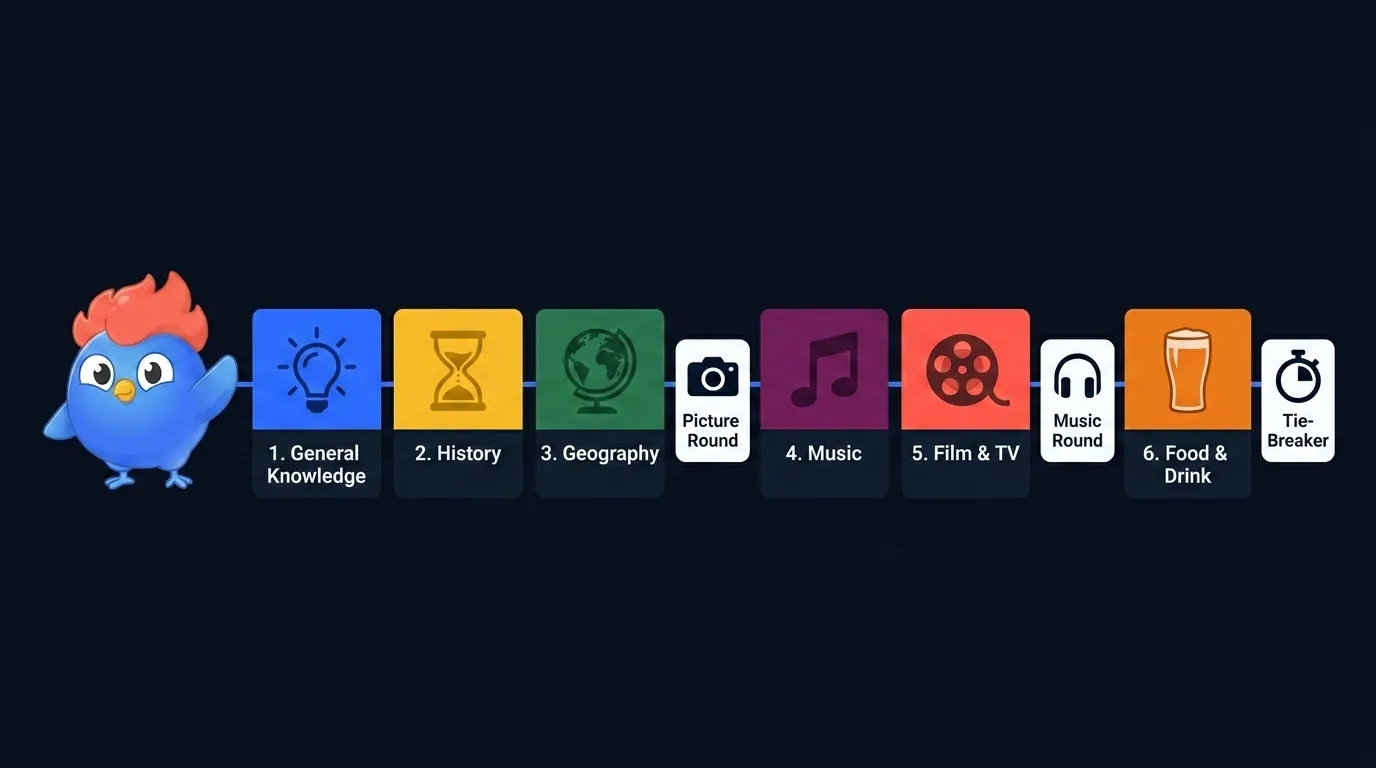
The skeleton barely varies between venues:
- Six spoken rounds, 10 to 15 questions each, read aloud by the host
- One picture round, printed sheets with logos, faces, or objects to identify
- One music round, short intro clips played over the PA
- One tie-breaker, always phrased as a nearest-number question
The earliest quiz night anyone has documented ran in a Yorkshire pub in 1946, a stray entry preserved by the Guinness Book of Records. Burns and Porter arrived thirty years later and turned the curiosity into an industry. By the 1990s the format had crossed the Atlantic, where it picked up local habits: wager rounds, pop-culture wildcards, sponsored leagues. Our 67 bar trivia questions set covers that US-native branch, and the team-building trivia guide reshapes the same rounds into 73 office-safe questions for workplace play.
One thing the app borrowed from this format: hosts pace a spoken round at somewhere between 30 and 60 seconds a question, and that window is why a LearnClash duel gives both players a single shared 45-second clock per question. I picked 45 because it sits in the middle of pub tempo: long enough to argue with yourself, short enough that the round keeps moving.
Order matters less than hosts pretend, with two exceptions. General Knowledge goes first, and Food & Drink goes last. The sections below explain why.
Round 1: General Knowledge
General Knowledge opens the night because every table gets a foothold somewhere. Broad does not mean easy, though. LearnClash’s production question bank has logged 80,553 answers, and 43.5 percent of them landed wrong; the signature stumper of the hardest topic in that index sits right in this round’s territory: “In which country does nodding your head up and down mean no?” Twelve attempts on record, twelve misses. The answer is Bulgaria, and the full league table of what people miss lives in LearnClash by the numbers.
Duel me on general knowledge →
1. How many months of the year have 28 days? Easy
Answer: All 12.
Every month has at least 28 days. But the question is built to make you say “one,” since February is the only month with exactly 28 and no more. A classic opening trap.
2. What is the only letter that does not appear in any US state name? Medium
Answer: Q.
Every other letter turns up in at least one of the 50 state names. Z is rarest (Arizona). X is close behind (Texas, New Mexico). Q gets nothing at all.
3. Which country has a national flag that is not a quadrilateral? Medium
Answer: Nepal.
Nepal’s flag is a pair of stacked triangular pennants, symbolising the Himalayas and Hinduism-Buddhism duality. Every other sovereign flag has four sides; Switzerland and Vatican City run square, and Nepal alone breaks the rule entirely.
4. What percentage of all species that ever lived are now extinct? Medium
Answer: About 99%.
Estimates run from 99.0% to 99.9%. The number you hear most often is over 99%. Most of those extinctions were not mass events but slow species turnover.
5. Which country has the most time zones? Hard
Answer: France, with 12.
Not Russia. France’s overseas departments and territories stretch from French Polynesia to Wallis and Futuna to Saint Pierre and Miquelon, and for part of the year the count reaches 13. Russia and the United States tie for second with 11 each.
6. How many hearts does an octopus have? Easy
Answer: Three.
Two pump blood through the gills. One pumps blood through the rest of the body. When an octopus swims, the main heart actually stops beating, which is why octopuses prefer to crawl.
7. What is the chemical symbol for potassium? Medium
Answer: K.
K comes from the Latin kalium, itself from Arabic al-qalyah (plant ashes). Several element symbols follow this pattern: sodium is Na (natrium), iron is Fe (ferrum), lead is Pb (plumbum).
8. What is the longest English word you can type using only the top row of a QWERTY keyboard? Hard
Answer: “Typewriter.”
Ten letters, all on the top row (Q, W, E, R, T, Y, U, I, O, P). Legend says the keyboard layout was exactly engineered so salespeople could demo the machine by typing the word “typewriter” fluently.
9. What is the only bird that can fly backwards? Easy
Answer: The hummingbird.
A hummingbird’s wings beat in a figure-of-eight pattern and can rotate at the shoulder joint, which allows sustained backward, upward, and hovering flight. No other bird can do this.
10. Which planet is known as both the Morning Star and the Evening Star? Medium
Answer: Venus.
Ancient cultures assumed they were two different objects. Venus is the brightest natural object in the night sky after the Moon. It shows as the Evening Star when it trails the Sun and the Morning Star when it leads the Sun.
11. Which mammal cannot jump? Medium
Answer: The elephant.
An adult elephant is too heavy for its leg bones and joint mechanics to support all-four-off-the-ground motion. It can move fast, but never with all feet airborne. Sloths, hippos, and rhinos also cannot jump, but the elephant is the classic answer.
12. Which planet has the shortest day? Hard
Answer: Jupiter.
Jupiter rotates once every 9 hours and 55 minutes. Gut picks Mercury because it is closest to the Sun, but Mercury takes 59 Earth days just to spin once. For more space surprises, see our 42 space trivia questions.
13. In Morse code, what letter does dot-dash-dot-dot represent? Hard
Answer: L.
Morse gave short codes to common letters and longer ones to the rest: E is a single dot, T a single dash, and mid-pack letters like L stretch to four signals.
14. How many bones does a newborn baby have? Easy
Answer: About 300.
Adults have 206. Many of a baby’s bones, especially the skull plates, fuse together during growth. The final count is reached around age 25.
15. What is the rarest ABO blood type? Easy
Answer: AB negative.
Roughly 0.6% of the global population has AB negative blood. O positive is the most common at about 38%. AB plasma, with or without the negative, is the universal plasma donor type.
Round 2: History
Dates are where confident teams bleed points. Nobody forgets that the Berlin Wall fell; plenty of tables put it in 1990 anyway. The thirteen below, drawn from the same territory as our history trivia questions set, reward whoever double-checks a memory before the pen moves.
16. How long was the Hundred Years’ War? Medium
Answer: 116 years.
From 1337 to 1453. The war lasted more than a century but was given a round-number name for symmetry. It also was not a single continuous war but a series of conflicts across generations.
17. How many of Henry VIII’s six wives were actually his wife under English law? Hard
Answer: Three.
Three of the six marriages were annulled (Catherine of Aragon, Anne Boleyn, and Anne of Cleves), which in law meant they had never happened. The three who stayed wives on paper: Jane Seymour, who died; Catherine Howard, executed but never annulled; and Catherine Parr, who outlived him. Most hosts accept “three” as the trick answer and “six” as the straight one.
18. Who was the first woman to win a Nobel Prize? Medium
Answer: Marie Curie.
She shared the 1903 Physics prize with Pierre Curie and Henri Becquerel for work on radioactivity, then won Chemistry outright in 1911. That second win made her the first person of any gender to take two Nobels, which is the follow-up question hosts love.
19. Which of the seven ancient wonders of the world is still standing? Easy
Answer: The Great Pyramid of Giza.
It is the oldest of the seven and the only survivor. The Lighthouse of Alexandria, the Hanging Gardens of Babylon, and the rest were destroyed by earthquakes, fires, or time.
20. Who was the last Tsar of Russia? Easy
Answer: Nicholas II.
He abdicated in March 1917 during the February Revolution and was executed with his family in July 1918 at Yekaterinburg.
21. Which US state was the first to ratify the Constitution? Medium
Answer: Delaware.
Delaware ratified on 7 December 1787, which is why it is nicknamed “The First State.” Pennsylvania ratified five days later.
22. What ship did Charles Darwin sail on during his 1831 voyage? Easy
Answer: HMS Beagle.
The voyage lasted nearly five years and supplied the observations that became On the Origin of Species in 1859.
23. Who wrote the Communist Manifesto with Karl Marx? Easy
Answer: Friedrich Engels.
The pair published in London in 1848. Engels also edited the second and third volumes of Das Kapital from Marx’s notes after Marx’s death.
24. In what year did the Berlin Wall fall? Easy
Answer: 1989.
The wall was physically breached on 9 November 1989. German reunification followed in 1990, and confusing the two years is the whole trap.
25. Which country was the first to grant women the right to vote? Hard
Answer: New Zealand.
New Zealand granted women’s suffrage in 1893. Australia followed in 1902, Finland in 1906. The United States did not grant nationwide women’s suffrage until the 19th Amendment in 1920.
26. Oxford University began teaching in 1096. Which civilisation was founded AFTER Oxford existed? Hard
Answer: The Aztec Empire.
The Aztec capital Tenochtitlan was founded in 1325. Oxford’s first college, University College, opened in 1249. The empire that feels ancient is two centuries younger than the English university.
27. Who ruled England for just 9 days in 1553? Hard
Answer: Lady Jane Grey.
She was proclaimed Queen on 10 July 1553 and deposed on 19 July when Mary I was proclaimed. She was executed the following February. Her reign is disputed by some historians because she was never crowned.
28. In what city was John F. Kennedy assassinated? Easy
Answer: Dallas, Texas.
On 22 November 1963. The assassination was the fourth of a US president in office.
Round 3: Geography
Reno sits west of Los Angeles. Central Antarctica gets less precipitation than parts of the Sahara. Geography rounds live on facts like these, because most of us carry a world picture assembled from flat projections and half-remembered classroom walls, and quiz setters know exactly where the distortions are. More of the same lives in our geography trivia questions set.
29. What is the largest country in the world by area? Easy
Answer: Russia.
Roughly 17.1 million km². Canada is second at about 10 million km². Russia’s land area is nearly double Canada’s.
30. Which is further west: Reno, Nevada or Los Angeles? Hard
Answer: Reno.
Reno sits at 119.8°W longitude. Los Angeles is at 118.2°W. Nevada’s western edge curves further west than southern California’s coast at those latitudes. The Sierra Nevada range hides this, which is why almost everyone gets it wrong.
31. What is the driest continent on Earth? Hard
Answer: Antarctica.
Parts of the Antarctic interior receive less than 50mm of precipitation a year. That makes them a desert by the scientific definition. The Sahara actually gets more rain than central Antarctica.
32. How many countries does the equator pass through? Hard
Answer: 13.
Colombia, Ecuador, Brazil, São Tomé and Príncipe, Gabon, Republic of the Congo, Democratic Republic of the Congo, Uganda, Kenya, Somalia, Maldives, Indonesia, Kiribati. The Maldives and Kiribati are often forgotten because they are island nations.
33. What country makes Panama hats? Medium
Answer: Ecuador.
Ecuador wove the hat for centuries, then shipped it through the Panama Canal for export. The route stuck to the name instead of the origin. It is also one of the most Google-cheatable trick questions going, which is why sharp hosts warn “no phones” before they read it out.
34. What is the only sea on Earth with no coastline? Hard
Answer: The Sargasso Sea.
It is bounded by four ocean currents (the Gulf Stream, North Atlantic, Canary, and North Atlantic Equatorial currents) rather than by land. It sits in the middle of the North Atlantic Ocean and is famous for its floating Sargassum seaweed.
35. Which African country has the most pyramids? Medium
Answer: Sudan.
Sudan has more than 200 pyramids, well ahead of Egypt’s roughly 120. The Nubian pyramids of the Kingdom of Kush are smaller and steeper-sided than their Egyptian counterparts.
36. What is the smallest country in the world by area? Easy
Answer: Vatican City.
About 0.49 km², an independent enclave within Rome and the administrative heart of the Catholic Church. Teams that write Monaco have named the runner-up.
37. What is the deepest lake in the world? Medium
Answer: Lake Baikal.
In southern Siberia, Russia. Maximum depth 1,642m. It holds roughly 20% of the world’s unfrozen freshwater. It is also the oldest lake on Earth, at an estimated 25 million years.
38. Which country has no permanent natural rivers? Hard
Answer: Saudi Arabia.
Saudi Arabia has wadis (seasonal stream beds) but no rivers that flow year-round. Its freshwater comes from desalinated seawater and aquifers. Several Gulf states share this trait.
39. New Zealand’s Ninety Mile Beach is how many miles long? Hard
Answer: 55 miles.
About 88 kilometres. The usual explanation, that settlers measured the Aupouri Peninsula beach in cattle-walking days at 30 miles a day and the cattle walked slower than expected, is repeated everywhere and documented nowhere solid. Treat the story as seasoning; the length is the answer.
40. What is the largest country that has a land border with France? Hard
Answer: Brazil.
France shares a land border with Brazil through French Guiana, an overseas department of France. Brazil is larger than any of France’s European neighbours. A favourite “got you” in UK pub quizzes and the kind of question that also makes great true-or-false trivia fuel.
41. What is the longest continental mountain range in the world? Medium
Answer: The Andes.
About 7,000 km along the western coast of South America, passing through Venezuela, Colombia, Ecuador, Peru, Bolivia, Chile, and Argentina. The Rockies, for comparison, run roughly 4,800 km.
Round 4: Music
Music splits a table by birth year. The side that sweeps the 1990s goes silent on 1965, and the reverse. Thirteen questions spanning the swing era to streaming, with no mercy for single-generation teams; another 43 wait in the full music trivia questions set.
42. How many keys are on a standard grand piano? Easy
Answer: 88.
52 white keys and 36 black keys. The instrument’s range runs from A0 to C8, spanning more than seven octaves.
43. In what city was jazz born? Easy
Answer: New Orleans.
Late 19th and early 20th century. The style fused African rhythmic traditions, European harmony, and brass-band instrumentation that became widely available after the US Civil War.
44. Which composer was already deaf when he completed his Ninth in D minor? Easy
Answer: Ludwig van Beethoven.
He conducted the premiere in Vienna in 1824 and had to be turned around by a soloist to see the applause he could not hear.
45. What does it mean to sing “a cappella”? Medium
Answer: Without instrumental accompaniment.
The Italian phrase translates as “in the manner of the chapel,” from church music sung unaccompanied. Teams overthink it and reach for “solo”; a hundred-voice choir is still a cappella as long as no instrument plays.
46. Who wrote the MUSIC for Elton John’s hits? Hard
Answer: Elton John himself.
Bernie Taupin wrote the lyrics. The partnership runs so deep that the credit blurs, and a table will hand Taupin the melodies too. He never touched them. Elton John composed the music for “Your Song,” “Rocket Man,” and “Tiny Dancer.” This is the question that ends more music rounds than any other on the list.
47. What was The Beatles’ longest song? Medium
Answer: “Revolution 9.”
8 minutes and 22 seconds from the 1968 White Album. It is an avant-garde sound collage rather than a conventional song, which is why many fans forget it.
48. Which artist holds the record for most cumulative weeks at #1 on the US Billboard Hot 100? Hard
Answer: Mariah Carey.
In December 2025 she became the first artist to pass 100 cumulative weeks at #1, built across 19 chart-toppers. Elvis Presley sits second at 79 weeks. The Beatles still hold the most #1 singles, with 20, and that is the trap: most songs at the top and most weeks at the top are different records.
49. What was Bob Dylan’s birth name? Medium
Answer: Robert Zimmerman.
Robert Allen Zimmerman, born 1941 in Duluth, Minnesota. He adopted the stage name Bob Dylan after Welsh poet Dylan Thomas.
50. What band took their name from an AC/DC label on a sewing machine? Medium
Answer: AC/DC.
Malcolm and Angus Young, founders of the Australian band, saw the letters “AC/DC” (alternating current/direct current) on their sister’s sewing machine motor. They liked the image of power and electricity.
51. What is the best-selling album of all time? Easy
Answer: Thriller by Michael Jackson.
Estimated sales sit around 70 million copies, with some industry claims running far higher. Released in 1982, it held the #1 slot on the Billboard 200 for 37 weeks.
52. Which Pink Floyd album spent 741 consecutive weeks on the Billboard 200 chart? Hard
Answer: The Dark Side of the Moon.
Released in 1973, with estimated global sales of 45 million. It still re-enters the Billboard 200 so reliably that its cumulative chart total keeps climbing decades later.
53. What song did Frank Sinatra record in 1964 that became, by most accounts, the first music played on the Moon? Hard
Answer: “Fly Me to the Moon.”
Buzz Aldrin played it on a portable cassette player during the Apollo 11 mission in 1969. It became an accidental historical footnote. If you want a memory hack for isolated details like this, our guide on how to memorise facts faster covers the technique.
54. Which band appears on the Abbey Road album cover? Easy
Answer: The Beatles.
Photographed on 8 August 1969 at the zebra crossing outside EMI Studios on Abbey Road, London. The crossing is now a UK listed landmark.
Round 5: Film & TV
Film quotes are the great false-memory factory. The most famous lines in cinema are almost all misremembered, and a confident table will defend a line no actor ever delivered. This round pays out for what you can verify, not what you can recite; our movie trivia questions set stocks 43 more in the same spirit.
55. In Star Wars: The Empire Strikes Back, what exactly does Darth Vader say to Luke? Hard
Answer: “No. I am your father.”
Not “Luke, I am your father.” The actual line begins with “No” and does not use the name Luke at all. It is one of the most widely misquoted lines in film history.
56. What was the first feature-length animated film? Medium
Answer: Snow White and the Seven Dwarfs.
Released by Walt Disney Productions in 1937. There were earlier animated shorts and compilations, but Snow White was the first full-length cel-animated feature.
57. Which actor has won the most Academy Awards? Medium
Answer: Katharine Hepburn.
Four Best Actress Oscars, for Morning Glory (1933), Guess Who’s Coming to Dinner (1967), The Lion in Winter (1968), and On Golden Pond (1981). No other actor has matched four wins in a lead acting category.
58. What was Pixar’s first feature film? Easy
Answer: Toy Story.
Released in November 1995. It was also the first entirely computer-animated feature film.
59. Which film was the first to gross $1 billion worldwide? Hard
Answer: Titanic.
James Cameron’s 1997 film passed $1 billion in March 1998. It held the all-time box office record for twelve years until Avatar (also Cameron) passed it in 2010.
60. In the US sitcom Friends, what is the name of Ross’s second wife? Medium
Answer: Emily.
Emily Waltham. They marry in London in Season 4 and divorce after Ross says “Rachel” at the altar.
61. Which US sitcom’s 1983 finale still holds the record for the most-watched scripted episode in American television history? Hard
Answer: M*A*S*H.
“Goodbye, Farewell and Amen” drew just under 106 million US viewers on 28 February 1983. No scripted broadcast has come close since, and the fragmentation of TV audiences means one probably never will.
62. What was Gone With The Wind’s best-selling format before the 1939 film? Medium
Answer: A novel.
Margaret Mitchell’s 1936 novel won the Pulitzer Prize in 1937 and sold about a million copies within six months of publication. It remains one of the best-selling American novels of all time.
63. Which 1994 film opens with a feather drifting down to a man waiting on a bench in Savannah, Georgia? Easy
Answer: Forrest Gump.
It beat Pulp Fiction and The Shawshank Redemption to Best Picture. Quote it carefully, though: the actual line is past tense, “Life was like a box of chocolates,” which is why it doubles as a trap in misquote rounds.
64. Who directed Citizen Kane, widely cited as the greatest film ever made? Medium
Answer: Orson Welles.
Welles directed, co-wrote, produced, and starred in Citizen Kane (1941). He was 25 years old at the time. The film was largely unsuccessful on release and only gained critical consensus years later.
65. How many episodes of Seinfeld were produced? Hard
Answer: 180.
Over nine seasons, from 1989 to 1998. The finale, which aired on 14 May 1998, was watched by an estimated 76 million US viewers.
66. In what year did the first Doctor Who episode air? Medium
Answer: 1963.
On 23 November, the day after John F. Kennedy’s assassination. The BBC aired a repeat the following week because many viewers had missed the original broadcast.
67. What is the highest-grossing film of all time at the worldwide box office (unadjusted for inflation)? Medium
Answer: Avatar.
James Cameron’s 2009 film has grossed over $2.9 billion worldwide, including a 2022 re-release. Avengers: Endgame briefly held the record before Avatar’s re-release reclaimed it.
Round 6: Food & Drink
Hosts sequence food and drink last for a reason: half of these are trick questions in a friendly costume, and by round six the room is relaxed enough to fall for them. Menu knowledge will not save anyone here.
68. What is the most consumed drink in the world after water? Easy
Answer: Tea.
Yes, not coffee. By most estimates global tea consumption tops six billion kilograms a year, driven by China, India, and Turkey. Coffee is a close second.
69. What country is the world’s largest exporter of coffee? Medium
Answer: Brazil.
Brazil grows close to 40% of the world’s coffee and ships more of it abroad than any other country. Vietnam is a distant second. Colombia is third.
70. What is the primary ingredient in Japanese sake? Easy
Answer: Rice.
Sake is brewed from fermented rice, water, and koji mould. It is sometimes called “rice wine” in English but is closer to beer in its brewing process (starches converted to sugars before fermentation).
71. From which animal do we usually get “catgut” strings? Hard
Answer: Sheep or horses.
Not cats. Catgut is made from the intestines of sheep, goats, or horses. The name is a corruption of “kitgut” (kit being an old word for a small fiddle) or “catapult” (the bowstring material).
72. What is a camel’s-hair brush usually made of? Hard
Answer: Squirrel fur.
Not camel; the brushes have always used squirrel, goat, or pony hair. One story credits an 18th-century brushmaker named Camel with the design, though nobody has ever confirmed he existed. Either way, a classic pub quiz trick question.
73. In what country was ketchup first made? Medium
Answer: China.
Kê-tsiap, a fermented fish-sauce condiment, originated in 17th-century coastal China. British traders brought it home, swapped the fish for mushrooms or walnuts, and American cooks later substituted tomatoes in the 19th century.
74. Which fruit is the most consumed in the world? Medium
Answer: Tomato.
Yes, tomato is botanically a fruit. Global tomato production tops 180 million tonnes a year, driven by its role in sauces, pastes, and soups across most global cuisines. Bananas are second.
75. What spirit is the base of a Negroni cocktail? Medium
Answer: Gin.
One part each of gin, Campari, and sweet vermouth, built over ice. Campari’s bitterness dominates the glass, which is why teams name it as the base; the gin is doing the structural work underneath.
76. What is the most expensive spice in the world by weight? Medium
Answer: Saffron.
Roughly $5,000-$10,000 per kilogram depending on grade. It takes about 150,000 Crocus sativus flowers to produce 1 kilogram of dried saffron, and each flower is harvested by hand.
77. Where was the first restaurant (in the modern sense) opened? Hard
Answer: Paris.
In 1765. A bouillon shop run by a Monsieur Boulanger is cited as the first establishment to offer menus, individual tables, and seated service, rather than a communal inn meal.
78. What is the main ingredient of Bombay duck? Hard
Answer: Fish.
Despite the name, Bombay duck is not a duck at all. It is a lizardfish native to the Arabian Sea, dried and salted as a condiment in Indian cuisine.
79. How many grapes are usually eaten at midnight on New Year’s Eve in Spain? Easy
Answer: Twelve.
One grape per strike of the midnight clock, each buying a month of luck. Accounts of the custom’s origin differ between a late-19th-century Madrid fashion and an early-1900s growers’ push to sell a surplus harvest; Spain eats the grapes either way.
80. Which soft drink is known as Scotland’s “other national drink”? Easy
Answer: Irn-Bru.
AG Barr launched it as Iron Brew in 1901 and respelled it Irn-Bru in 1946, when proposed labelling rules demanded brand names be literally true: the drink contains iron but is not brewed. The “made in Scotland from girders” slogan came later.
Picture Round
The picture round swaps listening for looking: printed sheets, obscured logos, silhouettes, landmark photos. It is also where funny pub quiz questions land best, since a silly silhouette gets a laugh no spoken one-liner matches. Each entry below describes what the sheet usually shows, because a written page cannot hand you the sheet itself.
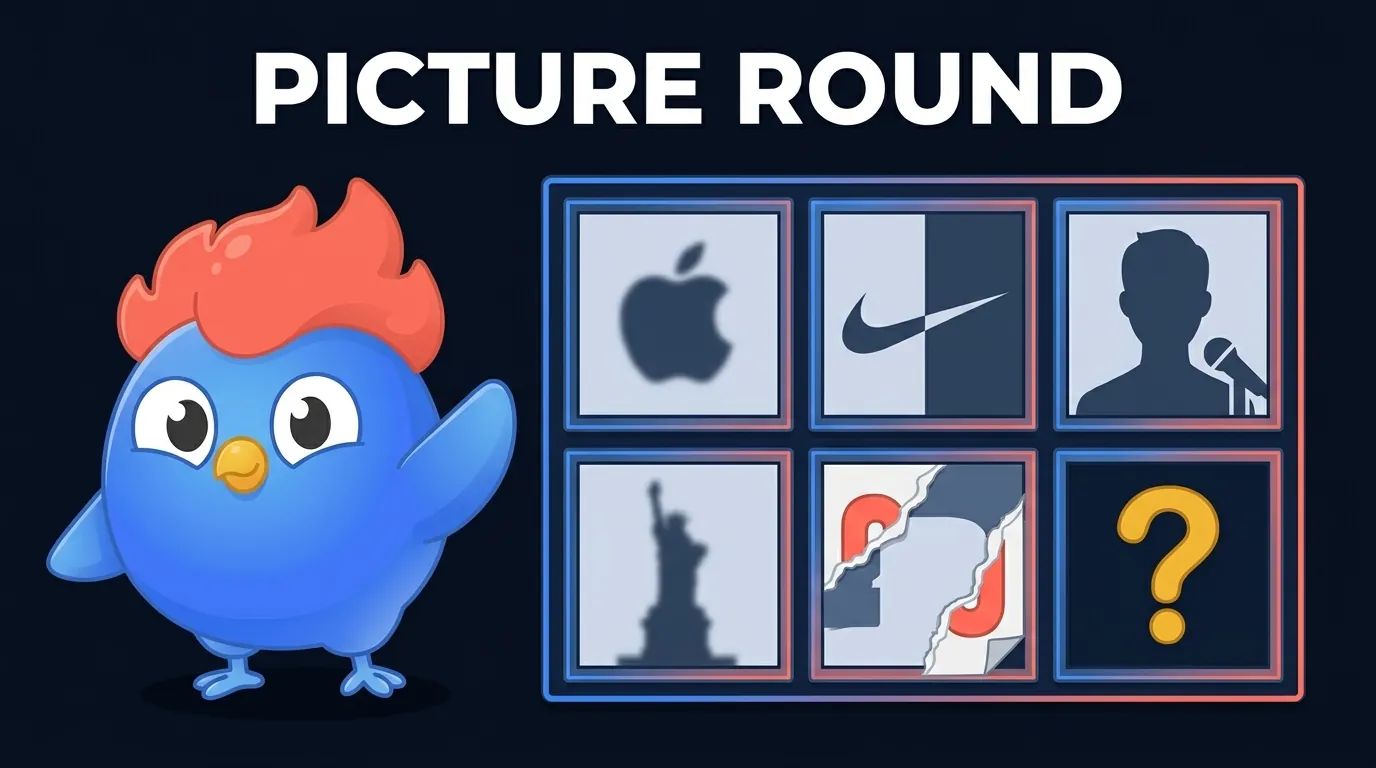
81. An apple silhouette with one bite taken out, black on white. Company? Easy
Answer: Apple Inc.
The bite was added by designer Rob Janoff in 1977 so viewers would not mistake the silhouette for a cherry at small sizes. The first-version logo from 1976, designed by Ronald Wayne, depicted Isaac Newton under a tree.
82. A partial swoosh in orange. Brand? Medium
Answer: Nike.
Carolyn Davidson designed the swoosh in 1971 and was paid $35. She later received Nike stock worth significantly more.
83. A silhouette of a tall, thin man with a bowler hat, holding a cane. Comedian? Medium
Answer: Charlie Chaplin.
His “Tramp” character first appeared in Kid Auto Races at Venice (1914) and became one of the most recognised silhouettes in film history.
84. A landmark photograph of two identical towers. City? Hard
Answer: Kuala Lumpur, Malaysia.
The Petronas Towers. They held the title of world’s tallest buildings from 1998 to 2004, when the Taipei 101 took the record.
85. Three curved brushstrokes, one red, one blue, one green, sweeping around a single point. Which sporting event’s symbol is this? Medium
Answer: The Paralympic Games.
The three “agitos” (from the Latin for “I move”) became the Paralympic symbol in 2003, replacing the earlier tae-geuk crescents, and launched publicly at the Athens 2004 closing ceremony.
Music Round: Intros & Lyrics
The music round plays 10 to 15 second song intros or lyric snippets over the PA, and teams name the song, the artist, the year, or all three. Five below, written out as prompts a host can read.
86. Song opens with a distinctive four-note bassline: “Dum, dum, dum, dum-dum.” Name the song. Easy
Answer: “Another One Bites the Dust” by Queen.
1980, from The Game. The bassline is often cited as one of the most recognisable opening hooks in pop music.
87. Intro features the lyric “Is this the real life? Is this just fantasy?” Name the song and year. Medium
Answer: “Bohemian Rhapsody” by Queen, 1975.
From A Night at the Opera. Six minutes long, no chorus, and famously difficult to categorise. It spent nine weeks at #1 on the UK Singles Chart on first release.
88. A song begins with the words “Imagine there’s no heaven.” Artist? Easy
Answer: John Lennon.
Released 1971. The piano intro is one of the most recognisable in popular music.
89. A song opens: “Hello darkness, my old friend…” Duo? Medium
Answer: Simon & Garfunkel.
“The Sound of Silence,” released in 1964 and revitalised in 1965 after Columbia Records added electric instrumentation without the duo’s knowledge.
90. A song opens with the line “Please allow me to introduce myself.” Name the song and the band. Hard
Answer: “Sympathy for the Devil” by The Rolling Stones.
From Beggars Banquet, 1968. The samba groove runs for a while before the vocal arrives, so teams that only know the famous line from print still miss the intro-clip version.
Tie-Breaker Questions
Tie-breakers come out when two or more teams finish the main rounds level. The phrasing is the whole trick: they are always framed as nearest-number questions, because asking for an exact fact just produces another tie. Closest guess wins, over or under, and every host needs a bank of these ready before the night starts. Seven of our favourites.
91. To the nearest year, when was the Eiffel Tower completed? Hard
Answer: 1889.
Officially inaugurated on 31 March 1889 for the Exposition Universelle marking the 100th anniversary of the French Revolution.
92. To the nearest metre, how tall is Mount Everest above sea level? Hard
Answer: 8,849 metres.
The most recent joint Nepal-China survey in 2020 set the official height at 8,848.86 metres. Earlier surveys put it at 8,848 or 8,850.
93. To the nearest thousand, how many words are in the complete King James Bible? Hard
Answer: 783,137.
Round to 783,000. Counts vary a little by edition and by what you count, but 783,137 is the figure most quiz masters accept.
94. To the nearest year, in what year did the RMS Titanic sink? Hard
Answer: 1912.
On 14-15 April 1912, on her maiden voyage from Southampton to New York. Roughly 1,500 passengers and crew died; the US inquiry counted 1,517, the British inquiry 1,490.
95. To the nearest pound, how much does the Statue of Liberty weigh in copper cladding alone? Hard
Answer: 62,000 pounds.
About 31 short tons of copper, hammered into sheets roughly 2.4mm thick, about the thickness of two pennies. The total weight of the statue including the iron interior framework is roughly 450,000 pounds.
96. To the nearest 10 million, what is the estimated human population of the world in August 2026? Hard
Answer: About 8,310,000,000.
UN-based population clocks put mid-August 2026 at roughly 8.31 billion, climbing by around 70 million a year. Any answer near 8.3 billion should take the point.
97. To the nearest cent, what is the exchange rate of 1 GBP to 1 EUR as of 12 August 2026? Hard
Answer: Approximately €1.17.
The rate fluctuates within a few cents. Pub quiz tie-breakers on live currency values are controversial because the “correct” answer depends on which source and which timestamp the host picked. Hosts should publish their reference source up front.
How to Win a Pub Quiz: Team of 5 Strategy
Five is the classic pub quiz team, and the case for it is more practical than scientific. The closest genuine research, Hackman and Vidmar’s small-group experiments from 1970, found decision-making teams peaked at about 4.6 members. Pub tables add a physical constraint on top: whoever holds the pen has to hear you. Under four, whole categories go dark; past six, the quiet specialist stops being consulted.
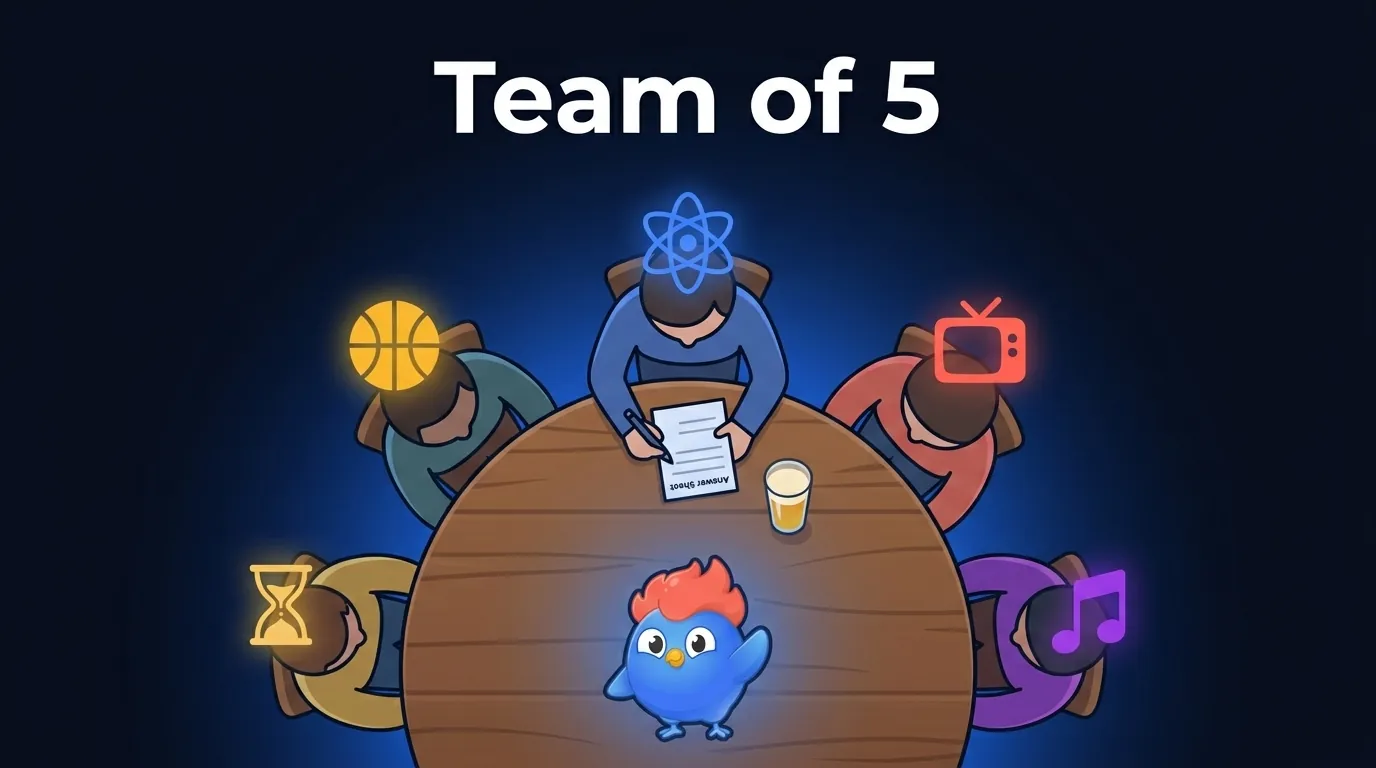
The team build that wins most often:
- One sports specialist: covers football, cricket, tennis, and US sports
- One history and literature specialist: Oxford-date-style questions and classic-book plots
- One music and pop culture specialist: covers Music Round and Film & TV
- One science and general-knowledge specialist: GK round’s science questions
- One current-events and geography specialist: the one who knows where Reno actually is
The last role is the most underrated. Quiz setters love to sneak in questions about last year’s news, and “Which country has the most time zones” will sink any team without a geography mind.
Execution tips that hold up across a long quiz night:
- On a 50/50, let the most confident voice decide, then move on. The minutes a re-litigation eats cost more points across the night than the swap ever gains.
- Leave the tie-breaker to the team member with the best instinct for scale. Mathematical averaging rarely wins.
- The old advice to never change a written answer is backwards. When Kruger, Wirtz, and Miller studied answer-switching in 2005, most changes went wrong-to-right, and a review of 33 earlier studies found the same direction every time. Change it when you have a concrete reason; “first instinct” is not one.
- Work the testing effect between rounds. While the host tallies, have someone fire two or three facts from the round just played back at the table. Recalling a fact under mild pressure fixes it far harder than hearing the answer read out again.
How to Host a Pub Quiz on LearnClash
An honest answer first: LearnClash is not a host console. There is no projector mode, no printable answer sheets, no team scoreboard, and this page will not pretend otherwise. It is a duel app, and three of its pieces happen to map well onto quiz night:
- Build the theme. Add any subject as a topic and the app generates questions for it at every difficulty tier, niche pub themes included. Useful when the pre-printed packs have nothing on your room’s obsession.
- Train for the night. Every question you miss comes back for review after 7 days, then after 90; clear both and the question locks in as Mastered. Solo sessions run 6 questions, short enough to finish at the bar.
- Settle the argument. A duel deals three questions on each of six topics, 18 in all, on that shared 45-second clock, matched by an ELO-style rating that starts everyone at 1300. Speed does nothing to the score; a right answer in the final second is worth exactly as much as an instant one.
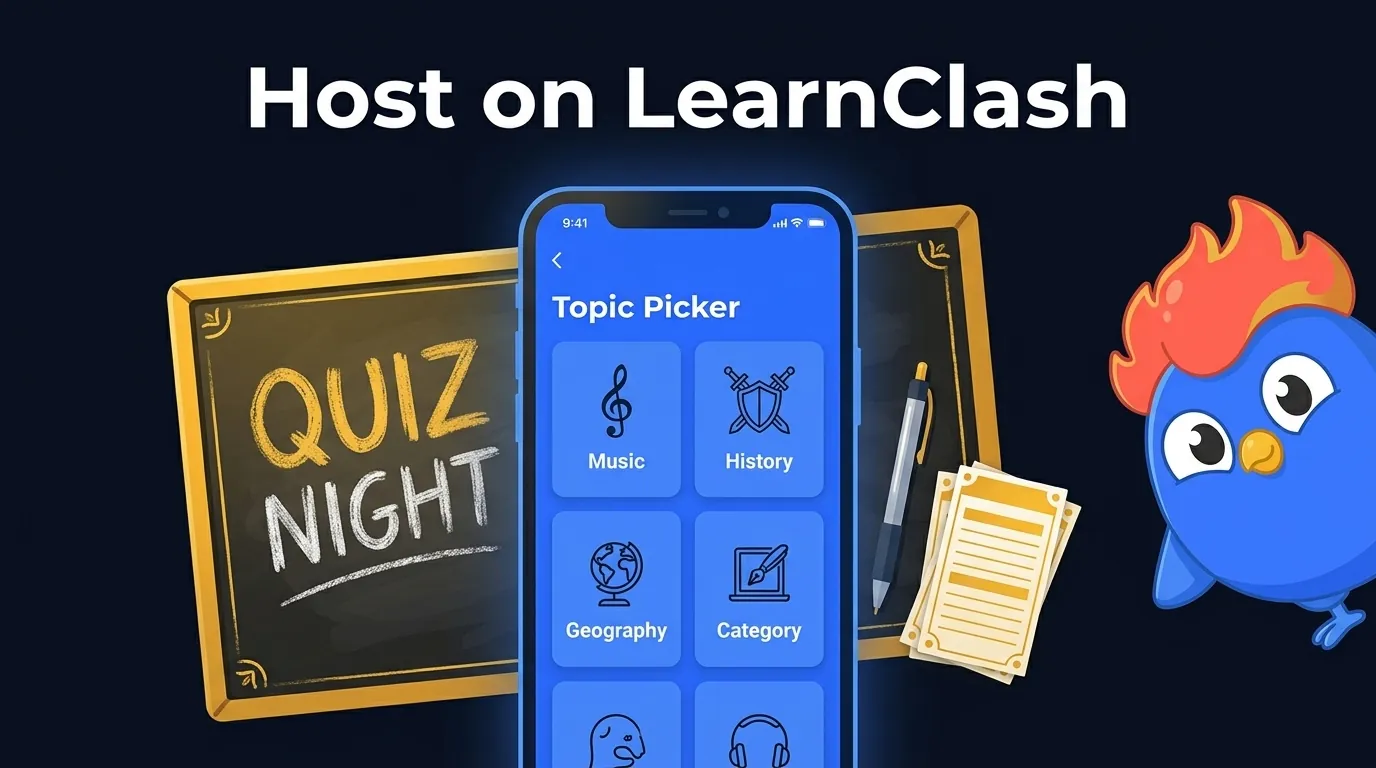
For the full directory behind these rounds, the trivia questions pillar indexes 37 topic sets holding 1,899 questions with answers, science to celebrity to kids, each linking to its complete list. Or skip the paper entirely and duel a friend on any of it.
Frequently asked questions
How many rounds are in a typical pub quiz?
A typical pub quiz runs six spoken rounds covering General Knowledge, History, Geography, Music, Film & TV, and Food & Drink, plus a picture round and a music round. Most venues land between 30 and 50 questions across 90 to 120 minutes and keep a tie-breaker ready in case two teams finish level. This guide includes 97 questions structured exactly that way, with difficulty tags so you can rebalance any round for your room.
What is the optimal pub quiz team size?
Four to six, with five the classic answer. The closest real research, Hackman and Vidmar's 1970 small-group experiments, put the ideal at about 4.6 members for decision tasks. In pub terms: five specialists cover sports, history, pop culture, science, and geography, and the odd number breaks 50/50 arguments before they eat the clock.
Are pub quiz questions and trivia questions the same thing?
They overlap, but pub quiz questions carry UK heritage conventions: round-based structure, a picture round, a music round, a tie-breaker, and a lean toward General Knowledge plus food and drink content. US bar trivia adds wager rounds and pop-culture wildcards. LearnClash covers both styles across 36 topic sets, so you can play either from the same app.
Who invented the pub quiz?
Sharon Burns and Tom Porter built the modern pub quiz. In 1976 they set up 32 teams in three quiz leagues across southern England, then spent years pitching the format to breweries; at the league's peak, over 10,000 teams a week played a Burns and Porter quiz. The earliest recorded quiz night predates them by three decades, in a 1946 Yorkshire pub.
Can you use LearnClash to host a pub quiz?
Partly. LearnClash is built around 1v1 duels and solo practice rather than projector hosting; there is no print or screen-share mode. What does work for quiz night: add your theme as a topic and let the app generate questions at every difficulty tier for inspiration, drill stumpers in 6-question solo sessions before the night, or settle a disputed table argument on the spot with an 18-question duel.