
Kahoot vs Blooket: Free Khanmigo AI vs $6K Spirit [Aug 2026]
Kahoot vs Blooket, re-checked August 2026: free Khanmigo AI, our $121 Kahoot Bronze error corrected to $36 a year, the $6,000 Spirit floor, the research.

One runs a live quiz show. The other runs a video game. Kahoot is a host-controlled live quiz where students race a countdown timer; Blooket wraps quiz questions inside strategy games like Tower Defense and Gold Quest, played at each student’s own pace. Blooket has had free Khanmigo AI question generation with no usage caps since January 21, 2025, while Kahoot’s AI still sits mostly behind paid plans. Neither has spaced repetition.
For this August 2026 update I re-checked every price, cap, and feature date against the live vendor pages, and the biggest correction landed on my own work. The Kahoot Bronze price this article carried in May was wrong, and two Blooket “2026 modes” from that same version failed verification and are gone.
Kahoot vs Blooket: Quick Comparison
Kahoot and Blooket gamify classroom review with opposite play styles: Kahoot is a host-led quiz show, Blooket hands students a strategy game. That one choice shapes everything downstream, from who sets the pace to what “winning” rewards.
| Feature | Kahoot | Blooket |
|---|---|---|
| Format | Live quiz show, host-controlled | Strategy games, student-paced |
| Free players | 10 (personal), 40 (school accounts) | 60 |
| Paid players | 50 (Bronze) up to 800 (Kahoot! One); school plans reach 2,000+ | 300 (Plus) |
| Game modes | 14, plan-gated (rebranded “experiences” in 2026) | 25+ counting seasonal and Plus-only modes; no official count published |
| Speed-based scoring | Yes (Classic mode default) | No (strategy and luck-based) |
| Learning evidence | Özdemir 2025 meta-analysis (43 studies) | Fewer than 5 published studies |
| Spaced repetition | None | None |
| Cheapest paid plan | $36/yr Bronze, billed annually (August 2026 listing) | $4.99/mo Plus (annual), $9.99/mo Plus Flex |
| AI question generation | Trial generations free, then paid; 70 languages since May 6, 2026 | Khanmigo + Blooket, free since Jan 21, 2025, no usage caps |
| Standards alignment | TEKS, CCSS, NGSS code search and tagging (April 2026) | Khan Academy curriculum spine via Khanmigo |
| Cheating risk | Low (server-side delivery) | High (client-side, GitHub scripts) |
| Founded | 2012 (Norway) | 2018 (US, Tom and Ben Stewart) |
Two rows in that table carry most of the argument. The free-player row explains why teachers drifted toward Blooket for years before Google Trends made it visible in January 2026, and the AI row explains why the drift accelerated after January 2025.
What Actually Shipped in 2025 and 2026
The launch that reframed this comparison predates 2026. On January 21, 2025, Khan Academy and Blooket shipped the Khanmigo + Blooket Generator: free AI question generation, no usage caps, sitting in Blooket’s free tier more than 15 months before Kahoot’s May 6, 2026 AI Generator update brought 70 languages and curriculum-standards search to its own tool. In between, Kahoot launched Energize for workplace meetings (February 2025), rolled out the standards-tagging tool in April 2026, and introduced the 360 Spirit AI tier. Blooket’s verified 2026 shipments are quieter: Save States for its solo modes, Solo Links for homework, and Plus Flex monthly billing.
| Period | Kahoot | Blooket |
|---|---|---|
| Jan 21, 2025 | Khanmigo + Blooket Generator: free AI question sets, no usage caps | |
| Feb 4, 2025 | Kahoot! Energize launches (workplace pivot) | |
| Jan 2026 | Google Trends crossover: Blooket passes Kahoot in US search interest | |
| April 6, 2026 | Standards-tagging tool: TEKS, CCSS, NGSS code search across all 50 states | |
| May 6, 2026 | AI Generator update: 70 languages + curriculum-standards search | |
| H1 2026 | 360 Spirit AI tier | Save States, Solo Links, Plus Flex $9.99/mo |
A correction is owed here. The May version of this article described two 2026 Blooket modes called Adventure Quest and Quiz Kingdom. An August re-check could not verify either against Blooket’s own mode previews or any fan-maintained mode tracker, so both have been removed from this page.
Neither platform’s 2025-2026 roadmap touched the variable that decides whether students remember anything past Friday. A missed answer in Kahoot Accuracy Mode or Blooket Gold Quest still dies with the session.
Game Format: Live Quiz Show vs Strategy Games
Kahoot’s format is a game show. The host shares a PIN, music builds, a timer counts down, and the podium reveals the top three. Teachers love it because the room feels alive: thirty phones out, thirty students focused on the same question at the same time.
There is a cost baked into that energy. In Classic mode, faster correct answers earn more points, so a student who reads slowly but knows the material scores lower than one who guesses fast. Accuracy Mode addresses this by counting only correctness, and Kahoot has pushed it across paid tiers, but Classic remains the default and most sessions never leave it.
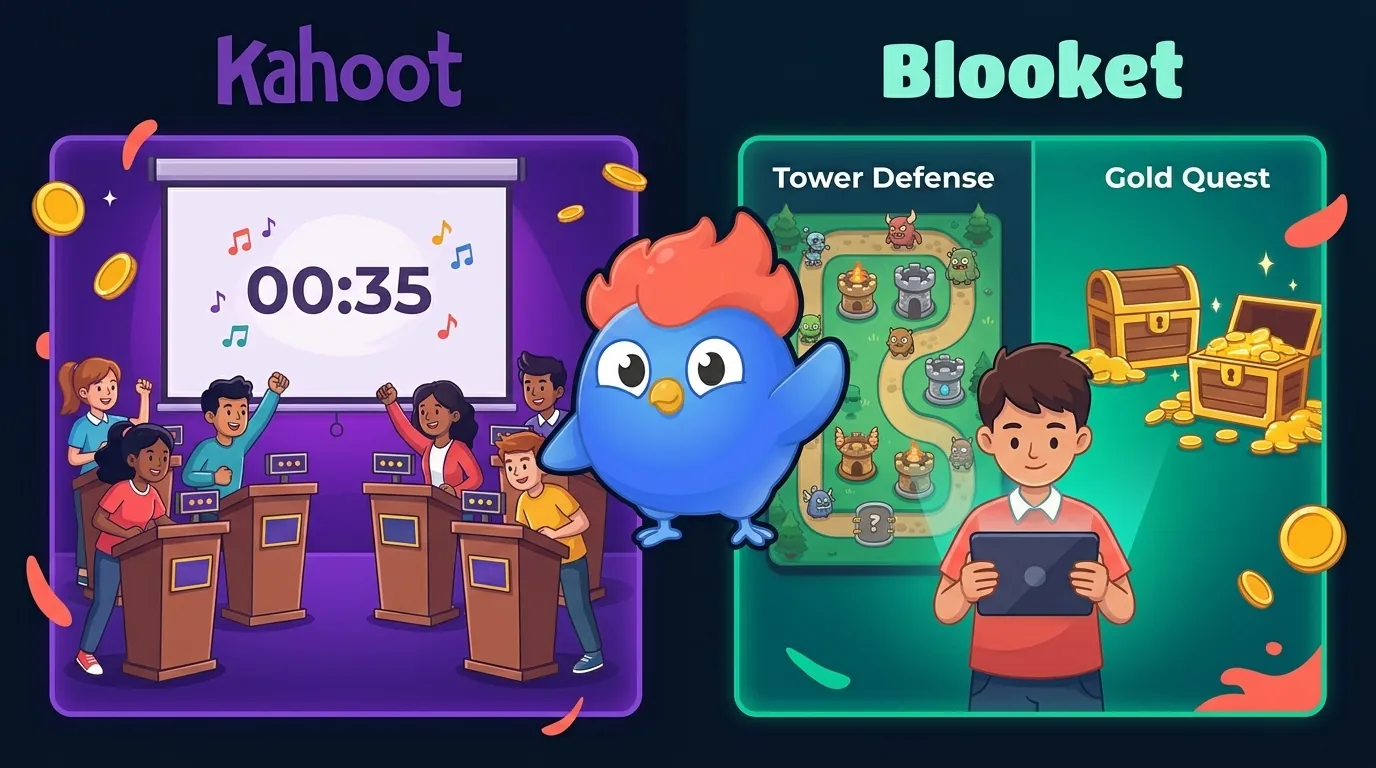
Blooket flips the model. Each mode wraps the quiz inside a strategy game that students drive themselves:
- Tower Defense 2: correct answers place defensive towers, and Save States let you resume later
- Gold Quest: correct answers open treasure chests with deliberately luck-based rewards
- Cafe: correct answers earn currency to build a restaurant, also with Save States
- Racing: correct answers move your character forward
- Crypto Hack, Fishing Frenzy, Battle Royale, and a rotating cast of seasonal modes round out a catalog of 25+
The catch is what Gold Quest optimizes for. A student who answers 5 questions correctly can beat someone who answered 50 through random chest luck; the mode is built that way on purpose. Teachers on Reddit have asked, reasonably, whether their students are focused on the math or on the slot machine.
| Kahoot | Blooket | |
|---|---|---|
| Pacing | Host sets the speed | Student controls the speed |
| Winning factor | Speed + accuracy | Strategy + luck + accuracy |
| Session type | Synchronous (everyone online) | Synchronous or homework (async) |
| Projector needed | Yes (host screen) | No (each student on their own device) |
| Save and resume | No | Yes, on solo modes like Tower Defense 2 and Cafe |
Wayground (formerly Quizizz) and Gimkit compete in the same space. Quizizz rebranded to Wayground on June 24, 2025 and plays closer to Kahoot’s self-paced quizzing; Gimkit leans toward Blooket’s style, with an in-game economy. So the trade sits here: speed pressure punishes slow-but-correct readers in Kahoot Classic, luck punishes high-effort answerers in Gold Quest, and you pick which distortion your classroom tolerates better.
Khanmigo + Blooket: Free AI Question Generation Since January 2025
The Khanmigo + Blooket Generator is free AI question generation with no usage caps: sign in to Khanmigo (free for educators), type any topic, and export the generated set into any Blooket mode in one click.
Kahoot’s equivalent path is paid. Free Kahoot accounts get a limited number of trial AI generations; sustained AI use starts with the paid teacher plans, and the full AI feature set (courses, reports, branding) sits in Kahoot 360 Spirit, which published at $20 per license per month with a 25-license minimum, a $6,000-per-year floor. As of August 2026, Spirit pricing is quoted through sales rather than listed publicly. LearnClash sits in a different lane again: AI question generation runs at duel time and the Clash Chat tutor explains every wrong answer, with no separate AI subscription.
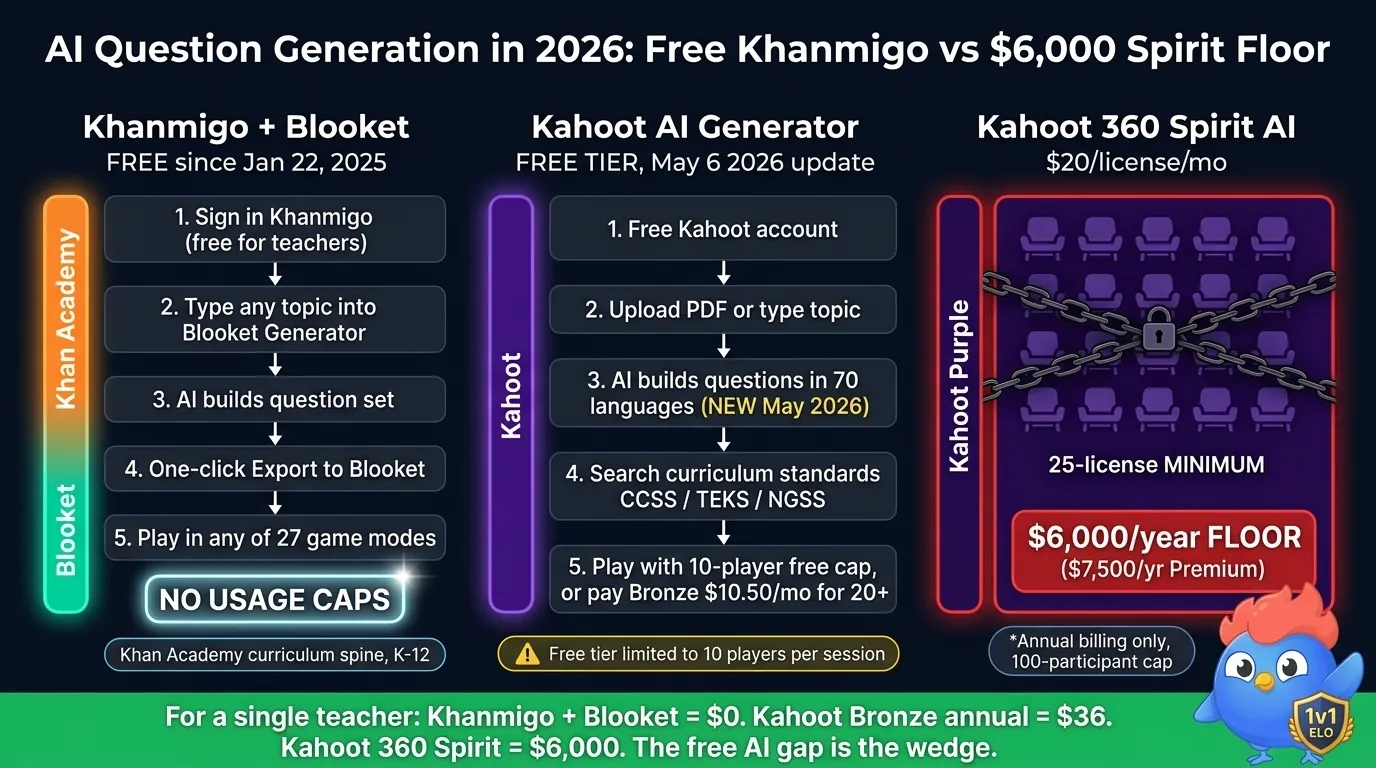
| Khanmigo + Blooket (free since Jan 21, 2025) | Kahoot AI Generator | Kahoot 360 Spirit AI | |
|---|---|---|---|
| Sign-in | Khan Academy account (free for teachers) | Free Kahoot account | 25-license minimum, sales-quoted (Aug 2026) |
| Workflow | Type topic → AI builds set → export to Blooket | Upload PDF or type topic; 70 languages since May 6, 2026 | AI slides, course creation, branding, reports |
| Usage caps | None on free tier | Trial generations free, then paid; free sessions cap at 10 players | Unlimited within license seats |
| Curriculum alignment | Khan Academy K-12 spine | TEKS, CCSS, NGSS code search (2026) | Custom + enterprise reporting |
| Cost for one teacher | $0 | $0 to try; $36/yr Bronze for real use | $6,000/yr floor (25 × $20 × 12, published rate) |
| Cost for a 25-teacher department | $0 | $900/yr (25 Bronze seats at August 2026 listing) | $6,000/yr and up |
The single-teacher math still favors Khanmigo, but the gap is smaller than the May version of this article claimed. That version priced the cheapest Kahoot path to AI for a full class at $121 per year; the real listing, on the live page and in a May 21 archive snapshot alike, is $36 per year with a 50-player cap that actually covers a classroom. Free-with-no-caps still beats $36, and Khan Academy’s curriculum spine and nonprofit trust still matter more to many departments than the raw generation quality, which is roughly comparable across modern tools.
Kahoot’s May 6, 2026 update deserves its credit. Seventy languages is a real jump, and curriculum-standards search inside the generator is the kind of feature curriculum leads ask for by name. It arrived more than 15 months after Khanmigo shipped, into a product where the free tier remains a trial.
Learning Evidence: 43 Studies vs Almost None
Kahoot has the strongest academic evidence of any classroom quiz platform. The headline study is Özdemir 2025, Journal of Computer Assisted Learning 41(1), e13084, a meta-analysis of 43 studies covering 3,353 students (1,706 experimental, 1,647 control). It reports an effect size of 0.772 standard deviations on academic achievement, which the education-research conventions class as moderate to large, and 1.492 on knowledge retention, which is unambiguously large. Blooket has fewer than 5 published studies. LearnClash builds on the same retrieval-practice evidence by adding spaced repetition to ranked quiz play, on a 3-stage schedule we chose after rejecting the standard 1/3/7/21-day interval.
| Kahoot | Blooket | |
|---|---|---|
| Peer-reviewed studies | Dozens, headlined by Özdemir 2025 | Fewer than 5 |
| Meta-analysis depth | 43 studies, 3,353 students | None published |
| Effect on achievement | 0.772 SD | Not measured |
| Effect on retention | 1.492 SD | Not measured |
| Spaced repetition | None | None |
| Mastery tracking across sessions | None | None |
The retention number is the one to weigh. Kahoot’s format triggers active retrieval under timed social pressure, and decades of cognitive science back timed recall as a powerful memory-building mechanism.
“Testing is a powerful means of improving learning, not just assessing it.” Roediger & Karpicke, Psychological Science (2006)
Blooket’s research gap is hard to miss. The platform launched in 2018, exploded during the 2020 school closures, and now serves millions of students, yet a Google Scholar search for Blooket learning outcomes returns almost nothing. Teachers report high engagement. Whether that converts into test scores remains an open question.
Part of the answer may sit in the collectibles economy. Students earn in-game currency to buy Blooks, collectible characters with rarity tiers running from Common to Mystical across a set of more than 300. Community rarity trackers treat “Tim the Alien” as one of the rarest Blooks in circulation, and for plenty of students, collecting Blooks is the actual reason to play. The rarity economy mirrors trading cards, not flashcards.
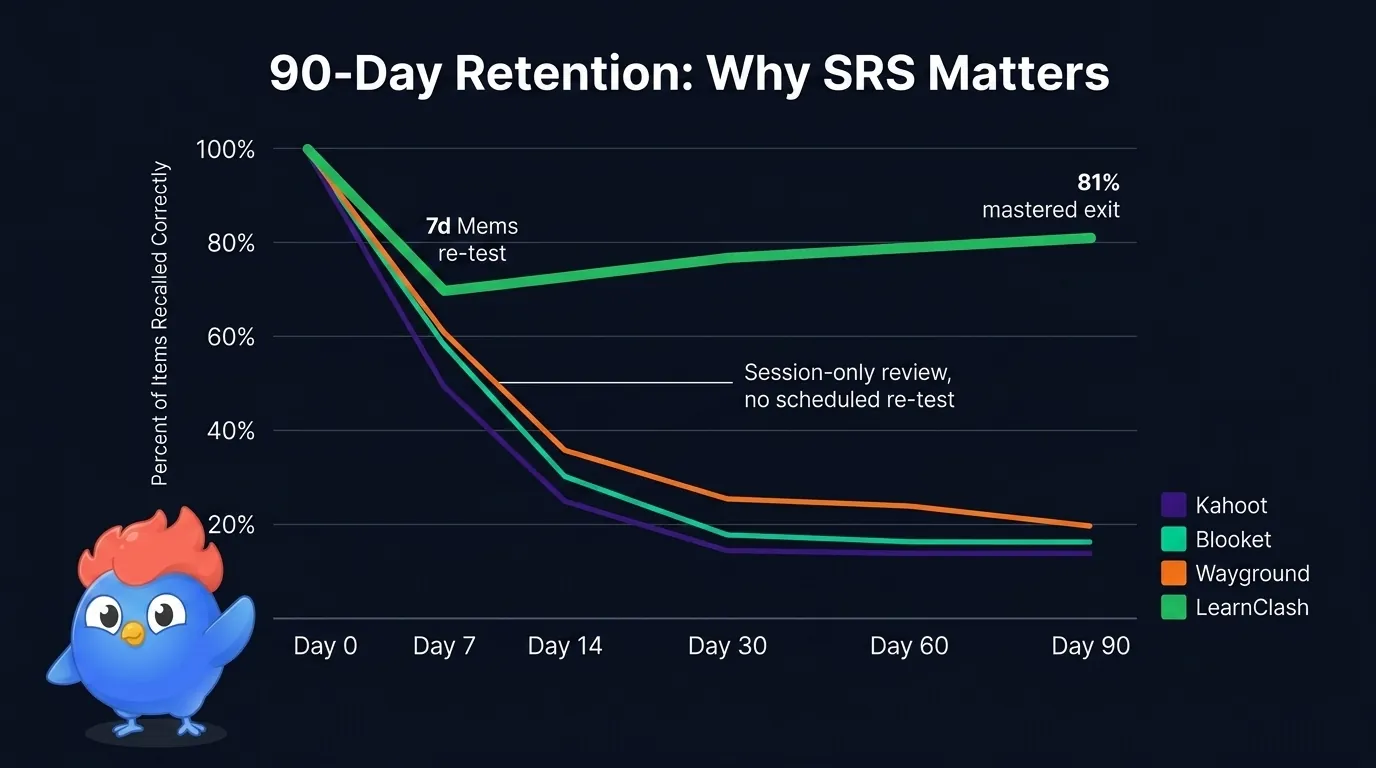
That structural gap is why the retention comparison keeps coming out the same way across every platform pairing we test: session-only review lets material fade on the schedule described by the forgetting curve, and a real scheduler interrupts that fade. In LearnClash, a missed answer returns at 7 days and a known answer at 90.
Pricing in August 2026: Correcting My Own May Number
Here is what surprised me most in this update, and it is not flattering. I re-checked both pricing pages on August 5, ten weeks after the May version of this article shipped, expecting to re-confirm the numbers. The Kahoot ladder on the live page did not match the one I had published: Bronze shows $3 per month billed annually, $36 for the year, with a 50-player cap, where my May table said $121.
My first thought was that Kahoot had quietly cut prices. The Wayback Machine says otherwise: an archived copy of the same pricing page from May 21, 2026, three days before our May update went out, already shows Bronze at $3 per month, $36 billed annually, 50 players. The $121 was my error, and the May file even contradicted itself, listing Bronze at $36 per year in its own AI-cost table a few sections earlier.
So the correction runs against me, not Kahoot. Silver and Gold carry crossed-out promotional prices directly on the page ($9 struck to $7, $15 struck to $12 per month), and the 360 Spirit tier no longer lists a public price at all; the published $20-per-license floor is now quoted through sales.
The number that held steady in both checks is the free cap. Personal accounts still top out at 10 live players, school accounts at 40, and Blooket’s free tier still takes 60. The free-tier gap that drove years of teacher switching is intact; the paid escape hatch was simply always cheaper than I had reported.
| Kahoot (Aug 2026 listing) | Blooket | |
|---|---|---|
| Free player limit | 10 (personal), 40 (school accounts) | 60 |
| Cheapest paid plan | Bronze: $36/yr billed annually, 50 players | Plus: $4.99/mo annual ($59.88/yr), 300 players |
| Monthly option | Yes, at a premium: $9/mo Bronze up to $34.99/mo One | Plus Flex: $9.99/mo, cancel anytime |
| Mid tiers | Silver $84/yr (100 players), Gold $144/yr (200) | n/a |
| Top individual tier | Kahoot! One $228/yr (800 players) | n/a |
| School plans | From ~$15/teacher/mo billed annually | $550/yr for 10 Plus seats, up to ~$3,000/yr for 80 |
| Enterprise AI tier | 360 Spirit: published $6,000/yr floor, sales-quoted as of Aug 2026 | None (free Khanmigo tier covers AI) |
Some history explains the pattern. Before 2019 Kahoot’s free tier had no player cap; a $1.7 billion buyout by Goldman Sachs, General Atlantic, and KIRKBI (the Lego family’s investment arm) took the company private in January 2024, and the free tier tightened while the paid surface expanded. The same squeeze played out faster at QuizUp, which Glu Mobile bought in a 2016 deal valued at $7.5M and shut down in March 2021. The $36 Bronze entry point reads like Kahoot’s counter-move: with Blooket free at 60 players and search interest crossed over, a cheap paid escape hatch is the one defensible position left in the classroom market.
Kahoot’s billing reputation still needs repairing, though. Its Trustpilot and BBB pages carry a steady stream of complaints about renewal notices landing in spam, surprise annual charges, and support that is hard to reach when cancellation goes wrong. Blooket’s pricing surface is small enough that there is less to go wrong: one paid tier, annual or monthly, plus school bundles.
Two Roadmaps: Enterprise Kahoot, Classroom Blooket
Kahoot is no longer primarily a classroom company. Its own marketing puts it in 97 percent of the Fortune 500, Kahoot! Energize (February 2025) targets workplace meetings, and the 360 product line runs from $228 per year to a $49-per-month Pro Plus tier and the sales-quoted Spirit floor. Blooket went the other way. The Stewart brothers stayed independent and K-8 focused, and their 2025-2026 shipments (Khanmigo partnership, Save States, Solo Links, Plus Flex) all serve the single classroom teacher.
| Signal | Kahoot | Blooket |
|---|---|---|
| Ownership | Goldman Sachs + General Atlantic + KIRKBI, $1.7B buyout, Jan 2024 | Stewart brothers, independent since 2018 |
| 2025-2026 enterprise launches | Energize, 360 Spirit AI | None |
| 2025-2026 classroom launches | Standards-tagging tool, 70-language AI Generator | Khanmigo AI, Save States, Solo Links, Plus Flex |
| Primary segment | Enterprise, districts, Fortune 500 | K-8 classroom teachers |
For a single teacher the practical question is whose roadmap keeps pointing at you. Blooket’s does. Kahoot’s classroom shipments are real, and the $36 Bronze entry price suggests the classroom market still matters to them, but the company’s growth engine now sits in HR departments. (The full enterprise-tier analysis is in LearnClash vs Kahoot.)
For Teachers: Classroom Management and Standards-Tagging
Kahoot gives teachers more control: structured reports, LMS hookups, accessibility tooling, and since April 2026 a standards-tagging tool that maps games to TEKS, CCSS, and NGSS codes in one search. Blooket gives teachers more variety, and nearly all of it sits in the free tier.
| Kahoot | Blooket | |
|---|---|---|
| Quiz creation | Manual + AI generator + slide import | Manual + import from Quizlet |
| Homework mode | Challenge (async, with deadline) | Assign any mode async; Solo Links need no game code |
| Reports | Per-quiz downloadable reports | Basic stats free, enhanced reports on Plus |
| LMS integration | Google Classroom, Teams, Canvas | Google Classroom (limited) |
| Access features | Read-aloud, high-contrast, screen readers, Accuracy Mode | TTS with speed control, font size, volume, High-Contrast Mode |
| Standards alignment | TEKS, CCSS, NGSS code search (2026) | None |
The standards tool is Kahoot’s district play. A Texas teacher enters a TEKS code and gets every tagged game instantly; the coverage spans all 50 states plus Common Core, NGSS, and ISTE. Multi-year district contracts run on exactly this kind of auditability, and Blooket has no equivalent.
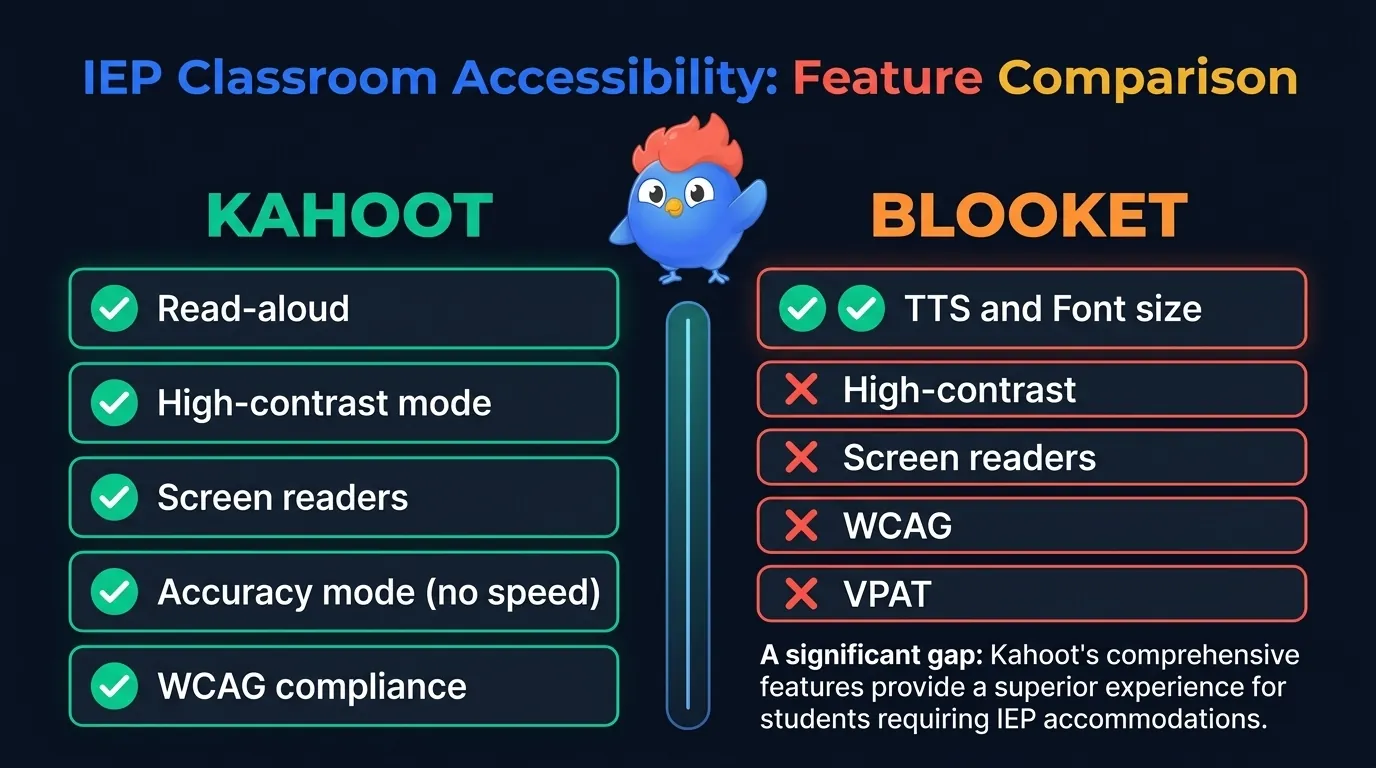
Where Blooket wins teachers back is week-ten energy. With Kahoot the format never changes (question, timer, leaderboard) and the novelty fades by mid-semester. Blooket’s mode wheel lets teachers rotate: Tower Defense one week, Cafe the next, Racing after that, with Save States letting students resume mid-game and Quizlet import saving the set-building hours. For how Kahoot compares as a study tool rather than a classroom platform, see Kahoot vs Quizlet.
For Students: Engagement vs Retention
Ask any middle schooler and they will pick Blooket. It feels less like a test and more like a game: no countdown pressure, no public podium humiliation, towers to build, chests to open, rare Blooks to collect. The quiz questions are the price of admission rather than the main event, which is exactly the property teachers either love or distrust about it.
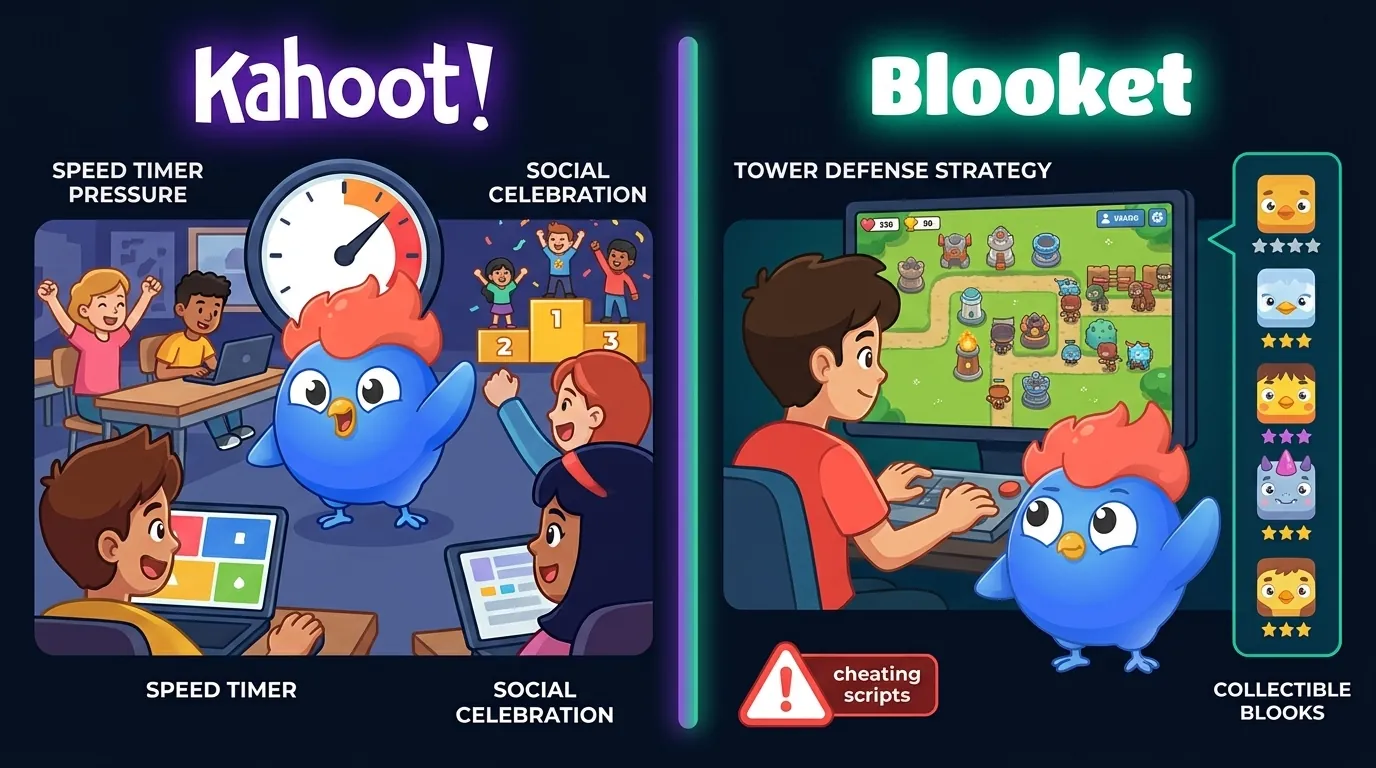
Blooket has tightened server-side rate limits against lobby flooders, and mass fake-player floods now tend to stall or get kicked. Bookmarklet auto-answer scripts still work, though, because the game logic still runs partly in the browser. Kahoot runs quiz delivery server-side, which makes the same tricks structurally harder; that is the honest reason integrity-sensitive classrooms stay on Kahoot despite everything else in this article.
| Kahoot | Blooket | |
|---|---|---|
| Student energy | High (social, competitive) | Moderate (strategic, individual) |
| Speed pressure | Yes (Classic mode) | No |
| Collectibles | None | 300+ Blooks, rarity tiers |
| Solo play | Limited (Challenge mode) | All solo modes, via Solo Links |
| Cheating risk | Low (server-side) | High (client-side, GitHub scripts) |
Neither tool serves the self-directed learner. Both need a teacher to create content and start the session; a 35-year-old who wants to learn astronomy at home cannot just open them and begin. That use case is where duels paired by skill rating and the testing effect do the work a host otherwise would.
Games like Blooket and Kahoot in 2026
Five tools come up most often when teachers ask for games like Blooket and Kahoot. Wayground (formerly Quizizz) leads on reach, claiming 90% of US schools after its June 2025 rebrand. Gimkit wraps quizzes in an economy, AhaSlides and Wordwall broaden the format, and LearnClash is the only one of the five with built-in spaced repetition.
| App | Free tier | Best for | Has SRS? |
|---|---|---|---|
| Wayground (was Quizizz) | Self-paced quizzes, large library | Homework + AI lesson generation | No |
| Gimkit | Featured modes for a full class (about 3 rotate); Pro-exclusive modes cap Basic hosts at 5 | Strategy/economy classroom play | No |
| AhaSlides | 50 audience members per presentation | Live polls + quiz hybrid | No |
| Wordwall | 12 core templates (arcade templates on Pro) | Template variety and fast remixing | No |
| LearnClash | Free 1v1 duels, no ads, no player cap | Async competitive practice with retention | Yes |
Quick reads: Wayground serves the same self-paced intent students already know and ships its own AI generation hub. Gimkit’s currency loop is the closest thing to Blooket’s engagement model, but check the rotation before committing a class to Basic; Pro runs $59.88 per year or $14.99 month to month. AhaSlides is presentation-first, Wordwall is a template machine, and LearnClash is a different lane entirely: not a teacher tool but an async 1v1 duel ladder with 3-stage SRS, built for competitive learning between classes rather than during them. For the full rankings, see the Kahoot alternatives list or the games like Blooket ranking; for the three-way head-to-head, Kahoot vs Blooket vs Gimkit.
Who Should Choose Kahoot
Choose Kahoot if you:
- Need published learning evidence to justify the tool to admins (Özdemir 2025: 43 studies, 0.772 SD achievement, 1.492 SD retention)
- Have students who rely on read-aloud, high-contrast, screen readers, or no-speed scoring
- Need standards-tagged content your district can audit (TEKS, CCSS, NGSS search since April 2026)
- Run live sessions where group energy drives focus, and your class fits the 40-player school-account cap or a $36/yr Bronze seat
- Need low cheating risk for graded review (server-side delivery)
- Are buying for corporate training, where the 360 line and Spirit AI tier fit enterprise budgets
Who Should Choose Blooket
Choose Blooket if you:
- Want free AI question generation with no usage caps via Khanmigo + Blooket
- Have 25 to 35 students and need the whole class on the free tier (60-player limit)
- Rotate game modes to keep a full semester fresh, with Save States for multi-day play
- Assign review as homework students will actually finish (Solo Links, no game code)
- Already build in Quizlet and want one-click set import
- Prefer $4.99/mo annual or $9.99/mo cancel-anytime billing over tier ladders
- Teach grades 3 to 8, where collectibles and strategy modes land hardest
Blooket’s strength is that students ask to play it, and voluntary play is rare in school software. Whether it converts to test scores is still unmeasured; that is the trade you are making.
What a Year Costs per Classroom
Strip the feature lists away and the decision is an annual budget line. Here is the August 2026 cost of running one classroom for one school year on each setup:
| Setup | Cost per classroom per year | What the money buys |
|---|---|---|
| Blooket free | $0 | 60 players, most modes, Khanmigo AI with no caps |
| Kahoot free (school account) | $0 | 40 players, trial-level AI only |
| Kahoot+ Bronze | $36 | 50 players, working AI generation |
| Blooket Plus | $59.88 ($119.88 on Flex) | 300 players, enhanced reports, Plus modes |
| Kahoot+ Silver / Gold | $84 / $144 | 100 / 200 players, richer formats |
| Kahoot! One | $228 | 800 players, full individual feature set |
| Kahoot 360 Spirit | $6,000 minimum | 25 licenses, AI courses, branding, reports |
| LearnClash | $0 | 1v1 duels with 3-stage SRS, no player caps, no ads |
Read the table bottom-up and the two free rows plus Bronze cover almost every real classroom scenario; the May version of this table obscured that, because it carried my $121 Bronze error. What no row in the middle buys, at any price, is a second look at a missed question.
That gap is the reason LearnClash exists: a missed answer comes back at 7 days, a known one at 90, a mastered one leaves the pool, free, on a ranked 1v1 ladder. If your budget question is “engagement today,” any row in the table works. If the question is what students still know in October, the scheduler is the only line item that answers it.
Frequently asked questions
Does Blooket have free AI question generation in 2026?
Yes. Khan Academy and Blooket announced the Khanmigo + Blooket Generator on January 21, 2025. Teachers sign in to Khanmigo (free for educators), type any topic, and the AI builds a question set that exports to Blooket in one click, with no usage caps on the free tier. Kahoot's AI Generator added 70 languages and curriculum-standards search on May 6, 2026, but free Kahoot accounts only get trial generations, and the highest AI tier (Kahoot 360 Spirit) published at a 25-license, $6,000-per-year minimum.
Did Blooket overtake Kahoot in 2026?
Yes, in Google search interest. Google Trends shows Blooket passing Kahoot in US search interest for the first time in January 2026, the visible end of a growth run that began during the 2020 school closures. That is a teacher-preference signal, not a learning-outcomes verdict. Kahoot still holds the strongest peer-reviewed evidence base.
Is Blooket better than Kahoot for learning?
Kahoot has stronger academic evidence. The Özdemir 2025 meta-analysis (43 studies, 3,353 students, Journal of Computer Assisted Learning) found an effect size of 0.772 on achievement and 1.492 on retention. Blooket has almost no published research. Blooket's game modes do keep students engaged longer, which can matter in classrooms where motivation is the main challenge. Neither platform reschedules a missed question 7 or 90 days later, so neither tracks whether a student still remembers the material a week from Friday.
What's new in Kahoot and Blooket for 2026?
Blooket shipped Save States for solo modes like Tower Defense 2 and Cafe, Solo Links for homework, and Plus Flex monthly billing at $9.99 per month, and continues to run the free Khanmigo + Blooket AI generator (live since January 2025). Kahoot shipped the April 2026 standards-tagging tool, the May 6, 2026 AI Generator update with 70 languages, the Kahoot 360 Spirit AI tier, and Kahoot Energize for workplaces; Bronze lists at $36 per year billed annually. Neither added spaced repetition.
Does Kahoot or Blooket have spaced repetition?
Neither platform has true spaced repetition. When a student misses a question today, neither Kahoot nor Blooket reschedules it 7 or 90 days later. Both are engagement tools, not memory tools. LearnClash builds a 3-stage SRS into every game mode: a missed question returns after 7 days, a known answer returns after 90 days, a mastered answer exits the review pool.