
LearnClash vs Jeopardy: Which Teaches You More? [2026]
LearnClash vs Jeopardy compared on questions, ranking, learning, pricing, and ads. See which quiz app actually teaches what it tests.

In 2010, a contestant used spaced repetition to win a then-record $77,000 in a single day of Jeopardy. Sixteen years later, the official Jeopardy app still doesn’t include it.
That’s the entire comparison. LearnClash generates questions on any topic at three difficulty levels, ranks players on an 8-tier ELO ladder, and schedules everything you miss for spaced review. The official Jeopardy game, listed on both stores as Jeopardy! Trivia TV Game Show and still branded World Tour once you’re inside, offers TV-writer clues in seven fixed categories, a Cash fee to enter each game, and in-app purchases that now reach $99.99.
Everything below was checked on August 12, 2026: store listings via Apple’s public app data, the newest player reviews via Apple’s review feed, app mechanics against Uken’s support pages and fan guides, and our own numbers against the app’s configuration files.
Test your trivia knowledge in a duel
LearnClash vs Jeopardy: Quick Comparison
There are three official Jeopardy apps in August 2026, not one. Uken’s free-to-play Jeopardy! Trivia TV Game Show is the main event on iOS and Android. Apple Arcade subscribers get two more: Jeopardy! World Tour+ (the same game without ads or IAPs) and Jeopardy! Daily, a Frosty Pop title with typed answers that launched in September 2025. The comparison below uses the main free-to-play app, since that’s what most people download.
| Feature | LearnClash | Jeopardy App |
|---|---|---|
| Developer | Independent | Uken Inc. (Sony license) |
| Based on | Original quiz duel app that explains every answer | Jeopardy! TV show (1964-present) |
| Topics | Any topic you can search | 7 fixed categories |
| Questions | AI-generated on demand, reviewed | TV show writers, fixed bank |
| Question format | Multiple choice, difficulty-matched | Multiple choice (not answer-in-question form) |
| Ranking | ELO ladder, 8 tiers (Iron to Phoenix) | Cash winnings + city progression |
| Spaced repetition | Built into every mode | None |
| Solo mode | 6-question SRS sessions | Solo city progression |
| Multiplayer | 1v1 turn-based duels, 72h chess clock | Matches within a field of players; friend play via Facebook or Game Center sign-in |
| Ads | Zero, any tier | Reviewers describe ads after every match |
| Pay-to-play | No | Yes (Cash fee per game) |
| Free tier | Daily duels, all topics, ELO, SRS | Limited by Cash + ads |
| Premium price | $7.99/mo or $59.99/yr (7-day trial on annual) | IAPs $1.99 to $99.99 |
| Ad-free option | Free tier is already ad-free | World Tour+ via Apple Arcade ($6.99/mo) |
| Platforms | iOS, Android | iOS, Android |
One app is built so you remember what it asked you. The other is built so you come back and spend Cash. Neither is hiding it, and the rest of this page walks through the evidence.
Questions: Any Topic vs Seven Fixed Categories
The real Jeopardy writing operation is the best in trivia. The show employs seven full-time writers and seven researchers, and every fact in every clue must be supported by two sources before it airs, with Britannica and the OED among the writers’ trusted references. The J! Archive fan database has logged 565,615 clues from the show’s history as of August 2026.
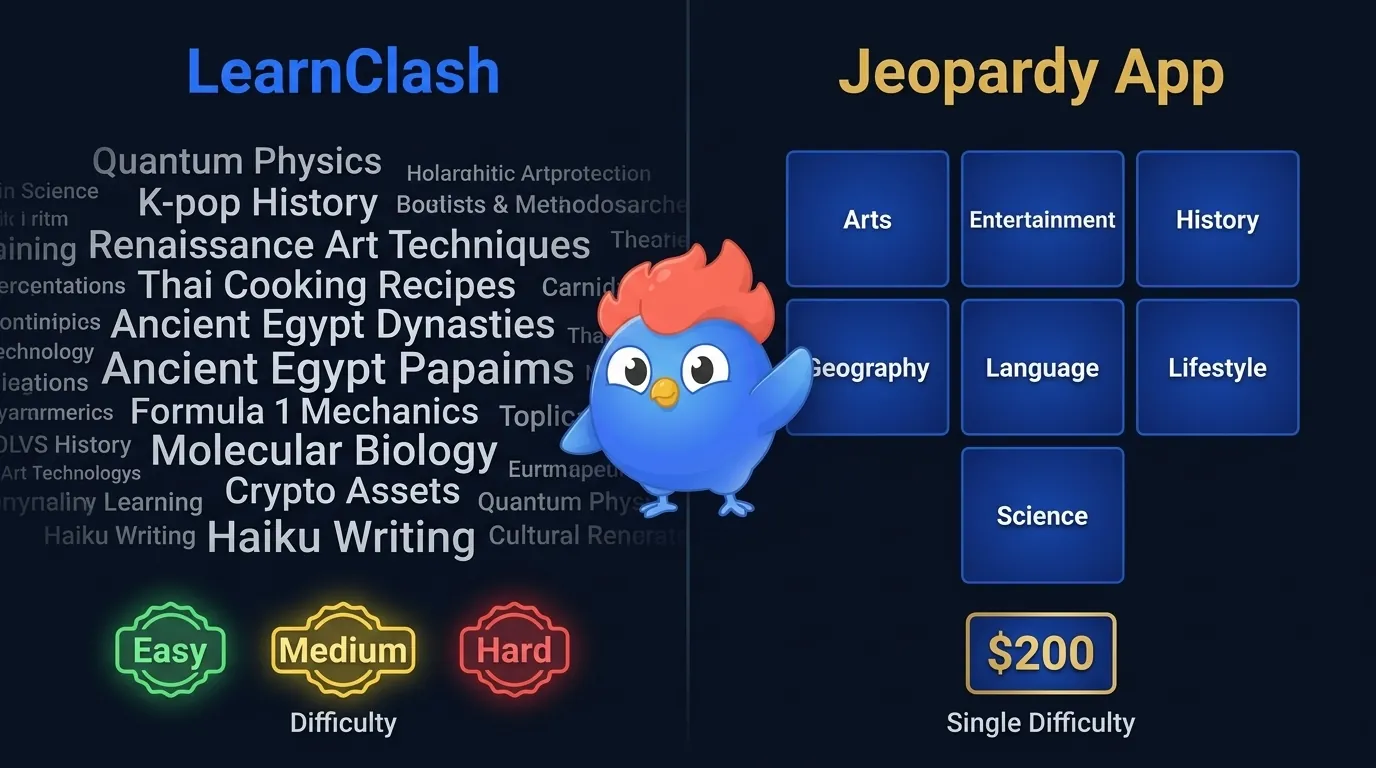
The app gets a slice of that pedigree, not the whole thing. Its clue bank spans seven gem categories: Arts and Literature, Entertainment, Geography, History, Language, Lifestyle, and Science. Answer correctly and you collect the matching gem, which upgrades your Bank, which pays out more Cash. It’s an economy, and it loops.
Before rewriting this page I pulled the newest US reviews of the Uken app through Apple’s public review feed. A four-star review from that pull asked for exactly one fix: “one thing that should probably be fixed is getting the same question twice in a row in one category.” Repeats have been a recurring complaint for years, and a finite licensed bank makes them hard to avoid.
There’s a second surprise for TV fans. Jeopardy is famous for handing you the answer and demanding the question, and the app drops that format entirely in favor of tap-the-right-option multiple choice. Apple Arcade’s Jeopardy! Daily markets “Type answers like real contestants” as its differentiator, which tells you what the flagship serves. The reversed Q&A format itself is older than the show, by the way: it first appeared on CBS Television Quiz in 1941, two decades before Julann Griffin suggested it to Merv on a 1963 flight.
Our approach starts from the opposite constraint. Type “Cold War espionage” or “Thai cooking” and it generates a duel’s worth of multiple-choice questions on that exact topic, matched to your rating across easy, medium, and hard. No writers’ room, and I won’t pretend our pipeline matches one: generated questions pass automated validation and review before they stick around, but the show’s two-source standard on every single clue is a bar only fourteen salaried humans clear. What the generator wins on is range. Seven buckets against any topic you can type is not a close contest.
Ranking: ELO Tiers vs Points and Currency
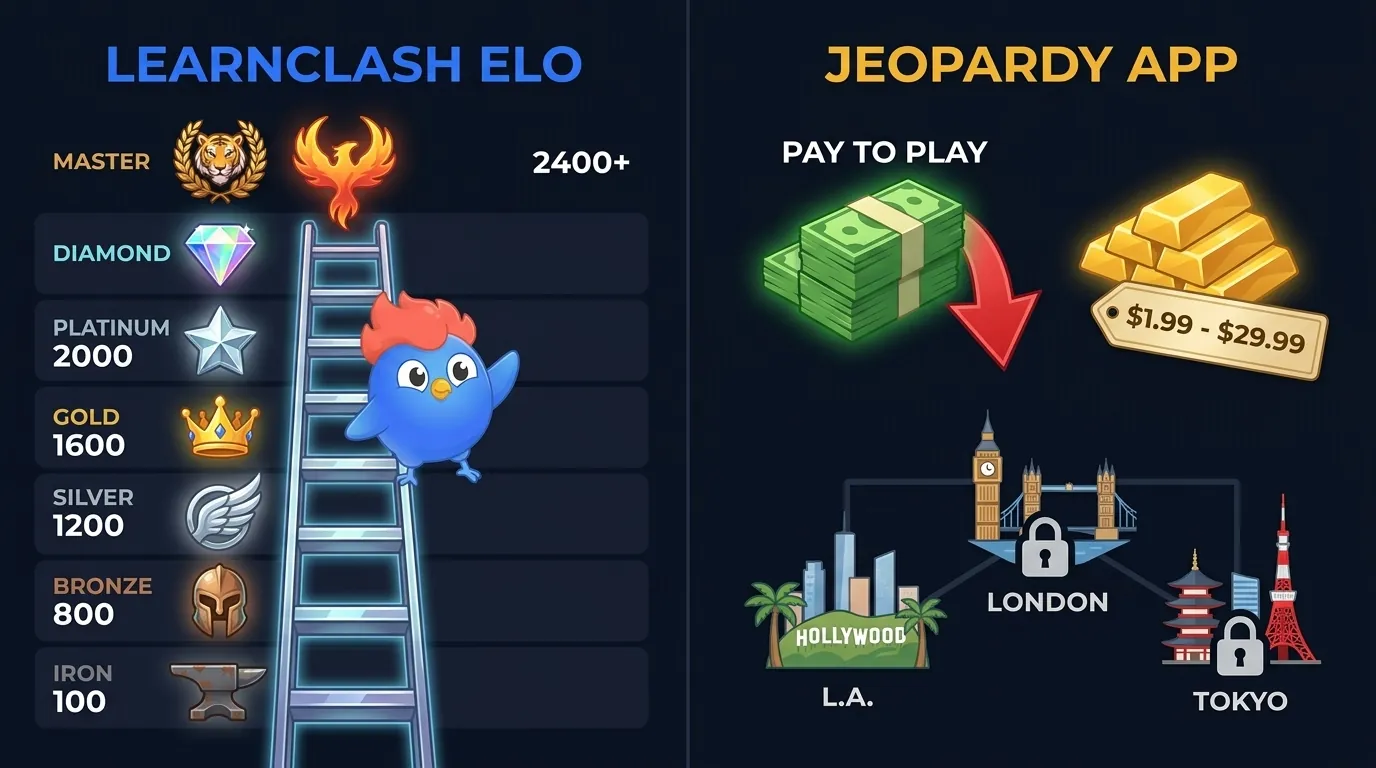
LearnClash ranks every player on a chess-style ELO ladder: 8 tiers from Iron to Phoenix, each split into three ranks except Phoenix at the top, 22 ranks in all. New players start at 1300, which sits at Gold II, the ladder’s average. Iron begins at the rating floor of 100; Bronze starts at 600, Silver at 900, Gold at 1200, Platinum at 1500, Emerald at 1800, Diamond at 2100, and Phoenix at 2400 and up. Underneath, the math is Glicko-2, which swings your rating fast in early duels and settles as it learns your real level.
The Jeopardy app tracks something different: money. Cash is spent to enter games city by city, from Los Angeles through London to Tokyo, and Gold Bars convert to Cash when you run dry. Win a game and your payout depends on your point total. It’s a progression system with real charm, and it measures your bankroll, not your knowledge.
| LearnClash | Jeopardy App | |
|---|---|---|
| System | ELO rating (skill-based) | Cash + Gold Bars (currency-based) |
| Progression | Tier promotions by winning | City unlocks by playing and spending |
| Skill tracking | Yes (Glicko-2 calibration) | No |
| Cost to compete | Free | Cash fee per game |
Ranked duels on our side cost nothing, at any rating. On the Jeopardy app, a four-star reviewer from my August pull summed the structure up while still recommending the game: “Fun game - just wish it was possible to play without paying!”
Learning: Spaced Repetition vs Play-and-Forget
Here’s the method behind that $77,000 day. In 2010, computer scientist Roger Craig mined the J! Archive, clustered past clues by topic to find what the show actually asks, then drilled his weak areas with Anki, a spaced repetition program that schedules each review just before you’d forget. On September 14, 2010 he won $77,000, a single-day record that stood until James Holzhauer passed it in 2019. Craig’s edge wasn’t a freak memory. It was scheduling.
The app carrying the Jeopardy name contains none of this. No review queue, no per-topic accuracy, no record of which clues you missed. Play a category, miss four clues, and the app’s only memory of it is the Cash you did or didn’t win.
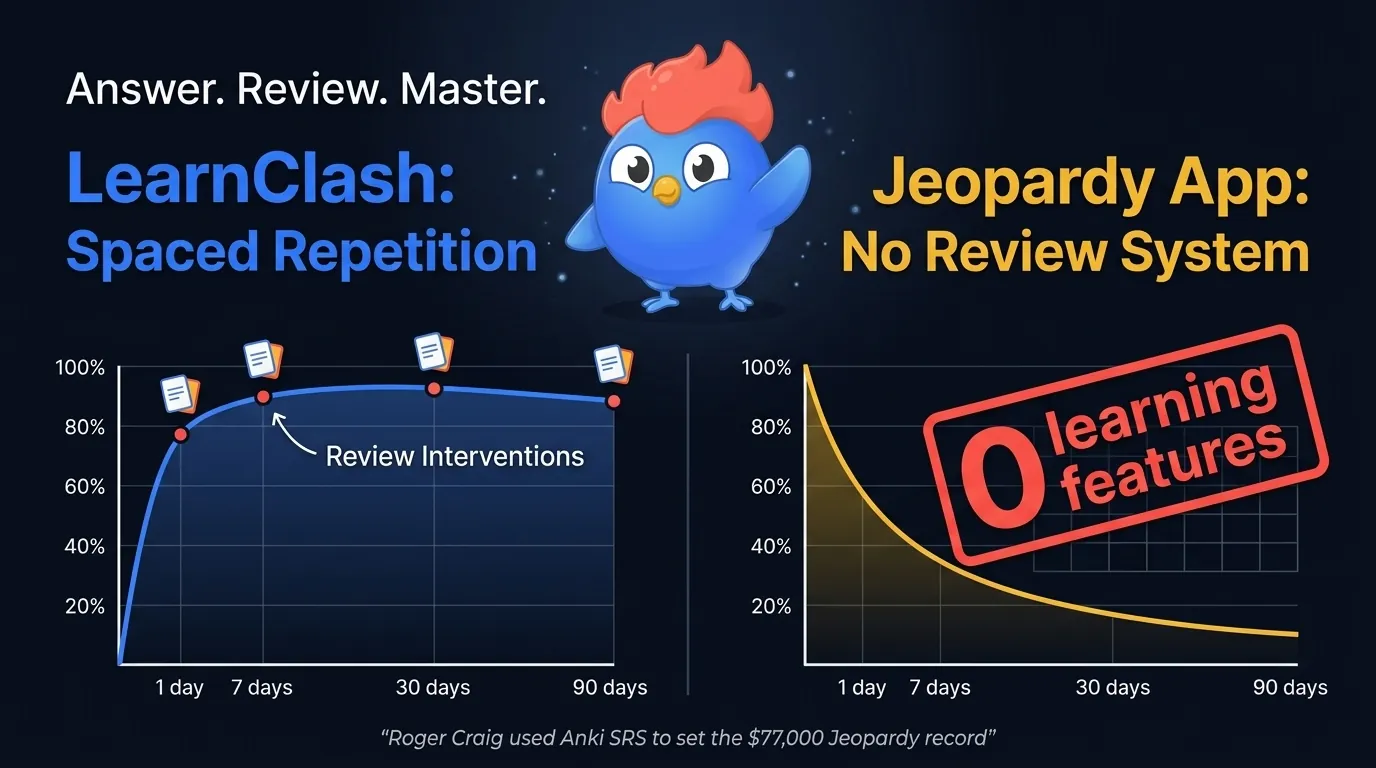
LearnClash builds spaced repetition into every mode, and the system is deliberately small: three stages, two checkpoints. A question you miss sits in Learning with a 7-day cooldown before it can advance. Answer it correctly once that cooldown clears and it moves to Known, with a re-check 90 days out. Pass the 90-day re-check and the question graduates to Mastered and leaves the regular rotation. A wrong answer drops a question back one stage rather than resetting it to zero. Why 7 and 90 instead of a longer ladder of intervals is its own story; the short version is that a question climbs only when you answer it correctly, however long that takes.
| Learning feature | LearnClash | Jeopardy App |
|---|---|---|
| Spaced repetition | 3 stages, 7d and 90d checkpoints | None |
| Per-topic accuracy tracking | Yes | No |
| Wrong-answer review | Auto-surfaces in Solo sessions | None |
| Difficulty adaptation | Rating-matched mix | Single level |
| Answer explanations | Clash Chat (Premium) | None |
The retrieval itself does half the work; that’s the testing effect, and it fires in any quiz app. The scheduling is what the Jeopardy app leaves out, and it’s the part champions rely on. Dr. Monica Thieu, who won the 2012 Jeopardy! College Championship and now researches memory at Emory, published work in Psychonomic Bulletin & Review showing that trivia experts bind new facts to the episodic context where they learned them more tightly than non-experts do (Thieu, Wilkins & Aly, 2024). Experts don’t just hold facts. They hold onto where the facts came from, which is exactly the kind of anchoring repeated, spaced encounters create.
Multiplayer: Duels on a Chess Clock vs Solo World Tour
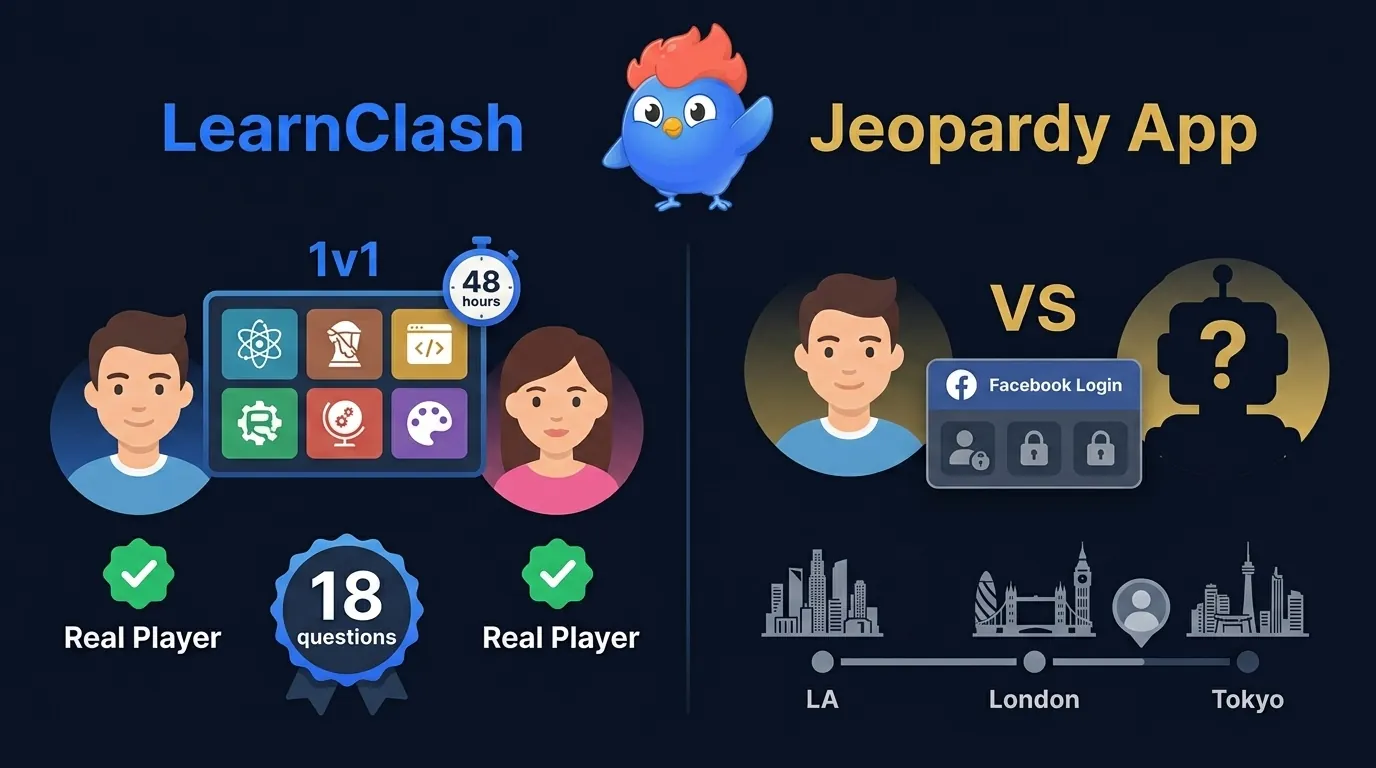
A LearnClash duel is 18 questions: 6 rounds of 3, with a 45-second timer per question and a 72-hour chess clock on every turn, so two people in different time zones can finish a match without ever being online together. You can challenge a friend with a shareable link, no account gymnastics required, or take on opponents near your rating.
The Jeopardy app is a solo world tour with competitive dressing: you climb cities, enter tournaments, and compete against a field of other players’ results. Playing directly against friends requires signing in through Facebook or your phone’s game service, which then unlocks friend challenges and a friend leaderboard.
| LearnClash | Jeopardy App | |
|---|---|---|
| Format | 1v1 turn-based (72h chess clock) | Solo progression + tournaments |
| Friend play | Shareable challenge link | Facebook or Game Center sign-in |
| Stakes | ELO rating on the line | Cash winnings |
Machines have a history with this franchise, incidentally. IBM’s Watson beat Ken Jennings and Brad Rutter on air in February 2011, finishing with $77,147 to their $24,000 and $21,600, after ingesting 200 million pages of content on four terabytes of disk. Jennings conceded in writing: “I for one welcome our new computer overlords.” We keep our AI on the other side of the table, writing the questions instead of answering them.
Pricing: Ad-Free vs Pay-to-Play Freemium
LearnClash shows zero ads on every tier, including free. The free tier covers daily duels, every topic, ELO ranking, and the full SRS. Premium runs $7.99 a month or $59.99 a year with a 7-day trial on the annual plan, and adds Premium Solo mode, a bigger topic library, Clash Chat explanations, advanced stats, and cosmetics. Nothing about the core loop sits behind it. Every plan and its limits are listed on the LearnClash pricing page.
The Jeopardy app’s economics point the other way, and its own current App Store listing spells them out. The IAP ladder runs from a $1.99 Starter Pack and Gold Bar bundles at $1.99 to $29.99, past a $9.99 Premium Contestant tier, up to limited-offer packs at $99.99. That ceiling more than tripled since spring, when the priciest listed pack was $29.99.
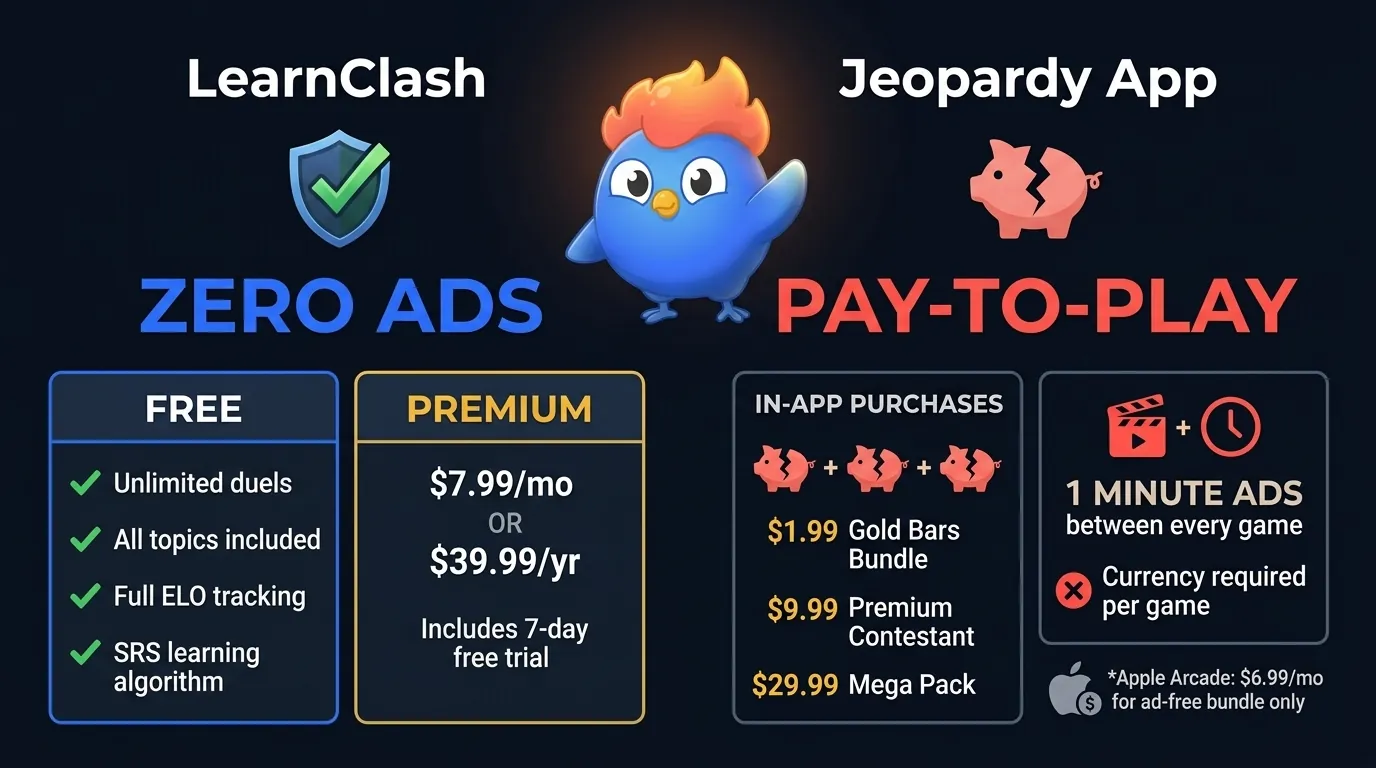
Ads are the loudest theme in the review feed right now. From my August 12 pull of the newest US reviews: a one-star review reports “at some point they started introducing ads after every match… you’ll be watching ads nonstop unless you pay $10,” and two separate reviews describe ads that hang with no way to close them. I dropped the older ad quotes this page used in April because I could no longer trace them; these are current, and they say the same thing louder.
| LearnClash Free | LearnClash Premium | Jeopardy Free | Jeopardy via Apple Arcade | |
|---|---|---|---|---|
| Price | $0 | $7.99/mo or $59.99/yr | $0 + IAPs to $99.99 | $6.99/mo or $49.99/yr (bundle) |
| Ads | None | None | After matches, per reviews | None |
| Pay-to-play | No | No | Yes (Cash per game) | No |
The Apple Arcade route is genuinely the better Jeopardy deal if you’re on iOS: $6.99 a month or $49.99 a year covers Jeopardy! World Tour+ (the main game stripped of ads and IAPs) plus Jeopardy! Daily, Frosty Pop’s September 2025 release with fresh boards every 24 hours, weekly Final Jeopardy, and typed answers. Both are Apple-only, and you’re subscribing to a game catalog, not buying an app.
Can a Trivia App Help You Prepare for Jeopardy?
Yes, and the show’s own numbers explain why preparation is the whole game. Roughly 100,000 people take the Jeopardy! Anytime Test each year, a few thousand reach auditions, and about 400 to 500 contestants make air each season. That’s a success rate well under 1%. The filter rewards exactly two things: breadth across categories and fast, reliable recall.
Tools and methods Jeopardy hopefuls actually use:
| Method | What it trains | LearnClash fit |
|---|---|---|
| Jeopardy! Anytime Test | The official screening gate | Not applicable (official only) |
| Anki with J! Archive decks | Spaced repetition on past clues | SRS is built in, no deck-building |
| Wikipedia deep reading | Breadth across categories | Any-topic question generation |
| Buzzer timing drills | Physical reflex speed | No app replaces a real buzzer |
| Timed quiz play | Recall under pressure | 45-second duel questions |
Note what’s missing from that list: the official Jeopardy app. Its seven-category bank is far narrower than the show’s range, and without a review system, drilling weak spots means replaying categories and hoping. Craig’s approach, spaced repetition pointed at your personal gaps, is the one with a record attached, and a duel with rating on the line adds the recall-under-pressure element the Anytime Test measures. A word of honesty from the other direction: no phone app trains the buzzer, and the buzzer decides more games than fans like to admit.
Who Should Choose the Jeopardy App?
Pick the Jeopardy app when the brand is the point. The show has won a record 45 Emmy Awards, Alex Trebek hosted it for 37 seasons, and Ken Jennings’ 74-game streak is trivia’s most famous run. An app that lets you hear the Think music while answering real writers’ clues has value no generator can copy.
Choose the Jeopardy app if you:
- Want the licensed TV experience, Daily Doubles and all
- Enjoy solo progression through themed city stages
- Already pay for Apple Arcade (World Tour+ and Daily remove the ads and IAPs)
- Prefer a fixed, curated category set over picking topics yourself
For how it stacks up against ten other apps, see the best trivia apps ranking.
Who Should Choose LearnClash?
Pick LearnClash when you want the trivia you play to still be in your head in March.
Choose LearnClash if you:
- Want missed questions scheduled for review instead of gone
- Prefer 1v1 duels with a rating at stake over a Cash bankroll
- Want any topic, from octopus biology to 1920s jazz, at your difficulty
- Refuse to watch ads or pay an entry fee to answer questions
What you lose is concrete: no TV brand, no writers’ room, no Think music. What you get instead is the learning system the show’s own champions built for themselves. The Trivia Crack comparison covers the same trade against a different giant.
What’s Left When the Ads Stop
Jeopardy is the most decorated quiz brand on Earth, and its flagship app spends that inheritance on a Cash economy wrapped in ads. The method that made Roger Craig a record-holder never made it in. LearnClash started from that method and built the game around it.
Frequently asked questions
Does the Jeopardy app help you learn?
No learning system is built in. The Jeopardy app tracks seven category gems, but gems feed Bank upgrades that pay out more Cash, an economy loop rather than a learning metric. There is no review scheduling and no per-topic accuracy tracking. LearnClash schedules every missed question for spaced review at 7-day and 90-day checkpoints until mastered.
Is the Jeopardy app free to play?
Jeopardy! Trivia TV Game Show is free to download, but entering each game costs Cash, the in-game currency, and recent reviews describe ads running after every match. In-app purchases on the App Store range from $1.99 Gold Bar bundles to $99.99 limited offers. LearnClash's free tier includes free daily duels, all topics, and ELO rankings with zero ads.
Can you play Jeopardy against friends on the app?
Yes, but friend challenges require signing in through Facebook or your phone's game service, which also powers the friend leaderboard. LearnClash friend duels work through a shareable challenge link, and both players get 72 hours to finish the duel.
Is LearnClash better than Jeopardy for trivia practice?
For practice with retention, yes. LearnClash covers any topic, tracks accuracy per topic, and runs a 3-stage spaced repetition system with 7-day and 90-day checkpoints. The Jeopardy app offers seven fixed categories with no review system, so a missed clue simply disappears.
What is the best trivia app like Jeopardy?
It depends on the job. For the licensed TV experience, Jeopardy! Trivia TV Game Show and the two Apple Arcade titles are the real thing. For competitive trivia that schedules what you miss for review, LearnClash is the closest alternative, with any-topic questions, 8-tier ELO ranking, and no ads on any tier.